Table of Contents

For many engineering leaders in Silicon Valley and the broader California tech corridor, the excitement of a successful AI prototype often evaporates the moment that model hits a live production environment. The transition from a controlled sandbox to a messy, real world deployment reveals a host of operational friction points that most internal teams are not equipped to handle. When you are under pressure to show immediate ROI on expensive machine learning investments, discovering that your infrastructure cannot handle the scale or that your model accuracy is decaying in real time is a recipe for executive level frustration.
The core of the issue is rarely the algorithm itself. Instead, it is the lack of specialized engineering talent required to maintain, monitor, and scale these systems. As you look to hire AI developers California based or otherwise, the focus must shift from pure data science to operational excellence. Engineering leaders are now finding that the traditional software development lifecycle does not quite fit the iterative and unpredictable nature of AI, leading to a massive demand for teams that understand both the code and the underlying statistical infrastructure.
Bridging the Divide Between Innovation and Operational Stability
California startups and enterprises alike are world class at innovation, but the operational side of AI is where many projects stall. The initial goal is usually to prove the model works, but once it is integrated into a customer facing product, the requirements change. You no longer need just a mathematician, you need a systems architect who understands how to build resilient pipelines that do not break under load. This is a primary reason why many firms choose to hire AI developers who have specific experience in productionizing models rather than just building them.
The Talent Scarcity Crisis for ML Ops Teams
One of the biggest hurdles is the sheer difficulty of building out full scale ml ops teams in a hyper competitive market. In California, the competition for talent is not just against other startups, but against tech giants who can offer compensation packages that are difficult for mid-sized firms to match. This scarcity leads to a dangerous compromise where generalist software engineers are asked to manage complex AI infrastructure, often leading to technical debt that becomes impossible to manage after a few months of operation.
High Cost of Local Acquisition
The financial burden of hiring locally goes beyond just the base salary. When you factor in benefits, equity, and the time spent on recruitment, the cost of scaling an in-house team in San Francisco or Los Angeles can be prohibitive. Decision makers are increasingly looking at hybrid models where they keep core leadership local while they hire AI developers from specialized offshore hubs to handle the heavy lifting of day to day operations and monitoring.
Recruitment Lead Times
In the fast moving AI space, a three month hiring cycle is an eternity. By the time you have onboarded a local hire, your competitors may have already iterated on their production models three times. Speed to market is often the deciding factor in who wins a particular niche, making the agility of remote hiring a strategic necessity rather than just a cost saving measure.
If your current team is struggling to keep up with the demands of live data, it may be time to Schedule a Consultation to discuss how to augment your engineering capacity without the local hiring friction.
Tackling AI in Production Challenges California Teams Encounter
When we look at the specific ai in production challenges California companies face, infrastructure costs and model observability sit at the top of the list. It is one thing to run a model on a local GPU, it is quite another to manage a distributed cloud environment where costs can spiral out of control if the system is not optimized for inference. Without the right oversight, a successful product can quickly become a financial liability due to inefficient resource allocation.
Model Decay and Data Drift
AI is not a set and forget technology. The moment a model is deployed, its performance begins to degrade as the real world data it encounters shifts away from the training set. This phenomenon, known as data drift, requires constant monitoring and a robust retraining pipeline. For many California teams, the lack of dedicated ml ops teams means that drift goes unnoticed until customers start complaining about poor results. This is where specialized support becomes critical to stabilize AI production before it impacts the brand reputation.
Infrastructure and Latency Requirements
Customer expectations for speed are higher than ever. If your AI feature adds three seconds of latency to a user request, adoption will plummet. Optimizing the inference layer requires a deep understanding of cloud architecture and containerization. To manage this effectively, many CTOs choose to hire cloud & devops engineers who specialize in high performance computing environments, ensuring that the AI remains responsive under heavy traffic.
Managing these systems requires a blend of traditional DevOps and modern AI expertise. If your infrastructure is lagging, you should Schedule Developer Interviews to find experts who can streamline your deployment pipelines and reduce latency.
Strategic Evaluation of Team Composition
When you decide to hire AI developers California focused roles, you must evaluate the composition of your team carefully. A common mistake is hiring too many data scientists and not enough machine learning engineers. Data scientists are excellent for research and model selection, but machine learning engineers are the ones who build the “scaffolding” that allows the model to function in the real world. This includes API integration, database management, and automated testing frameworks.
The Role of Dedicated Pods
Many successful companies are moving away from individual staff augmentation in favor of dedicated teams or “pods.” A pod typically includes a mix of backend developers, AI specialists, and QA engineers who work together as a cohesive unit. This structure reduces communication overhead and ensures that everyone is aligned on the production goals. Using a pod model allows you to review ML ops support needs holistically rather than trying to fix individual pieces of the puzzle in isolation.
Communication and Time Zone Alignment
A frequent objection to hiring remote developers is the concern over time zone differences. However, for California based teams, a well structured handoff process with an offshore team in India can actually create a 24 hour development cycle. While the local team sleeps, the offshore team can handle model monitoring, bug fixes, and data labeling, ensuring that the local team wakes up to a stable environment. This “follow the sun” model is a powerful way to accelerate development timelines.
To see how a dedicated pod can transform your engineering velocity, you can Request Developer Profiles that match your specific tech stack and operational needs.
Cost, Scalability, and Delivery Risk Mitigation
The ROI of AI depends heavily on managing the cost of the people and the machines. Local California salaries for AI specialists often start in the mid six figures, which can burn through venture capital or department budgets at an alarming rate. By leveraging offshore talent, firms can often achieve a 40 to 60 percent reduction in personnel costs, allowing them to reinvest those savings into better infrastructure or more aggressive marketing.
Reducing the Risk of Vendor Lock-in
When hiring external help, it is vital to maintain project control and IP protection. At WeblineGlobal, we emphasize that the client retains full control over the project and the code. This is a critical factor for CXOs who are wary of becoming too dependent on a single vendor. By using a month to month hiring model, you gain the flexibility to scale up or down based on the project’s current phase, significantly reducing the financial risk associated with long term local contracts.
Quality Assurance in AI Environments
Testing AI is fundamentally different from testing traditional software. You are not just checking for logic errors, you are checking for probabilistic accuracy and bias. This requires a sophisticated QA process that most standard teams lack. When you hire AI developers with a focus on production, they bring established testing frameworks that ensure your model behaves as expected across a wide variety of edge cases.
The RelyShore Model: Combining US Presence with India Scale
For California based leaders, the ideal hiring partner is one that provides the cost benefits of India with the accountability and communication standards of the US. This is the foundation of the RelyShore model used by WeblineGlobal. It ensures that while the developers are based in India, the delivery standards, IP protection, and strategic oversight meet the high expectations of the American market. It is a way to stabilize AI production without the overhead of managing a disparate group of freelancers.
Transparency and Month-to-Month Flexibility
One of the largest buyer objections in offshore hiring is the fear of being “trapped” in a bad contract. We address this by offering transparent pricing and the flexibility to adjust team sizes on a month to month basis. This aligns with the agile nature of AI development, where needs can change rapidly as you move from training to deployment. This flexibility is a key differentiator for companies that need to remain lean while they solve hire cloud & devops engineers or AI specialist gaps.
Building a world class AI product requires more than just a great idea, it requires an engineering engine that does not quit. Whether you are looking to build from scratch or need to review ML ops support for an existing system, the right team composition is your most valuable asset.
Finalizing Your AI Hiring Strategy
Success in AI production is not a destination, it is an ongoing operational commitment. For California engineering leaders, the path forward involves a blend of local strategic leadership and global execution. By addressing the operational challenges of cost, scale, and talent scarcity through a structured remote hiring model, you can ensure that your AI initiatives move beyond the pilot phase and deliver genuine business value. Focus on building a resilient team that can handle the unpredictability of live data, and the ROI will follow. If you are ready to move your models into a stable, scalable production environment, the first step is to contact us and evaluate the talent that will get you there.
Social Hashtags
#AIinProduction #MLOps #ArtificialIntelligence #AIInfrastructure #AIEngineering #MachineLearningOps #AITalent #AIHiring #DevOps #TechLeadership #AIStartup #SiliconValleyTech #CloudInfrastructure #DataDrift #AIInnovation
If you are concerned about the stability of your current deployment, you should Schedule a Consultation to identify the gaps in your delivery pipeline and explore how a dedicated team can provide the necessary oversight.
Frequently Asked Questions
We typically provide a shortlist of vetted developer profiles within 48 hours. This allows you to start the interview process almost immediately and significantly reduces the recruitment lead time compared to local California hiring.
Most clients see a cost reduction of approximately 40 to 60 percent compared to the total cost of hiring a local developer in major California tech hubs, without compromising on the technical quality or communication standards.
We implement strict NDAs, access controls, and IP protection protocols. All work created by the developers is the sole property of the client, and we operate under US-aligned business standards to ensure full compliance and peace of mind.
You have the flexibility to hire a single dedicated developer for staff augmentation or a full managed pod depending on your project requirements. Our month to month model allows you to scale the team size as your production needs evolve.
Our developers are experienced in working with US based teams and can adjust their schedules to provide necessary overlap for meetings and collaboration. Many clients use the time difference to their advantage by establishing a 24 hour development and monitoring cycle.


Success Stories That Inspire
See how our team takes complex business challenges and turns them into powerful, scalable digital solutions. From custom software and web applications to automation, integrations, and cloud-ready systems, each project reflects our commitment to innovation, performance, and long-term value.
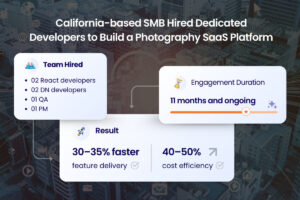
California-based SMB Hired Dedicated Developers to Build a Photography SaaS Platform
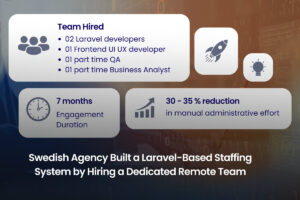
Swedish Agency Built a Laravel-Based Staffing System by Hiring a Dedicated Remote Team