Table of Contents

In the high-stakes environment of Silicon Valley and the broader California tech ecosystem, the rush to deploy Generative AI has often bypassed traditional engineering rigors. For many CTOs and VPs of Engineering, the first production incident is a sobering moment that marks the transition from the honeymoon phase of experimentation to the hard reality of enterprise-grade reliability. Whether it is a chatbot providing hallucinated legal advice or an automated system leaking sensitive data, these incidents serve as a catalyst for a fundamental shift in how teams are built and how projects are managed.
After the initial fallout is contained, the conversation in the boardroom changes from how fast we can ship to how we can ensure this never happens again. This pivot requires more than just a patch to the codebase. It demands a total re-evaluation of team composition, vendor selection, and the technical safeguards used to protect the brand. If you are looking to scale your team to avoid these pitfalls, you likely need to hire AI developers who have been through the fire and understand that production AI is 10 percent modeling and 90 percent engineering discipline.
The Reality Check: Why AI Production Incidents in California Drive Strategy Shifts
California remains the global epicenter for AI innovation, but it is also where the most public and costly AI failures occur. When a deployment fails, the immediate response is tactical, but the long-term response is strategic. Engineering leaders realize that the skills required to build a prototype are vastly different from those required to maintain a resilient production system.
The Cost of Unpredictability in AI Systems
Unlike traditional software where logic is deterministic, AI models are probabilistic. This inherent unpredictability is the root cause of most AI production incidents California based companies face. When a system fails, the cost is not just measured in downtime but in brand trust and potential legal liability. Leaders quickly learn that they need to respond to AI incidents with a structured framework rather than ad-hoc fixes. This realization usually leads to an immediate freeze on new features until the core infrastructure is hardened.
Moving Beyond the “Prompt Engineering” Hype
Early on, many teams thought they could solve every problem with better prompts. After an incident, they realize that prompt engineering is a brittle solution. The shift moves toward retrieval-augmented generation (RAG), fine-tuning, and robust validation layers. To execute this, you must hire AI developers who understand the underlying architecture of LLMs rather than just those who know how to call an API. The goal is to build a system that is resilient to edge cases that no prompt could ever fully cover.
The Importance of Data Pedigree
One minor but critical heading in this shift is data pedigree. Post-incident, teams start asking where their training or grounding data came from. They implement stricter controls over data pipelines to ensure that the AI is not being fed “poisoned” or low-quality information that could lead to a recurrence of the failure.
Just faced (or worried about) an AI production failure? Don’t wait for costly mistakes to pile up. Get expert guidance to build resilient, production-ready AI systems from day one.
Shift 1: Prioritizing Observability and Real-Time Monitoring
Before a major incident, monitoring is often an afterthought, relegated to basic uptime checks. After an incident, observability becomes the cornerstone of the AI strategy. California teams begin to treat AI models like “black boxes” that need constant surveillance.
Implementing Guardrails and Validation Layers
The first technical change is often the introduction of a middle layer between the AI and the end user. This layer acts as a filter, checking for hallucinations, bias, and PII leaks before the output is ever displayed. Leaders decide to review production safeguards to ensure that there are programmatic checks on every response. This is where the role of the backend engineer becomes just as important as that of the data scientist.
Defining Success Metrics Beyond Accuracy
Post-incident, “accuracy” is no longer the only metric that matters. Teams start looking at latency, token usage efficiency, and “helpfulness” scores. They build custom dashboards to track drift in model performance over time. To build these systems, companies often need to hire cloud & devops engineers who can integrate these complex monitoring tools into existing CI/CD pipelines. This ensures that the AI system is not a silo but a managed part of the enterprise ecosystem.
Shift 2: Re-Architecting for Scalability and Delivery Risk
Many AI production incidents California startups experience are actually scaling issues. A model that works for 100 beta users often breaks when faced with 100,000 concurrent requests. The architectural shift post-incident is almost always toward decentralization and redundancy.
The Role of Hybrid Cloud and Model Redundancy
Relying on a single model provider is a risk that many leaders are no longer willing to take. After a significant outage or performance dip, teams move toward a multi-model strategy. This might involve using a high-power model like GPT-4 for complex tasks while falling back to an open-source model hosted on private infrastructure for simpler operations. To manage this complexity, the need to hire cloud & devops engineers becomes a top priority, as they are the ones who manage the orchestration of these diverse environments.
Balancing Cost with Performance
The “bill shock” after an AI incident is real. Unoptimized loops or recursive calls can lead to astronomical API costs in a matter of hours. Engineering leaders start looking for developers who can optimize token consumption and implement caching strategies. When you hire AI developers California, you should specifically look for candidates who can explain the trade-offs between model size, inference speed, and cost, as this directly impacts the ROI of the entire initiative.
Implementing Rate Limiting and Circuit Breakers
Another minor supporting heading in the architecture discussion is the use of circuit breakers. Just as in electrical engineering, a circuit breaker in an AI pipeline stops the flow of requests if the error rate exceeds a certain threshold. This prevents a localized failure from cascading into a total system collapse.
Shift 3: Changing the Team Composition and Hiring Strategy
The most significant change is often human. The “lone wolf” AI researcher is replaced by a balanced “pod” of specialists. California teams realize that to prevent AI production incidents California, they need a mix of technical prowess and operational discipline.
The Rise of the Dedicated AI Engineering Pod
Rather than having AI developers scattered across different departments, leaders are moving toward dedicated pods. These pods typically include an AI engineer, a backend developer, and a QA specialist who understands model testing. This is where the WeblineGlobal model of dedicated teams becomes highly effective. By providing pre-vetted talent from India, we help California firms scale their pods without the exorbitant local overhead. When you hire AI developers through a structured staff augmentation model, you get access to professionals who are used to working in high-pressure production environments.
Evaluating Communication and Risk Assessment Skills
Hiring for technical skill alone is a mistake. Post-incident, VPs of Engineering prioritize “soft” skills like risk assessment and the ability to communicate technical limitations to non-technical stakeholders. You want an engineer who will say “No, we shouldn’t deploy this yet” rather than one who blindly follows a roadmap. This cultural shift is essential for maintaining a high bar for quality.
Scaling AI safely requires more than prompts—it needs the right engineers, architecture, and monitoring. Access pre-vetted AI, DevOps, and QA experts who’ve handled real-world production incidents.
Shift 4: Enhancing Testing and Quality Assurance Frameworks
Traditional software testing involves inputs and expected outputs. AI testing is much more complex because the “correct” answer can vary. After an incident, the QA process is usually the first thing to be overhauled.
Moving to “LLM-as-a-Judge” and Automated Eval Frameworks
California teams are increasingly using one AI model to test another. This “LLM-as-a-judge” approach allows for automated, high-volume testing of model responses against a set of predefined brand guidelines and safety standards. To set up these frameworks, you need to review production safeguards and build custom evaluation datasets. This requires a specialized skill set that combines data science with traditional QA automation.
Red Teaming and Adversarial Testing
Another major change is the introduction of red teaming. Teams intentionally try to break their own AI models to find vulnerabilities before a malicious actor or an accidental prompt does. This proactive approach is a direct result of learning from past AI production incidents California. It is no longer enough to test if the system works, you must test all the ways it can fail. This is why many firms choose to hire AI developers who have specific experience in AI safety and adversarial robustness.
How California Leaders Bridge the Talent Gap
The demand for high-level AI talent in San Francisco, Los Angeles, and San Diego is far outstripping the supply. After an incident, when the need for expert talent becomes urgent, many leaders find that local hiring is too slow. It can take three to six months to find the right person, and by then, the project might be at risk.
Leveraging Offshore Expertise for Speed and Scalability
This is where the offshore model, specifically focusing on India, provides a strategic advantage. By working with a partner like WeblineGlobal, California companies can hire AI developers who are already vetted and ready to integrate into their workflows. This allows the local team to focus on high-level strategy and vision while the offshore pod handles the rigorous engineering, testing, and monitoring required to prevent future incidents. The cost savings, often between 40 and 60 percent, allow teams to hire more QA and DevOps support than they could afford locally.
Ensuring Seamless Integration with RelyShore℠
The biggest fear of offshore hiring is the “disconnect” in communication or quality. The RelyShore℠ model addresses this by providing US-based assurance and Indian scale. This ensures that when you hire cloud & devops engineers or AI specialists, they are aligned with your timezone, your security standards, and your corporate culture. It reduces delivery risk, which is exactly what a CTO needs after a production failure.
Final Considerations for Scaling Your AI Team
The journey from a failed AI pilot to a successful production system is paved with hard lessons. California teams that succeed are the ones that view an incident not as a setback, but as an opportunity to build a more robust, professionalized engineering culture. They stop treating AI as a “special” project and start treating it with the same rigor as their core financial or database infrastructure.
As you look to your next phase of growth, remember that the most important asset is not the model you use, but the people who manage it. When you hire AI developers California, look for those who prioritize stability over hype. Focus on building a team that understands the full lifecycle of an AI product, from data ingestion to real-time monitoring. Contact us to combine local vision with global engineering talent, and you can build systems that are not only innovative but also incredibly resilient.
Social Hashtags
#AIEngineering #GenerativeAI #AIInfrastructure #MLOps #AITesting #DevOps #AIObservability #TechLeadership #StartupScaling #ArtificialIntelligence
Ready to eliminate delivery risk and build a high-performance AI team? Hire experienced AI developers and DevOps engineers who ensure reliability, scalability, and faster time-to-market.
Frequently Asked Questions
Most incidents stem from unexpected model hallucinations, data drift, where the model's performance degrades over time, and a lack of proper input/output filtering. Scaling issues, where API latency spikes under heavy load, are also a frequent cause of system failure in fast-growing startups.
Testing should include a mix of automated evaluation frameworks, RAG-specific testing to ensure context accuracy, and manual red teaming. Using an "LLM-as-a-judge" can help automate the evaluation of thousands of responses against your safety and brand guidelines.
Hiring from India through a partner like WeblineGlobal provides access to a massive pool of pre-vetted technical talent at a significant cost advantage. This allows California firms to scale their engineering and QA pods quickly, ensuring they have the headcount to manage production monitoring and safety without the high costs of the local market.
Effective control is maintained through integrated communication tools, daily stand-ups, and shared Jira/GitHub environments. Using the RelyShore℠ model ensures that there is a layer of US-based accountability, providing the perfect balance between global scale and local project management.
The first step is to contain the failure, often by reverting to a previous model version or implementing a hard stop on specific AI features. Next, perform a blameless post-mortem to identify the root cause, then respond to AI incidents by updating your validation layers and hiring the necessary talent to close any identified engineering gaps.


Success Stories That Inspire
See how our team takes complex business challenges and turns them into powerful, scalable digital solutions. From custom software and web applications to automation, integrations, and cloud-ready systems, each project reflects our commitment to innovation, performance, and long-term value.
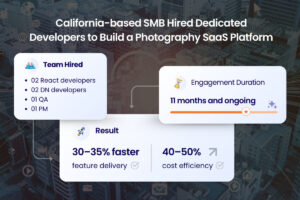
California-based SMB Hired Dedicated Developers to Build a Photography SaaS Platform
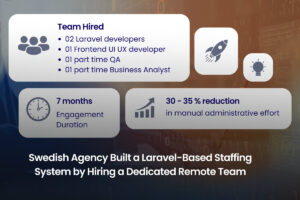
Swedish Agency Built a Laravel-Based Staffing System by Hiring a Dedicated Remote Team