Table of Contents

Modern engineering leadership in the Northeast is currently facing a dual challenge. On one hand, the pressure to accelerate product roadmaps has never been higher, while on the other, the technical complexity of maintaining uptime across global infrastructure continues to grow. For CTOs and VPs of Engineering, the focus has shifted from simple feature delivery to the foundational resilience of their systems. This is especially true in the Keystone State, where the tech corridor is rapidly expanding beyond traditional hubs. Many organizations are now analyzing how Pennsylvania teams improve API reliability across distributed teams to maintain a competitive edge in high-stakes industries like fintech, healthcare, and logistics.
The decision to expand a technical workforce involves more than just filling seats. It requires a strategic understanding of how backend architecture supports business goals. When companies look to hire backend developers Pennsylvania, they are often searching for a specific blend of architectural foresight and execution discipline. Reliability is not a feature that can be added later, it must be woven into the hiring and onboarding process from the very start. By focusing on distributed team dynamics and rigorous API standards, leaders can ensure that their platforms remain performant even as they scale across multiple geographies and time zones.
The Evolving Landscape of API Reliability for Pennsylvania Enterprises
The shift toward distributed work has fundamentally changed how backend systems are designed and maintained. In the past, localized teams could rely on proximity for quick debugging and architectural alignment. Today, when you hire backend developers to work in a distributed capacity, the focus must shift toward standardized protocols and automated reliability measures. API reliability in distributed teams is no longer just about code quality, it is about the systems and communication structures that surround that code.
The Critical Role of Backend Stability in Business Growth
Every minute of downtime or latency in an API can result in lost revenue and eroded customer trust. For Pennsylvania firms, the ability to maintain a consistent uptime is a direct reflection of their engineering maturity. Leaders must look for developers who understand the business implications of a 500-level error. This is why the search to hire backend developers Pennsylvania often centers on candidates who have experience with high-traffic environments and complex data integrations.
Identifying the Cost of API Failures
Calculating the ROI of reliability involves looking at the hidden costs of failure. These include developer burnout from constant firefighting, the cost of customer support tickets, and the long-term impact on brand reputation. When engineering leaders review backend architecture, they often find that investing in reliability upfront is significantly cheaper than post-launch remediation. A reliable API acts as a force multiplier for frontend teams and third-party integrators, allowing the entire ecosystem to move faster.
If you are looking to strengthen your infrastructure, it is time to look at vetted talent that understands these stakes. You can Request Developer Profiles today to see how experienced backend engineers can transform your reliability metrics and help your distributed teams perform at a higher level.
Strategic Hiring: Why Leaders Hire Backend Developers Pennsylvania
The talent market in the Northeast is unique, offering a mix of established enterprise experience and startup agility. However, the cost of local hiring can often be a barrier to rapid scaling. This is where a hybrid approach becomes valuable. Many firms choose to hire backend developers Pennsylvania to lead architectural strategy while leveraging offshore pods to handle the heavy lifting of development and testing. This model balances local oversight with global scale, ensuring that API reliability remains a top priority across the entire lifecycle.
Evaluating Technical Maturity in Distributed Candidates
When interviewing for backend roles, the focus should be on how a candidate handles failure scenarios. Do they design for the “happy path” only, or do they build in redundancy? Reliability in distributed teams requires a mindset of defensive programming. When you hire Node developers or Python experts, you should ask about their experience with circuit breakers, retry logic, and distributed tracing. These are the tools that keep a system alive when a specific microservice goes down.
The Importance of Communication in Remote Teams
Technical skill is only half the battle. In a distributed environment, the ability to document an API clearly is just as important as the code itself. A developer who cannot explain their architectural choices will eventually become a bottleneck. Senior leaders must evaluate how well a candidate communicates with asynchronous teams. This ensures that the documentation is always up to date and that the API remains usable for everyone involved in the project.
Building a high-performing team requires finding the right balance of skill and culture. When you are ready to Hire Dedicated Developers who can bridge the gap between technical excellence and business reliability, choosing a partner with a deep talent pool in both local and offshore markets is essential.
How Distributed Teams Improve API Reliability and Performance
The actual mechanics of how Pennsylvania teams improve API reliability across distributed teams involve a combination of rigorous tooling and cultural shifts. It starts with a “contract-first” approach to development. By defining the API contract before any code is written, distributed teams can work in parallel without blocking each other. This reduces integration friction and ensures that the final product meets the original specifications.
Implementing Continuous Reliability Protocols
Reliability is not a one-time achievement but a continuous process. Distributed teams must implement automated testing suites that go beyond simple unit tests. Contract testing, load testing, and chaos engineering are all parts of a mature reliability strategy. When organizations improve api reliability, they often find that the most significant gains come from automating the “boring” parts of the QA process, allowing developers to focus on complex architectural problems.
Leveraging Monitoring and Observability Tools
You cannot improve what you cannot measure. Modern backend teams rely on deep observability to understand how their APIs are performing in real-time. This includes tracking latency, error rates, and throughput across different regions. For a CTO, having a dashboard that shows the health of the entire system is vital for making informed decisions about infrastructure investment and team allocation.
Managing a distributed engineering department is a complex task that requires constant adjustment. You can schedule a consultation to discuss your current challenges and learn how a structured approach to backend hiring can help you achieve 99.9 percent uptime and beyond.
Mitigating Risks When Scaling Backend Teams Globally
Scaling a team always introduces risk, particularly when thousands of miles separate the developers. The primary risks are related to delivery speed, code quality, and security. However, these can be managed through a clear vendor selection process and a commitment to standardized engineering practices. Many Pennsylvania companies have found success by partnering with firms like WeblineGlobal to access pre-vetted talent that is already trained in distributed best practices.
The Role of Standardized Documentation in Distributed Reliability
In a remote setting, documentation is the single source of truth. Without it, knowledge silos form, and API reliability inevitably suffers. When you hire backend developers, you are hiring the people who will maintain your system for years to come. Ensuring they have a passion for documentation is a key part of long-term risk mitigation. Every endpoint, every data model, and every deployment script must be clearly defined and accessible to the entire team.
Managing Time Zone Differences and Delivery Speed
While time zone differences are often seen as a challenge, they can be turned into an advantage. A “follow-the-sun” model allows for 24/7 development and support. While the Pennsylvania team sleeps, the offshore pod can handle bug fixes and performance optimizations. This accelerates the feedback loop and ensures that API issues are addressed within hours rather than days. This is a core reason why firms look to hire backend developers Pennsylvania who can manage these global handoffs effectively.
If your goal is to accelerate your roadmap without sacrificing stability, the remote pod model is the most effective way to scale. Hire Remote Developers today to gain access to a scalable workforce that understands the nuances of global engineering delivery.
Financial and Operational Advantages of the Hybrid Team Model
The financial justification for hiring distributed teams is compelling. By blending local leadership with offshore execution, companies can reduce their engineering costs by 40 to 60 percent. This allows for a larger team, which in turn leads to faster iterations and more robust testing. For a VP of Engineering, this means being able to deliver more features while simultaneously improving the underlying stability of the platform.
ROI Justification for Backend Reliability Investments
Investing in API reliability for distributed teams has a direct impact on the bottom line. It reduces the need for expensive emergency fixes and allows the product to scale more efficiently. When you review backend architecture through a financial lens, the benefits of hiring experienced developers become clear. Higher quality code leads to lower maintenance costs and a longer lifecycle for the software, providing a much higher return on investment over time.
Scaling Without Compromising Technical Debt
The biggest danger of rapid scaling is the accumulation of technical debt. An unmanaged distributed team often takes shortcuts to meet deadlines. By establishing clear quality gates and peer review processes, Pennsylvania leaders can ensure that their backend stays clean and maintainable. This disciplined approach to growth is what allows a company to move from a startup to an enterprise-grade platform.
Ready to see the difference that high-quality talent can make? Schedule Developer Interviews to find backend experts who are not only technically proficient but also understand the operational goals of your business.
Evaluating a Vendor for Distributed Engineering Success
Choosing the right partner is the most important decision a CTO will make when building a distributed team. The vendor must provide more than just resumes; they must provide a framework for success. At WeblineGlobal, we utilize our RelyShore model to ensure that every project is backed by US-based assurance and India-based scale. This provides our clients with the best of both worlds: local accountability and global cost-efficiency.
Key Criteria for Selecting a Remote Hiring Partner
When evaluating a vendor, look for a long history of successful deliveries and a deep understanding of your specific tech stack. It is also important to check their security protocols and IP protection policies. For Pennsylvania firms, working with a partner that has a physical presence in the US can simplify legal and administrative hurdles, making the process of hiring backend developers Pennsylvania much more seamless.
The WeblineGlobal Advantage in Backend Reliability
With over two decades of experience, WeblineGlobal has helped hundreds of companies improve API reliability through strategic staffing. Our developers are pre-vetted for both technical skill and communication ability, ensuring they can integrate into your distributed teams immediately. We focus on month-to-month flexibility, allowing you to scale your team up or down based on your current project needs.
The right talent is only a click away. Request Developer Profiles and see why so many Pennsylvania engineering leaders trust us to provide the backend expertise they need to stay ahead of the competition.
Finalizing Your Backend Strategy for Long-Term Success
Building a reliable API in a distributed environment is a marathon, not a sprint. It requires a commitment to excellence at every level of the organization. By understanding how Pennsylvania teams improve API reliability across distributed teams, you can build a roadmap that balances speed, cost, and stability. Whether you are looking to hire Node developers for a new microservices project or need to review backend architecture for an existing platform, the key is to prioritize reliability from day one.
The most successful engineering leaders are those who recognize that talent is their most important asset. Contact us to choose to hire backend developers Pennsylvania and complementing them with high-performing offshore pods. You can create a resilient engineering culture that delivers consistent value to your customers. At WeblineGlobal, we are here to support that journey, providing the vetted talent and strategic guidance you need to succeed in today’s distributed world.
Social Hashtags
#APIReliability #DistributedTeams #BackendDevelopment #TechLeadership #SoftwareEngineering #DevOps #ScalableSystems #HiringDevelopers #RemoteDevelopment #EngineeringManagement #CloudArchitecture #Microservices
Ready to improve uptime and scale faster? Partner with experts who specialize in reliable backend systems for distributed teams. Let’s build your high-performance engineering team.
Frequently Asked Questions
Distributed teams often use a combination of automated CI/CD pipelines and strict documentation standards. By using semantic versioning and providing clear deprecation notices, they ensure that backend changes never break frontend teams and external users.
Using distributed tracing tools like Jaeger or New Relic allows teams to see exactly where latency is occurring. By monitoring from multiple geographic locations, developers can identify regional issues before they affect a large number of users.
We use a multi-stage vetting process that includes technical tests, communication evaluations, and cultural fit interviews. Our developers often have experience with global brands, ensuring they understand the high standards required for enterprise-grade API reliability.
You have the flexibility to choose. We offer both individual staff augmentation and dedicated pods. For many Pennsylvania teams, starting with a few key developers and scaling into a full pod as the project grows is an effective strategy.
Most clients see a reduction in total engineering costs of 40 to 60 percent. This allows them to reallocate budget toward R&D, marketing, or other growth-focused initiatives while maintaining a high level of technical output.

Success Stories That Inspire
See how our team takes complex business challenges and turns them into powerful, scalable digital solutions. From custom software and web applications to automation, integrations, and cloud-ready systems, each project reflects our commitment to innovation, performance, and long-term value.
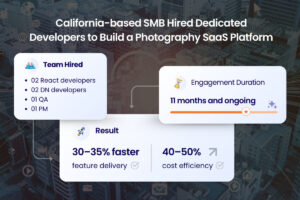
California-based SMB Hired Dedicated Developers to Build a Photography SaaS Platform
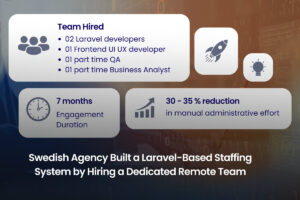
Swedish Agency Built a Laravel-Based Staffing System by Hiring a Dedicated Remote Team