Table of Contents

Austin has long been a powerhouse for innovation, but the journey from a fledgling startup with a Minimum Viable Product (MVP) to a scaling growth-stage company is fraught with organizational challenges. In the early days, the focus is almost entirely on speed and validation. Founders and early engineering leads often wear multiple hats, writing code, managing deployments, and handling customer support. However, once the product finds market fit and the user base begins to expand, the scrappy approach that built the MVP starts to show its limitations.
The transition from MVP to growth requires a fundamental shift in how you think about talent and team structure. It is no longer just about building features; it is about building a sustainable, scalable engineering organization. For many local founders, the decision to hire full stack developers Austin becomes a strategic necessity to bridge the gap between initial development and a robust enterprise-ready platform. This article provides a roadmap for leaders navigating this shift, focusing on how to evaluate team composition, manage technical debt, and leverage remote engineering talent to sustain growth.
The Austin Startup Pivot: Moving Beyond the Minimum Viable Product
The MVP phase is characterized by a “just get it done” mentality. Architecture is often sacrificed for speed, and the primary goal is to prove the concept to investors and early adopters. As your startup enters the growth phase, the risks change. Security, performance, and maintainability become as important as feature velocity. If you continue to use an MVP team structure during a growth phase, you risk technical bankruptcy, where the cost of maintaining existing code prevents you from building anything new.
Recognizing the Signs of Growth Team Necessity
How do you know when your MVP team is no longer sufficient? One of the clearest indicators is a decline in feature delivery speed despite an increase in headcount. This often happens because the initial codebase was not designed for scale, and the current team is spending more time fixing bugs than building value. When your customer acquisition starts to outpace your ability to patch the system, it is time to transition to growth teams that can handle more complex architectural demands.
Technical Debt and System Stability
In an MVP, technical debt is a tool used to buy time. In a growth stage, it becomes an anchor. If your current developers are constantly firefighting instead of innovating, you need to bring in engineers who understand how to refactor without breaking the user experience. This is where the decision to hire full-stack engineers becomes critical, as they can navigate both the frontend complexities and the backend logic to streamline the entire stack.
Assessing Team Burnout
Continuous firefighting leads to high turnover. If your early-stage engineers are feeling the weight of an unscalable system, their productivity will drop. Bringing in a dedicated growth team allows your initial core team to focus on high-level strategy while new talent stabilizes the platform.
Scaling your startup faster than your engineering team can handle? Don’t let MVP limitations slow your growth. Get expert guidance to build a scalable team structure from day one.
Why You Need to Hire Full Stack Developers Austin for Your Growth Phase
As you scale within the Austin tech ecosystem, the competition for talent is fierce. Hiring specialists for every single niche early in the growth phase can be prohibitively expensive and can lead to communication silos. This is why many VPs of Engineering choose to hire full stack developers Austin to maintain a level of agility. A full stack engineer understands how a change in the database affects the user interface, which is vital when you are iterating rapidly on a growing product.
Versatility and Cross-functional Ownership
Growth teams need to be more autonomous than MVP teams. In a growth pod, a full stack developer can take a feature from concept to deployment without waiting for a handoff between different departments. This cross-functional ownership reduces the friction that often slows down larger engineering organizations. When you hire full-stack engineers, you are investing in individuals who can troubleshoot the entire request-response lifecycle, which is invaluable during high-traffic growth periods.
Balancing Frontend Polish with Backend Logic
A growth-stage product needs to look and feel professional. The UI/UX must be seamless, but the backend must be performant. Full stack developers provide the necessary bridge, ensuring that the visual elements of the application are backed by efficient data processing. While you might eventually need specialized talent to hire backend developers for deep data engineering tasks, the full stack role remains the backbone of the growth team’s daily output.
Evolving Team Composition: From Generalists to Specialized Pods
As the transition from MVP to growth teams Austin progresses, the structure of the team must evolve. In the MVP stage, you likely had a flat structure. In the growth stage, you should move toward “pods” or dedicated teams organized around specific business outcomes, such as “Growth/User Acquisition,” “Core Platform,” or “Payments.” Each pod should have the resources it needs to succeed independently.
Strengthening the Foundation with Dedicated Back-end Support
While full stack developers provide agility, the growth phase often reveals bottlenecks in the data layer. As your user base grows, simple queries that worked for 1,000 users might fail at 100,000. At this point, it becomes necessary to hire backend developers who specialize in database optimization, API design, and microservices architecture. These specialists work alongside your full stack developers to ensure the infrastructure can handle the load while the full stack team continues to push out user-facing features.
The Role of QA and DevOps in Growth
Manual testing is feasible for an MVP, but it is a death sentence for a growth-stage company. Your growth team must include automated testing and robust CI/CD pipelines. This ensures that as you hire full stack developers Austin and add them to your team, their contributions do not introduce regressions into the system. Reliability becomes a key metric for success.
If your team is stuck fixing bugs instead of shipping features, it’s time to upgrade your engineering capacity. Access pre-vetted full stack developers who can stabilize and scale your product—without hiring delays.
Cost and Scalability Trade-offs in the Austin Tech Market
The cost of living and the influx of major tech giants in Austin have driven developer salaries to record highs. For a startup in the growth phase, burning through capital on local talent alone can be a risky move. Decision-makers must balance the need for local presence with the financial reality of scaling an engineering team. This is where a hybrid model, combining local leadership with offshore scale, becomes highly effective.
Strategic Staff Augmentation via Offshore Resources
Many Austin-based CTOs are turning to staff augmentation to supplement their local teams. By working with a partner like WeblineGlobal, companies can access pre-vetted talent in India that costs significantly less than local hires without sacrificing quality. This allows you to review scaling plan options that include dedicated pods that work in tandem with your Austin-based product leads. The 40 to 60 percent cost savings can be reinvested into marketing or further product R&D.
Mitigating Delivery Risks in Remote Hiring
The primary concern with remote or offshore hiring is often delivery risk and communication. To mitigate this, look for partners that offer a structured delivery model, such as the RelyShore model, which provides US-based assurance and local accountability. When you hire full stack developers Austin through a vetted channel, you gain the flexibility of a month-to-month engagement while retaining full project control. This is a much safer alternative to traditional project-based outsourcing where you might lose visibility into the development process.
Buyer Objections and ROI Justification for Scaling Teams
When presenting a scaling plan to the board or a CEO, the biggest objection is usually cost versus immediate return. The ROI of transitioning to a growth team is not always seen in the next month’s feature list, but in the long-term stability and velocity of the company. You must frame the transition as a risk mitigation strategy. Without the right team, the product will eventually hit a “feature ceiling” where no new updates can be made without causing system-wide failures.
Evaluating Vendor Selection Criteria
If you decide to supplement your growth team with external talent, how do you choose a vendor? Look for longevity and a proven track record. A firm that has been around since the late nineties and has delivered thousands of projects provides a level of stability that a newer boutique agency cannot. You should evaluate their ability to provide shortlists quickly, typically within 48 hours, and their internal vetting processes for both technical skills and communication ability.
Maintaining IP and Access Control
Security is a major concern for growth-stage startups. Any vendor you work with must have strict IP protection protocols, NDAs, and access controls in place. When you transition to growth teams, ensure that your partner treats your code with the same level of security as your internal team would. This includes secure access to repositories and compliance with international data protection standards.
Navigating the Culture Shift from MVP to Growth
The cultural transition is often harder than the technical one. Early employees may feel protective of the code they wrote in the “garage phase.” New hires, specifically those brought in to hire full stack engineers for growth, must be integrated with care. Leadership must communicate that the shift is a sign of success, not a critique of the early work. The goal is to move from a culture of individual heroics to a culture of collective reliability and process.
Establishing Clear Communication Channels
In a larger growth team, “tribal knowledge” becomes a bottleneck. Documentation must become a priority. Whether your developers are in Austin or India, everyone needs to work from the same source of truth. Using tools like Jira, Slack, and Notion effectively ensures that as you hire full stack developers Austin, they can onboard quickly and contribute to the codebase within days, not weeks.
Making the Final Decision: When to Pull the Trigger
You may contact us, and we will help you make the decision to shift from an MVP team to a growth team through a data-driven approach. Monitor your deployment frequency, your mean time to recovery (MTTR), and your bug-to-feature ratio. If the data shows that your current team is struggling to keep up with the demands of a growing user base, the time to act is now. Delaying the transition only increases the amount of technical debt you will eventually have to pay back, often at a much higher interest rate.
Start by identifying the most critical bottlenecks. Is it the user interface? Is it the database performance? Use these insights to decide whether to hire backend developers or versatile full stack talent. By taking a proactive approach to team composition, you ensure that your Austin startup remains competitive and capable of reaching its full market potential.
Social Hashtags
#AustinStartups #StartupGrowth #MVPtoScale #TechStartups #FullStackDevelopers #StartupScaling #EngineeringTeams #TechLeadership #SaaS #DevOps #ProductGrowth #StartupTips #SoftwareDevelopment #CTO #TechHiring
Ready to transition from MVP chaos to a high-performing growth team? Partner with experienced engineers who understand scaling challenges and deliver results faster—while optimizing your costs.
Frequently Asked Questions
An MVP team focuses on rapid prototyping and market validation, often sacrificing long-term code quality for speed. A growth team focuses on scalability, reliability, and sustainable feature velocity, requiring more robust processes and specialized engineering talent.
Austin has a high cost of talent and intense competition. Hiring from India allows startups to scale their engineering teams 40 to 60 percent more cost-effectively while accessing a massive pool of pre-vetted, high-quality full stack and backend engineers.
Full stack developers are ideal for general feature development and agility. You should hire backend developers when your application faces complex data processing challenges, performance bottlenecks at the database level, or requires a transition to microservices architecture.
WeblineGlobal uses a rigorous vetting process that evaluates both technical proficiency and communication skills. With over 25+ years of experience and a delivery model backed by US-based assurance, we provide developers who integrate seamlessly into your growth pods.
The beauty of the staff augmentation model is flexibility. You can start by adding a single developer to your team or hire a full dedicated pod, depending on your current scaling needs and budget. We offer month-to-month flexibility to match your growth trajectory.


Success Stories That Inspire
See how our team takes complex business challenges and turns them into powerful, scalable digital solutions. From custom software and web applications to automation, integrations, and cloud-ready systems, each project reflects our commitment to innovation, performance, and long-term value.
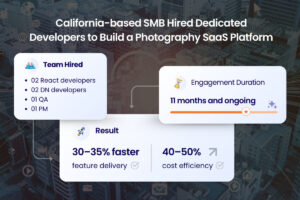
California-based SMB Hired Dedicated Developers to Build a Photography SaaS Platform
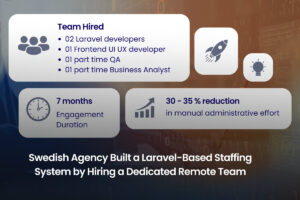
Swedish Agency Built a Laravel-Based Staffing System by Hiring a Dedicated Remote Team