
Table of Contents

How did we discover the spatial processing bottleneck?
During a recent project for a spatial analytics SaaS platform, we were tasked with optimizing the core 3D point cloud processing engine. The system was designed to handle massive geospatial datasets, running operations like radius searches, neighborhood clustering and spatial filtering across 10 to 400 million floats per session.
To meet aggressive latency SLAs, the backend was deployed on dual-socket Intel Xeon Ice Lake instances (AVX-512 capable, 32 cores per socket). Our engineers implemented the hottest path—a squared Euclidean distance filter—using AVX-512 intrinsics and OpenMP for loop parallelization. Initially, performance in isolated unit tests looked phenomenal. However, as we scaled up the workload in the staging environment, CPU utilization metrics plateaued and overall throughput degraded.
Through deep profiling, we realized that despite the high core count and vectorization, the CPU cores were starving for data. We encountered a situation where instruction execution was continuously blocked, a classic case of a memory bandwidth bottleneck. This specific challenge inspired this article, as navigating low-level hardware constraints is crucial for engineering leaders who want to maximize cloud compute ROI without over-provisioning infrastructure.
What was the architectural context of the radius search?
The function in question was responsible for scanning arrays of 3D coordinates stored in a Structure of Arrays (SoA) layout (separate contiguous arrays for X, Y and Z). For a given point, the function had to evaluate a small “window” of neighboring points (typically 1,000 to 10,000 items), compute the squared Euclidean distance and compact the indices and distances of points that fell within a specific radius.
Because this was parallelized with OpenMP, multiple threads were simultaneously executing this AVX-512 function over different subsets of the data. The arrays were 64-byte aligned and we relied on GCC 14 optimizations. In theory, processing 16 single-precision floats per instruction cycle should have saturated the arithmetic logic units (ALUs). Instead, it saturated the memory bus.
Why were we hitting a memory bandwidth bottleneck and stalled cycles backend?
Using Linux perf and Intel VTune Profiler, we observed an unusually high metric for stalled cycles backend. This occurs when the CPU’s backend pipeline is waiting on resources—most commonly data from the memory subsystem or resolution of dependency chains.
We identified several symptoms:
- L3 Cache Thrashing: With 32 cores fetching three separate memory streams (X, Y, Z) simultaneously, the aggregate memory read bandwidth was hitting the hardware limit.
- Wasted Loads: The AVX-512 algorithm blindly loaded X, Y and Z coordinates for every 16-element block, computed the heavy fused multiply-add (FMA) instructions and evaluated the mask. Since the spatial density was sparse, the condition
if (mask != 0)evaluated to false more than 90% of the time. We were loading massive amounts of Y and Z data from main memory just to throw it away. - Loop Carried Dependencies: The compaction step required tracking
elements_countand incrementing thebase_idx, creating minor bottlenecks, though the primary culprit remained the memory loads.
How did we evaluate potential optimizations for AVX-512?
When you encounter a memory bound system, throwing more compute at it does not work. We systematically evaluated several approaches to alleviate the pressure.
Should we restructure the data layout (SoA to AoSoA)?
We considered moving from a pure Structure of Arrays (SoA) to an Array of Structures of Arrays (AoSoA) or interleaved blocks. While AoSoA improves cache locality by keeping associated X, Y and Z chunks within the same cache line, it would have required a massive rewrite of upstream data ingestion services. We decided to keep SoA but optimize the access pattern.
Can software prefetching alleviate the memory bandwidth bottleneck?
We experimented with _mm_prefetch to warm up the L1/L2 caches before the loop consumed the data. Unfortunately, because the issue was absolute bandwidth saturation across all OpenMP threads, prefetching only shifted the bottleneck to the memory controller sooner, providing negligible latency improvements.
Would early-exit conditions reduce stalled cycles backend?
Since the problem was loading too much unused data, we considered a bounding box early-exit strategy. If we only load the X array first, compute the absolute difference and check if it exceeds the radius, we can completely skip the loads and FMA computations for Y and Z arrays when the X distance alone rules out the neighborhood.
What was the final AVX-512 implementation for the 3D radius filter?
We rewrote the AVX-512 loop to utilize masked loads and early-exit blocks. By separating the X-axis check from the Y and Z axes, we avoided pulling unnecessary cache lines into the L1 cache.
unsigned int optimized_radius_search_avx512(const float *restrict xs, const float *restrict ys, const float *restrict zs,
                 unsigned int window, unsigned int search_start_index, float x, float y, float z,
                 float radius, unsigned int *restrict indices, float *restrict distances)
{
    unsigned int elements_count = 0;
    const __m512 x0_vec = _mm512_set1_ps(x);
    const __m512 y0_vec = _mm512_set1_ps(y);
    const __m512 z0_vec = _mm512_set1_ps(z);

    // Use squared radius to avoid square root computations
    const float radius_sq = radius * radius;
    const __m512 r_sq_vec = _mm512_set1_ps(radius_sq);
    const __m512i increment = _mm512_set1_epi32(16);
    __m512i base_idx = _mm512_set_epi32(
        search_start_index + 15, search_start_index + 14, search_start_index + 13, search_start_index + 12,
        search_start_index + 11, search_start_index + 10, search_start_index + 9, search_start_index + 8,
        search_start_index + 7, search_start_index + 6, search_start_index + 5, search_start_index + 4,
        search_start_index + 3, search_start_index + 2, search_start_index + 1, search_start_index + 0);
    for (unsigned int i = 0; i + 15 < window; i += 16) {
        // Step 1: Load ONLY X coordinates first
        __m512 x_val = _mm512_load_ps(xs + i);
        __m512 x_diff = _mm512_sub_ps(x_val, x0_vec);
        __m512 dist_sq = _mm512_mul_ps(x_diff, x_diff);
        // Quick bounding box check on X axis
        __mmask16 mask_x = _mm512_cmp_ps_mask(dist_sq, r_sq_vec, _CMP_LE_OQ);
        // Early exit: if no points in this chunk satisfy the X bounding box, skip Y and Z loads
        if (mask_x == 0) {
            base_idx = _mm512_add_epi32(base_idx, increment);
            continue;
        }
        // Step 2: Load Y only for potentially valid points using mask or full load
        // Because masked loads can have latency and we already know mask_x > 0,
        // we do a full load but we only proceed if Y keeps them valid.
        __m512 y_val = _mm512_load_ps(ys + i);
        __m512 y_diff = _mm512_sub_ps(y_val, y0_vec);
        dist_sq = _mm512_fmadd_ps(y_diff, y_diff, dist_sq);
        __mmask16 mask_xy = _mm512_cmp_ps_mask(dist_sq, r_sq_vec, _CMP_LE_OQ);

        if (mask_xy == 0) {
            base_idx = _mm512_add_epi32(base_idx, increment);
            continue;
        }
        // Step 3: Load Z and finalize
        __m512 z_val = _mm512_load_ps(zs + i);
        __m512 z_diff = _mm512_sub_ps(z_val, z0_vec);
        dist_sq = _mm512_fmadd_ps(z_diff, z_diff, dist_sq);
        // Final exact spherical radius check
        __mmask16 final_mask = _mm512_cmp_ps_mask(dist_sq, r_sq_vec, _CMP_LE_OQ);
        if (final_mask != 0) {
            _mm512_mask_compressstoreu_epi32(indices + elements_count, final_mask, base_idx);
            _mm512_mask_compressstoreu_ps(distances + elements_count, final_mask, dist_sq);
            elements_count += __builtin_popcount(final_mask);
        }
        base_idx = _mm512_add_epi32(base_idx, increment);
    }
    return elements_count;
}
By enforcing an AABB (Axis-Aligned Bounding Box) early-exit on the X and Y axes, we drastically reduced the memory requests submitted to the L2/L3 cache system. The memory bandwidth bottleneck vanished and CPU ALU utilization skyrocketed. We saw an overall latency reduction of 62% in the OpenMP loops.
What are the key lessons for engineering teams optimizing C/C++ performance?
Modern hardware is rarely compute-bound; it is almost always memory-bound. When making the decision to hire software developer teams for low-level systems, ensure they understand architecture, not just syntax. Here are the core takeaways:
- Profile Before Vectorizing: Tools like Intel VTune or AMD uProf are mandatory. If you see high stalled cycles backend, you must identify whether the CPU is waiting on loads, stores or instruction execution.
- The Fastest Load is the One You Don’t Make: SIMD intrinsically encourages doing math on everything. However, leveraging SIMD masks to skip memory fetches entirely is often more performant than computing values you will eventually discard.
- Data Layout Dictates Scaling: A SoA format is excellent for vectorization, but if threads are thrashing independent memory pages, scaling will fail. Grouping memory access patterns logically saves bus traffic.
- Architecture Crosses Domains: These rules apply universally. For instance, when companies hire python developers for scalable data systems, they often prototype heavy numerical work in Python (NumPy) before rewriting the hot paths in C/C++. Similarly, companies that hire ai developers for production deployment often encounter identical tensor-processing constraints on GPUs.
- Acknowledge Thread Contention: OpenMP parallelization multiplies your memory bandwidth usage by the number of active threads. Always calculate your peak theoretical bandwidth and compare it against your algorithmic demands.
How to wrap up and next steps?
Resolving deeply entrenched hardware constraints requires a blend of algorithmic thinking and hardware sympathy. By implementing an early-exit strategy in our AVX-512 code, we bypassed the memory bandwidth limitations and eliminated backend stalls, restoring linear scaling to our spatial processing SaaS application. Whether you hire dotnet developers for enterprise modernization, C++ experts for high-frequency platforms or you want to hire app developer to create a mobile app that strictly manages on-device resources, these low-level principles remain the foundation of robust engineering. If your organization requires pre-vetted, highly skilled engineering teams to conquer complex technical architectures, contact us.
Social Hashtags
#AVX512 #Cpp #CPlusPlus #SIMD #PerformanceOptimization #HighPerformanceComputing #HPC #OpenMP #CPUOptimization #MemoryBandwidth #IntelXeon #SoftwareEngineering #SystemsProgramming #Vectorization #Geospatial
Frequently Asked Questions
It refers to processor cycles where the CPU's backend pipeline cannot complete instructions because it is waiting on resources. This is typically caused by L1/L2/L3 cache misses, memory latency or execution unit saturation.
OpenMP creates multiple threads, which increases the demand for memory bandwidth. If the algorithm is already saturating the memory bus on a few cores, adding more threads simply increases contention, leading to a severe memory bandwidth bottleneck rather than faster execution.
While deep branching inside a SIMD loop can disrupt pipelining, a chunk-level early exit (checking if an entire 16-float mask is zero) prevents the CPU from initiating expensive memory loads and subsequent dependent math operations. The cycles saved by avoiding main memory loads vastly outweigh the cost of a branch evaluation.
AoS (Array of Structures) stores coordinates as [XYZ, XYZ, XYZ], which is difficult for SIMD to load efficiently without scatter/gather operations. SoA (Structure of Arrays) stores them as [XXX, YYY, ZZZ], which allows perfectly aligned SIMD vector loads, but requires accessing three different memory regions simultaneously.
Yes, the fundamental concept of bounding-box early exits translates to AVX2 (using 256-bit registers and 8-float chunks) and ARM NEON (using 128-bit registers and 4-float chunks). The exact intrinsic instructions will change, but reducing memory loads remains universally effective.



Success Stories That Inspire
See how our team takes complex business challenges and turns them into powerful, scalable digital solutions. From custom software and web applications to automation, integrations, and cloud-ready systems, each project reflects our commitment to innovation, performance, and long-term value.
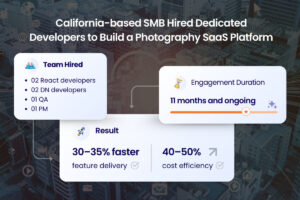
California-based SMB Hired Dedicated Developers to Build a Photography SaaS Platform

Swedish Agency Built a Laravel-Based Staffing System by Hiring a Dedicated Remote Team