
Table of Contents

INTRODUCTION
During a recent project for a global logistics and supply chain SaaS platform, we encountered a classic architectural dilemma: the cost of vendor lock-in. The platform processed millions of telemetry and package tracking events daily. To decouple the microservices, the original engineering team heavily utilized AWS EventBridge as the central nervous system. It provided an event bus, rule-based routing to filter payloads, and a highly reliable cron scheduler for automated dispatch tasks.
However, when the client’s enterprise customers mandated multi-cloud deployment capabilities to ensure regional redundancy and data compliance, reliance on a proprietary AWS service became a hard blocker. We realized that migrating away from EventBridge was not as simple as dropping in a standard message broker. We needed an open-source or cloud-agnostic solution that could replicate the specific trio of capabilities: an event bus, centralized rule-based routing, and distributed cron job scheduling.
This challenge inspired this article. If you are navigating a shift toward cloud-agnostic event-driven architecture migration, understanding how to replicate managed cloud services using open-source primitives is critical so others can avoid the same architectural traps.
PROBLEM CONTEXT
In the existing AWS-bound architecture, microservices blindly published state changes (e.g., package scanned, driver assigned) to an EventBridge Event Bus. The beauty of EventBridge lies in its decoupled rule evaluation. A downstream microservice (the Target) did not need to filter events. Instead, an EventBridge Rule evaluated the incoming JSON payload, checked if it matched specific criteria, and only routed the matching events to the Target queue or webhook.
Additionally, the platform relied on EventBridge Scheduler to trigger time-based workflows, such as end-of-day reconciliation tasks and SLA breach checks. Moving to a cloud-agnostic infrastructure meant we needed a mechanism that could intercept events, run routing logic before delivery, and handle distributed cron execution without deploying a massive operational footprint.
WHAT WENT WRONG WITH THE INITIAL APPROACH
Our initial instinct, like many teams, was to reach for Apache Kafka. Kafka is the industry standard for high-throughput event streaming. However, as we drafted the architecture, a fundamental paradigm mismatch surfaced.
Kafka operates on a “dumb broker, smart consumer” model. It allows you to create an event bus (topics), but it does not have built-in rule-based routing. If a notification service only cares about “package.delivered” events from a specific region, Kafka requires the consumer to read all events on the topic, deserialize them, and discard the ones it does not need. This wastes compute resources on the consumer side and violates the decoupled routing pattern EventBridge provided. While Kafka Streams or Apache Flink could handle this, they introduced an unacceptable level of operational complexity for simple event filtering.
Furthermore, Kafka lacks a native distributed cron scheduler. We quickly recognized that trying to shoehorn Kafka into an EventBridge-shaped hole would lead to bloated consumer services and fragmented scheduling logic.
HOW WE APPROACHED THE SOLUTION
When technology leaders hire cloud architects for multi-cloud strategies, they expect solutions that balance scalability with operational simplicity. We realized we had to break EventBridge down into its core primitives and solve for them using independent, best-of-breed open-source tools.
We needed a “smart broker, dumb consumer” model. We evaluated NATS JetStream and RabbitMQ. We chose RabbitMQ because its AMQP exchange-to-queue binding model perfectly mimics EventBridge’s Rule-to-Target behavior. With RabbitMQ Topic and Headers exchanges, the broker evaluates the routing keys or headers and routes messages to specific queues (Targets) before the consumer ever sees them.
For the scheduling component, we needed a robust, fault-tolerant replacement for EventBridge Scheduler. Relying on basic Kubernetes CronJobs was too fragile for stateful business logic. Instead, we introduced Temporal.io, a distributed orchestration engine, to manage all cron schedules and time-based event emissions.
Companies looking to hire backend developers for event-driven systems often struggle with standardization. To future-proof the communication, we mandated the use of the CloudEvents specification, ensuring all event payloads shared a consistent schema regardless of the underlying broker.
FINAL IMPLEMENTATION
Our final architecture decoupled routing from scheduling, relying on RabbitMQ for the bus and Temporal for the cron execution. Here is how we configured the core components.
The Event Bus and Rules (RabbitMQ)
We provisioned a highly available RabbitMQ cluster. Instead of an EventBridge Bus, we created a central RabbitMQ Topic Exchange named system_event_bus. Microservices published CloudEvents to this exchange with dot-delimited routing keys representing the event type and context.
// Generic RabbitMQ Topology Mapping
// 1. Create the Event Bus
Exchange: "system_event_bus" (Type: Topic)

// 2. Define the Target (Queue)
Queue: "sla_notification_target"

// 3. Define the Rule (Binding)
// Matches any event related to an SLA breach in the EU region
Binding:
  Exchange: "system_event_bus"
  Queue: "sla_notification_target"
  RoutingKey: "eu.tracking.*.sla_breach"
This implementation ensured that the notification service only processed relevant SLA breaches, restoring the precise filtering capabilities we lost when leaving AWS.
The Scheduler (Temporal.io)
To replace EventBridge cron jobs, we deployed Temporal workers. We defined recurring workflows that executed on standard cron schedules. When a workflow fired, its sole responsibility was to publish an event to the RabbitMQ exchange, triggering the appropriate downstream microservices.
// Pseudocode for Temporal Cron Workflow
WorkflowOptions options = WorkflowOptions.newBuilder()
    .setTaskQueue("cron_task_queue")
    .setCronSchedule("0 0 * * *") // Run daily at midnight
    .build();
public class DailyReconciliationWorkflowImpl implements DailyReconciliationWorkflow {
    @Override
    public void execute() {
        // Emit a standardized CloudEvent to RabbitMQ
        EventPublisher.publish("system_event_bus", "global.billing.daily_reconciliation", payload);
    }
}
This architecture proved highly resilient. The combination of RabbitMQ and Temporal provided a fully cloud-agnostic event routing and distributed cron job scheduling engine, paving the way for the platform’s multi-cloud rollout.
LESSONS FOR ENGINEERING TEAMS
If you are planning to migrate away from managed event buses, or if you plan to hire software developer teams to build cloud-agnostic platforms, keep these insights in mind:
- Understand Broker vs. Consumer Filtering: Do not default to Kafka for everything. If your architecture relies on pre-filtering events before they hit consumer logic, AMQP brokers like RabbitMQ or subject-based brokers like NATS are much closer alternatives to EventBridge.
- Standardize on CloudEvents: Adopting the CloudEvents specification decouples your application logic from the underlying message broker’s proprietary envelope, making future migrations seamless.
- Separate Eventing from Scheduling: Managed cloud services often bundle scheduling and eventing (e.g., EventBridge). In the open-source world, these are distinct problems. Use a message broker for events and a dedicated orchestrator (like Temporal or Quartz) for stateful crons.
- Beware of Consumer Bloat: If you force a “dumb broker” to do a “smart broker’s” job, your microservices will become bloated with filtering logic, leading to higher compute costs and tighter coupling.
- Map Topologies Explicitly: Treat your RabbitMQ exchanges, queues, and bindings as infrastructure-as-code. This provides the same visibility you would get from an AWS EventBridge rules dashboard.
WRAP UP
Replacing AWS EventBridge requires a shift in how you think about managed services. By combining RabbitMQ’s powerful routing exchanges with Temporal’s robust scheduling, we successfully transitioned a high-scale logistics platform to a completely cloud-agnostic architecture. This approach eliminated vendor lock-in while preserving the decoupled, rule-driven event processing the engineering team relied on.
If your organization is tackling complex architectural migrations and needs experienced engineering teams to execute them seamlessly, contact us.
Social Hashtags
#AWSEventBridge #EventDrivenArchitecture #CloudAgnostic #VendorLockIn #RabbitMQ #TemporalIO #CloudEvents #Microservices #MultiCloud #BackendArchitecture #CloudArchitecture #DevOps #SoftwareArchitecture #DistributedSystems #OpenSource
Frequently Asked Questions
Kafka is excellent for high-throughput stream processing, but it lacks native pre-delivery message filtering. You would have to build the routing rules into your consumer applications or introduce a heavy stream processing framework, which increases operational complexity compared to EventBridge's native rule engine.
RabbitMQ using Topic and Headers exchanges is functionally very close. NATS JetStream also provides powerful subject-based routing that acts similarly to EventBridge rules. For Kubernetes-native environments, Knative Eventing combined with a broker can also replicate this model.
Decouple scheduling from the event bus. Tools like Temporal.io, Apache Airflow, or even Quartz can be configured to execute on a cron schedule and emit an event to your message broker when the time arrives, mimicking the EventBridge Scheduler.
Yes. While it may not match Kafka's raw throughput for event sourcing, a properly tuned, clustered RabbitMQ deployment using Quorum Queues can handle thousands of messages per second with high availability, which is more than sufficient for most microservice event bus use cases.
CloudEvents provides a standardized way to describe event data. By adopting it, your applications generate a consistent payload structure, making it easier to switch underlying event brokers (e.g., moving from EventBridge to RabbitMQ) without rewriting application-level deserialization logic.
Success Stories That Inspire
See how our team takes complex business challenges and turns them into powerful, scalable digital solutions. From custom software and web applications to automation, integrations, and cloud-ready systems, each project reflects our commitment to innovation, performance, and long-term value.
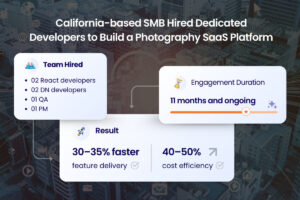
California-based SMB Hired Dedicated Developers to Build a Photography SaaS Platform
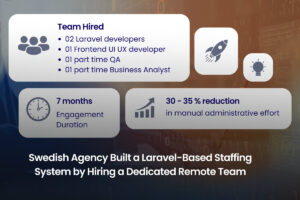
Swedish Agency Built a Laravel-Based Staffing System by Hiring a Dedicated Remote Team