
Table of Contents

How Do We Secure Azure Data Lake and Avoid Synapse 403 Errors in Production?
While working on a massive data modernization project for a leading FinTech enterprise, we were tasked with building a secure data analytics platform using Azure Synapse Analytics and Azure Data Lake Storage (ADLS) Gen2. Due to strict financial compliance regulations, the primary mandate was absolute network isolation. We had to ensure that no data could traverse the public internet.
To meet this requirement, we restricted all public network access to the Azure Data Lake and configured Azure Private Endpoints. However, the moment we flipped the switch to disable public access, our data pipelines ground to a halt. We encountered a scenario where Azure Synapse could no longer interact with the storage account. We faced consistent AuthorizationFailure (403) errors, both when executing data pipelines and when attempting to browse the ADLS file system directly from Synapse Studio.
When organizations decide to hire python developers for scalable data systems, they rightly expect that network security controls will not compromise pipeline reliability. Resolving this issue required a deep dive into how Azure’s control plane (Identity/RBAC) interacts with the data plane (Networking). This challenge inspired this article, so other engineering teams can confidently restrict public access to ADLS without inadvertently breaking their Azure Synapse workflows.
Why Does Restricting Public Network Access to Azure Data Lake Cause Connectivity Challenges?
In a standard cloud deployment, PaaS resources like ADLS and Azure Synapse communicate over the Azure network backbone via public IP addresses. However, in enterprise environments, security policies require isolating these PaaS services inside an Azure Virtual Network (VNet). By disabling public network access on ADLS, you are implicitly telling Azure to drop all traffic that does not originate from an approved, private network path.
In our FinTech use case, the data architecture relied on Synapse Pipelines to orchestrate data movement and Synapse Spark pools to process the data. All of this compute needed to read and write to our isolated ADLS account. Because public access was blocked, the default compute runtimes in Synapse—which dynamically allocate resources outside your specific VNet—were suddenly denied access. The challenge was bridging the secure gap between a managed Synapse environment and a completely locked-down storage layer.
What Causes the AuthorizationFailure 403 When Accessing ADLS from Azure Synapse?
The core symptom we experienced was a persistent HTTP 403 error. The logs and the Synapse Studio UI surfaced the following failure:
AuthorizationFailure (403) - This request is not authorized to perform this operation.
What made this particularly frustrating was that we had already handled identity and access management perfectly. We granted the Storage Blob Data Contributor role and the Owner role to the Synapse Workspace System Assigned Managed Identity on the target storage account. Furthermore, when testing via the Azure CLI using our own developer accounts (which also had Owner permissions), we still received the exact same 403 error.
The critical realization was that an AuthorizationFailure (403) in Azure Storage does not exclusively mean a lack of RBAC permissions. When public network access is disabled, Azure Storage evaluates network rules before evaluating RBAC roles. If the network request originates from a blocked IP or unapproved VNet, the firewall drops the request and returns a 403, regardless of whether the caller is a global administrator or an Owner.
How Can We Diagnose and Resolve Azure Data Lake Private Endpoint 403 Errors?
Before arriving at the final production-ready fix, our team mapped out several potential architectural solutions to restore connectivity while maintaining security compliance. As technical leaders look to hire dotnet developers for enterprise modernization, evaluating these architectural tradeoffs is a critical competency.
Should We Consider Allowing Trusted Azure Services for Storage Access?
The quickest potential fix we evaluated was navigating to the storage account networking settings and checking the box for “Allow Azure services on the trusted services list to access this storage account.” Because Synapse is a trusted Azure service and we were using a System Assigned Managed Identity, this exception would theoretically allow Synapse to bypass the firewall.
Tradeoffs: While this works for pipeline runs, it is broadly scoped. It relies entirely on identity for security, opening a tiny loophole in our “strict network isolation” policy. Furthermore, it did not solve the issue of our developers receiving 403 errors when browsing ADLS via the Synapse Studio UI, because the browser session originates from the developer’s local machine, not the Synapse backend.
Is Using VNet Service Endpoints a Viable Alternative to Private Links?
We also considered configuring VNet Service Endpoints. By injecting a service endpoint into our compute VNet, traffic to ADLS would remain on the Azure backbone and include the VNet context in the request headers.
Tradeoffs: Service Endpoints do not assign a private IP address to the storage account. They still rely on the public endpoint DNS resolution, albeit with optimized routing. Our Infosec team mandated the use of Azure Private Link so that the storage account would be accessed exclusively via a private IP address from our dedicated subnets. Therefore, Service Endpoints were rejected.
Does Adding Client IP Whitelists Solve Synapse Connectivity Issues?
To solve the CLI and Synapse Studio UI browsing issue, we thought about whitelisting our corporate office public IP addresses on the ADLS firewall.
Tradeoffs: IP whitelisting is an administrative nightmare, especially in a modern era where we frequently hire software developer teams working remotely. Maintaining dynamic IP lists is error-prone and violates zero-trust principles. We needed a purely private networking solution.
How Do We Implement the Fix for Synapse ADLS AuthorizationFailure 403?
Through our diagnostic process, we realized the problem was twofold: Synapse compute engines needed a private path to the storage and local browsers running Synapse Studio needed their own private path. We implemented a two-part architectural fix.
Step 1: Implementing Synapse Managed Private Endpoints
For pipelines and Spark jobs to run successfully, we had to configure a Managed Private Endpoint inside the Synapse workspace. This effectively creates a private link from the Synapse Managed VNet to the ADLS account.
- Navigated to Synapse Studio > Manage > Managed private endpoints.
- Created a new Managed private endpoint targeting the ADLS Gen2 storage account.
- Crucially, we then navigated to the Azure Portal > ADLS Storage Account > Networking > Private endpoint connections.
- We noticed the connection was in a Pending state. We manually Approved the connection.
After approval, any Synapse Integration Runtime configured to use the Synapse Managed VNet could securely and privately route traffic to ADLS, resolving pipeline 403 errors.
Step 2: Resolving the Synapse Studio Browser Access Issue
Synapse Studio is a client-side application. When you attempt to browse connected ADLS files in the “Data” tab, the API calls are made directly from your web browser, using your local machine’s internet connection. Because ADLS had public access disabled, the local browser’s IP was blocked.
To fix this securely without whitelisting public IPs, we implemented Point-to-Site (P2S) VPN access. By connecting our developer workstations to the Azure VNet via VPN and configuring our local DNS to resolve the storage account’s private endpoint IP (using an Azure Private DNS Zone), the browser traffic traversed the VPN tunnel, hitting the private IP of the storage account.
What Are the Key Lessons for Securing Azure Data Lakes With Private Endpoints?
The complexities of enterprise networking require foresight. When companies scale and decide to hire ai developers for production deployment, ensuring secure, seamless access to training data is paramount. Here are the key lessons our team documented from this engagement:
- RBAC is Not Network Access: Having Owner or Storage Blob Data Contributor permissions is meaningless if the network firewall drops your packets. Always verify network topology before debugging identity permissions.
- Synapse UI is Client-Side: Never forget that browsing data in the Synapse Studio Data hub executes from the user’s browser, not the Azure backend. You must account for the developer’s network route to the private endpoint.
- Pending Approvals Cause Silent Failures: Creating a Managed Private Endpoint in Synapse is only step one. If you do not approve it on the target resource side, the connection drops silently, often resulting in obscure timeouts or 403 errors.
- DNS Resolution is Critical: Private Endpoints require proper DNS configuration. If your local machine or compute node resolves the storage account URI to its public IP instead of the private endpoint IP, the traffic will be blocked. Always verify resolution using tools like
nslookup. - Use Managed VNets for Compute: Always deploy Azure Synapse workspaces with the “Managed Virtual Network” feature enabled. Without it, you cannot create Managed Private Endpoints for serverless compute components.
How Can You Prevent Network Authorization Failures in Enterprise Data Platforms?
Restricting public network access to Azure Data Lake is a non-negotiable security requirement for enterprise applications. However, as demonstrated by the 403 Authorization failures in Azure Synapse, implementing it requires strict alignment between your identity roles, private link topology and DNS infrastructure. By deploying Managed Private Endpoints, ensuring manual approvals and securing developer access via VPNs, we delivered a fully isolated, zero-trust data platform for our client.
If your organization is struggling with complex cloud network architectures or you are looking to scale your team with experienced engineers who understand the nuances of secure cloud infrastructure, contact us.
Social Hashtags
#Azure #MicrosoftAzure #AzureSynapse #AzureDataLake #ADLSGen2 #AzurePrivateLink #PrivateEndpoint #CloudSecurity #DataEngineering #AzureNetworking #DataArchitecture #CloudComputing #ZeroTrust #DevOps #FinTech
Frequently Asked Questions
Azure Storage evaluates network firewall rules before checking Role-Based Access Control (RBAC). If public access is disabled on the storage account and the incoming request is not routed through an approved Private Endpoint or whitelisted VNet, the storage firewall immediately rejects the request with a 403 error, regardless of the identity's permissions.
A Synapse Managed VNet is a virtual network completely managed by Microsoft specifically for your Synapse workspace. It simplifies network security by allowing you to create Managed Private Endpoints directly from Synapse to other Azure resources. Standard VNet integration requires you to manage the subnets, NSGs and routing manually within your own Azure subscription.
Because Synapse Studio UI runs in your local web browser, data preview requests originate from your local public IP. To browse a private ADLS account, you must either connect your local machine to the Azure VNet using a VPN/ExpressRoute (ensuring DNS resolves the storage account to its private IP) or use an Azure Virtual Desktop hosted within the secure VNet.
You can verify the status by navigating to the target resource (e.g., ADLS Storage Account) in the Azure Portal. Go to the Networking blade, select the Private endpoint connections tab and ensure the connection state associated with your Synapse workspace reads "Approved". If it says "Pending", you must manually approve it before traffic can flow.
Success Stories That Inspire
See how our team takes complex business challenges and turns them into powerful, scalable digital solutions. From custom software and web applications to automation, integrations, and cloud-ready systems, each project reflects our commitment to innovation, performance, and long-term value.
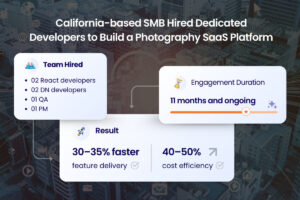
California-based SMB Hired Dedicated Developers to Build a Photography SaaS Platform
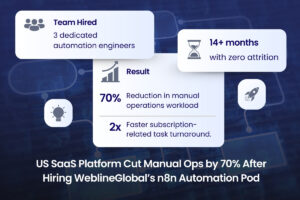
US SaaS Platform Cut Manual Ops by 70% After Hiring WeblineGlobal’s n8n Automation Pod