Table of Contents

Engineering leaders in the Dallas tech corridor face a recurring dilemma that can stall growth for months. As a product scales, the initial backend architecture often begins to buckle under the weight of new requirements, leading to increased technical debt and sluggish release cycles. This is the moment where backend refactoring Dallas becomes a non-negotiable priority. However, the risk is that the refactoring effort consumes the entire engineering team, causing feature delivery to grind to a halt. Balancing the need for a modern, scalable infrastructure with the market demand for continuous innovation requires a strategic approach to resource allocation.
For CTOs and VPs of Engineering at high-growth firms, the solution often lies in decoupling refactoring tasks from the core product roadmap. By bringing in specialized expertise to handle the heavy lifting of code optimization and database restructuring, local teams can maintain their focus on the user experience. The decision to hire backend developers Dallas is frequently driven by the need to inject fresh capacity into a pipeline that has become bottlenecked by legacy code. Navigating this transition successfully requires a deep understanding of velocity risks and a clear strategy for team composition during the overhaul phase.
The Velocity Paradox in Backend Refactoring for Dallas Enterprises
The velocity paradox is a phenomenon where attempts to improve a system actually slow down its output in the short term. In the context of backend refactoring Dallas, this occurs when your most senior developers, who possess the most institutional knowledge, are pulled away from product innovation to fix underlying architectural issues. While the long-term goal is to move faster, the immediate result is a drop in feature shipping. This trade-off is often difficult to justify to stakeholders who are focused on quarterly growth targets and market share expansion.
Identifying When Technical Debt Becomes a Business Risk
Technical debt is manageable until it begins to impact the bottom line. For many Dallas-based companies, the signal to initiate a refactor comes when the time-to-market for simple features begins to double or triple. If your team spends 70 percent of their sprint on bug fixes and only 30 percent on new features, your backend is no longer an asset; it is a liability. Recognizing this shift early is crucial for maintaining a competitive edge in a fast-moving market where agility is the primary currency of success.
Quantitative Indicators of Refactoring Need
Decision-makers should look at metrics such as lead time for changes, change failure rate, and mean time to recovery. When these numbers start trending in the wrong direction, it is a clear indicator that the backend requires attention. At this stage, leaders often look to hire backend developers who specialize in modernization and can work alongside the existing team to bridge the gap between old and new systems.
Evaluating System Fragility
Fragility manifests when a small change in one part of the backend causes unexpected failures in seemingly unrelated modules. This lack of isolation is a primary driver for moving toward a more modular or microservices-based architecture, which is a common goal in many refactoring initiatives today.
To avoid these pitfalls, many organizations find that the most effective way to maintain velocity is to augment their internal team with dedicated resources who can focus exclusively on the refactor. This allows the internal team to stay focused on the roadmap while the external pod handles the complex, often tedious work of restructuring the backend without breaking existing functionality.
Struggling to maintain velocity while refactoring your backend? Get expert guidance tailored for your Dallas engineering team—before delays impact your roadmap.
Strategic Resource Allocation to Mitigate Velocity Risks
Managing velocity risks during a backend overhaul requires a tactical approach to staffing. One of the most common mistakes is assuming the current team can handle both the refactor and the roadmap. This leads to burnout and half-finished initiatives. Instead, savvy leaders often choose to hire backend developers to form a dedicated “refactor pod” that operates in parallel with the main feature team. This structure ensures that neither the future of the product nor its current market obligations are sacrificed.
The Parallel Track Strategy for Engineering Teams
In a parallel track model, one team is responsible for maintaining the legacy system and adding critical features, while the second team builds out the new backend architecture. This requires tight synchronization but prevents the total work stoppage that often accompanies large-scale refactors. This approach is particularly effective when you hire backend developers Dallas who are experienced in legacy system migration and can quickly integrate into your existing workflows and communication channels.
Defining Clear Boundaries Between Teams
For a parallel track to work, you must define exactly where the legacy system ends and the new architecture begins. Clear API contracts and documentation are essential. This is where the expertise of external developers becomes invaluable, as they often bring a fresh perspective on how to decouple tightly bound components that the original team might be too close to see clearly.
When looking to review refactor approach, it is helpful to consult with partners who have handled similar migrations for other enterprise clients. They can provide insights into common roadblocks and help you design a phased rollout that minimizes downtime and risk. This consultative approach is a hallmark of how WeblineGlobal assists its clients in Dallas and beyond.
Why You Should Hire Backend Developers Dallas for Scalability
The Dallas market is highly competitive, and finding local talent with specific expertise in complex backend refactoring can be both time-consuming and expensive. Many companies find that a hybrid model, where they hire backend developers from a global talent pool, offers the best balance of cost and expertise. This allows them to scale their engineering capacity rapidly without the long lead times associated with local hiring in a tight labor market.
Leveraging Modern Tech Stacks for Performance
Refactoring is an opportunity to move to more modern, performant stacks. For instance, many teams choose to hire Node developers when moving from a monolithic architecture to an asynchronous, event-driven microservices model. Node.js offers excellent scalability and a vast ecosystem of libraries that can accelerate the refactoring process, provided you have the right talent to implement it correctly within your existing infrastructure.
Integrating Remote Developers into Dallas Workflows
A primary concern when hiring remote talent is cultural and operational alignment. However, modern collaboration tools and well-defined agile processes make it easier than ever to integrate remote developers into a Dallas-based engineering culture. By focusing on communication protocols and overlapping work hours, companies can achieve a high degree of synergy with their remote partners, ensuring that velocity remains high throughout the project lifecycle.
Cost-Benefit of Remote Augmentation
Hiring developers in India through a model like RelyShore℠ can reduce costs by 40 to 60 percent compared to local Dallas hiring. These savings can then be reinvested into other areas of the business, such as marketing or R&D, providing a significant competitive advantage for startups and established enterprises alike.
To maintain velocity, you need a partner who understands the nuances of Dallas business culture while providing the technical depth of a global engineering powerhouse. WeblineGlobal offers this unique combination, providing pre-vetted talent that is ready to hit the ground running on your most challenging refactoring projects.
Refactoring doesn’t have to slow your product down. Access pre-vetted backend experts who can seamlessly integrate with your team and accelerate modernization.
Managing Delivery Risks During Major System Overhauls
Every backend refactoring Dallas project carries inherent risks, including data loss, service outages, and extended timelines. Mitigating these risks requires a disciplined approach to testing and deployment. When you hire backend developers Dallas, you should look for candidates who prioritize automated testing and continuous integration. These practices are the safety net that allows for aggressive refactoring without the fear of catastrophic failure in production environments.
The Role of Automated Testing in Refactoring
Refactoring without a comprehensive test suite is essentially flying blind. Before the first line of code is rewritten, an investment must be made in unit, integration, and end-to-end tests. This ensures that the system’s behavior remains consistent throughout the transition. Teams that hire backend developers with a strong QA mindset find that their refactoring projects are significantly more predictable and less prone to regressions.
Incremental Rollouts and Feature Flags
Using feature flags allows teams to merge refactored code into the main branch without immediately exposing it to all users. This “dark launching” technique enables real-world testing and gradual rollouts, which are essential for maintaining system stability. It also allows the business to quickly roll back changes if performance issues are detected, significantly reducing the impact of potential errors.
If you are unsure how to structure your deployment pipeline for a major overhaul, it may be time to review a refactoring approach with an experienced external partner. They can help you implement the necessary DevOps practices to ensure that your refactoring efforts do not disrupt your daily operations or compromise the user experience.
Key Considerations for Hiring the Right Refactoring Talent
Not every backend developer is suited for the unique challenges of refactoring. While feature development requires creativity and a focus on the user, refactoring requires a more analytical, disciplined approach. When you look to hire backend developers for a modernization project, you should evaluate their experience with legacy codebases, their understanding of architectural patterns, and their ability to write clean, maintainable code that others can easily understand.
Technical Proficiency and Architectural Vision
A great refactoring developer doesn’t just fix the current problem; they anticipate future needs. They understand how to build systems that are not just scalable, but also evolvable. This is particularly important when you hire Node developers for a project, as the flexibility of the language can lead to “spaghetti code” if not managed with a strong architectural vision. Look for developers who can explain the “why” behind their technical choices and how those choices align with the long-term goals of the business.
Soft Skills and Collaborative Mindset
Refactoring is a highly collaborative effort that requires constant communication with the original authors of the code. The ability to give and receive feedback constructively is essential. Developers must be able to navigate the “ego” often associated with legacy code and focus on the objective goal of system improvement. This is a critical factor when you hire backend developers Dallas, as cultural fit can be just as important as technical skill in a collaborative engineering environment.
WeblineGlobal simplifies this process by providing access to a curated pool of developers who have been vetted for both their technical expertise and their communication skills. This ensures that when you hire through us, you are getting more than just a coder; you are getting a partner who is committed to helping you maintain velocity and achieve your business objectives.
Decision-Oriented Conclusion: Securing Your Product’s Future
The decision to refactor your backend is never easy, but it is often the only way to ensure the long-term viability of your product. For leaders in Dallas, the key is to manage the transition in a way that protects current velocity while building for the future. By strategically deciding when to hire backend developers Dallas, you can build a flexible, high-performing team that is capable of handling both the demands of today and the challenges of tomorrow.
Whether you choose to build a parallel track team or augment your existing staff, the goal remains the same: to create a backend that empowers your business to innovate at the speed of the market. If you are ready to review a refactor approach or need to scale your team quickly, consider the advantages of a partner that provides the expertise, scale, and cost-efficiency needed for success in today’s competitive landscape.
Social Hashtags
#BackendRefactoring #DallasTech #EngineeringLeadership #TechDebt #ScalableArchitecture #SoftwareEngineering #DevOps #Microservices #HireDevelopers #CTOInsights #TechStrategy #NodeJS #AgileDevelopment #DigitalTransformation
Ready to scale without compromising delivery? Partner with a team that helps Dallas companies refactor faster, reduce risk, and stay ahead of the market.
Frequently Asked Questions
A full refactor is typically necessary when the underlying architecture no longer supports the business goals, such as scaling to a higher volume of users or integrating new types of data. If minor optimizations no longer yield significant performance gains or if the cost of adding new features has become prohibitively high, it is likely time for a more comprehensive refactoring Dallas initiative.
The primary velocity risks include scope creep, where the refactor expands beyond its initial goals, and the "big bang" failure, where the new system is launched all at once and fails under production load. Additionally, pulling key members away from feature development can cause a significant drop in product momentum if not managed through strategic hiring and resource allocation.
Remote developers, particularly those from a proven market like India, offer a way to scale your team quickly and cost-effectively. They provide access to specialized skills that may be scarce or overly expensive in the local Dallas market. When managed through a trusted partner like WeblineGlobal, these developers can be seamlessly integrated into your workflow while providing 40 to 60 percent cost savings.
The timeline varies significantly based on the complexity of the system and the scope of the changes. However, by using an incremental approach and a dedicated team, most organizations can see significant improvements within 3 to 6 months. To maintain velocity, it is essential to set clear milestones and prioritize the most critical parts of the backend first.
The first step is to schedule a consultation where we can discuss your specific technical needs, project goals, and timeline. From there, we can provide a shortlist of pre-vetted developer profiles within about 48 hours, allowing you to quickly interview and hire the talent you need to move your project forward.




Success Stories That Inspire
See how our team takes complex business challenges and turns them into powerful, scalable digital solutions. From custom software and web applications to automation, integrations, and cloud-ready systems, each project reflects our commitment to innovation, performance, and long-term value.
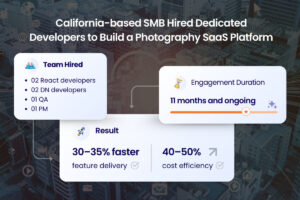
California-based SMB Hired Dedicated Developers to Build a Photography SaaS Platform
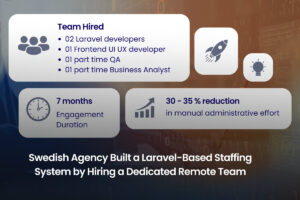
Swedish Agency Built a Laravel-Based Staffing System by Hiring a Dedicated Remote Team