
Table of Contents

HOW DID THIS ARCHITECTURAL CHALLENGE WITH PHP 8.1 SURFACE?
While working on a high-volume SaaS logistics platform, we encountered a critical infrastructure issue that brought automated synchronization jobs to a standstill. The system relied on background workers (cron jobs) built on CodeIgniter 4 (CI4) and PHP 8.1 to process millions of task records. To prevent concurrent executions, the platform utilized a standard lock file mechanism.
During a recent deployment, we realized that these background jobs were occasionally failing to clean up their lock files. The operations team had to manually SSH into the production servers to delete stale lock files just to keep the data pipelines moving. At first glance, the architecture seemed sound: the core execution logic was wrapped in a try-catch-finally block, with the finally block explicitly responsible for unlinking the lock file.
However, we discovered a situation where a database error—specifically an ambiguous column error in SQL—would trigger a failure, but the finally block was completely bypassed. This oversight led to severe operational bottlenecks. This challenge inspired this article so other engineering teams can avoid the hidden pitfalls of framework-level error handling combined with modern PHP strictness. When technology leaders decide to hire software developer teams, they expect robust concurrency control, and uncovering why a seemingly guaranteed code block fails is critical to delivering that reliability.
WHAT WAS THE PROBLEM CONTEXT BEHIND THE BYPASSED FINALLY BLOCK?
In our architecture, the background workers were encapsulated in a CI4 model class. The process started by creating a lock file on disk, executing a long-running data aggregation query, processing the results, and eventually releasing the lock. The environment was running CI4 version 4.4.3 on PHP 8.1.32, with the framework’s DBDebug configuration set to false for the production environment.
The issue surfaced inside a custom base model’s select() method. If a query failed, this wrapper method logged the error and returned an array containing the error message instead of a standard result object. The outer worker function wrapped the entire execution flow in a standard try { ... } catch (Throwable $e) { ... } finally { ... } structure.
Despite successfully catching the Throwable exception and logging it, the script terminated unexpectedly before reaching the finally block. The lock file remained on the disk. Interestingly, when we temporarily enabled a register_shutdown_function() to delete the lock file, it executed perfectly. This confirmed that the server wasn’t crashing, but rather, the PHP script was undergoing a deliberate, framework-driven shutdown sequence.
WHAT WENT WRONG WITH THE CI4 DATABASE EXCEPTION HANDLING?
The symptoms were baffling: a handled database error, no uncaught fatal errors in the application logs, and a bypassed finally block, yet shutdown handlers were still firing. The root cause lay in a perfect storm of PHP 8.1 behavior changes, object typing, and CodeIgniter 4’s global exception handler.
In PHP 8.1, the mysqli extension changed its default error reporting mode to throw exceptions (MYSQLI_REPORT_ERROR | MYSQLI_REPORT_STRICT) instead of silently returning boolean flags. When our SQL query failed due to an ambiguous column, mysqli threw a mysqli_sql_exception.
Our custom DB wrapper caught this exception and returned a formatted array: ['result' => 'Column name is ambiguous']. However, the subsequent code inside the synchronization loop expected a database result object to iterate over. When it attempted to call a method on the returned array, PHP 8.1 threw a TypeError.
This TypeError bubbled up to the outer catch (Throwable $e) block. Inside this catch block, the application attempted to log the failure using a custom logging function. Unfortunately, the logging function inadvertently attempted to cast an array context to a string. In PHP 8+, converting an array to a string throws a warning, which CodeIgniter 4’s error handler immediately promotes to an ErrorException.
Because this ErrorException occurred inside the catch block, it was uncaught by the local scope. It bubbled up to CI4’s global Exceptions handler. In production mode (DBDebug = false), CI4 suppresses the error output, writes it to the framework log, and explicitly calls exit(EXIT_ERROR). When PHP executes an exit() command, it immediately halts the current execution stack—skipping any pending finally blocks—but it still honors registered shutdown functions.
HOW DID WE APPROACH THE SOLUTION FOR THE TERMINATED EXECUTION?
To architect a resilient solution, we had to ensure that lock files were always released, regardless of how deeply the framework intervened. Companies looking to hire php developers for enterprise backend systems often prioritize this level of forensic debugging to ensure high availability.
DID WE CONSIDER AN UNCAUGHT FATAL ERROR?
Our initial hypothesis was an Out of Memory (OOM) fatal error or a script timeout, as the worker was processing thousands of records. However, resource exhaustion would not allow a local catch (Throwable) block to log the SQL error beforehand. Furthermore, system logs confirmed memory limits were nowhere near exhaustion.
DID WE CONSIDER THE CI4 FRAMEWORK EXECUTING AN EXIT CALL?
We investigated CodeIgniter’s internal exception lifecycle. We confirmed that the framework’s system/Debug/Exceptions.php calls exit($exitCode) when an exception is globally handled. This perfectly explained why the register_shutdown_function worked while the finally block did not. Our goal was to prevent local exceptions from reaching the global handler unnecessarily.
DID WE CONSIDER PHP 8.1 MYSQLI STRICT MODE BEHAVIORS?
We analyzed the impact of PHP 8.1’s strict typing and exception handling. We considered wrapping every single database call in localized try-catch blocks to prevent mysqli_sql_exception from mutating the return types. While effective, updating hundreds of legacy model queries was not feasible for an immediate hotfix, leading us to implement a more robust infrastructure-level lock mechanism.
WHAT WAS THE FINAL IMPLEMENTATION FOR ROBUST LOCK MANAGEMENT?
To permanently resolve this, we implemented a dual-layered approach. First, we fixed the fail-safe logic inside the catch block to ensure no secondary exceptions could trigger a framework exit(). Second, we decoupled the lock file management from the vulnerable try-catch-finally execution stack by utilizing the RAII (Resource Acquisition Is Initialization) pattern alongside native shutdown handlers.
Here is the sanitized implementation of our LockManager:
namespace AppLibraries;
class LockManager {
    private string $lockFile;
    private bool $isLocked = false;
    public function __construct(string $identifier) {
        $this->lockFile = WRITEPATH . 'cache/' . md5($identifier) . '.lock';
    }
    public function acquire(): bool {
        if (file_exists($this->lockFile)) {
            return false;
        }

        file_put_contents($this->lockFile, getenv('ENVIRONMENT') ?: 'production');
        $this->isLocked = true;
        // Fallback for unexpected framework exit() calls
        register_shutdown_function(function () {
            $this->release();
        });
        return true;
    }
    public function release(): void {
        if ($this->isLocked && file_exists($this->lockFile)) {
            unlink($this->lockFile);
            $this->isLocked = false;
        }
    }
    // RAII Pattern: Ensure cleanup if object is destroyed
    public function __destruct() {
        $this->release();
    }
}
And we integrated it safely into the task runner:
namespace AppModels;
use AppLibrariesLockManager;
class SyncTaskRunner extends BaseModel {
    public function run(array $payload): array {
        $lock = new LockManager('syncTaskRunner');

        if (!$lock->acquire()) {
            log_message('info', 'Process already running.');
            return ['result' => 'Locked'];
        }
        try {
            $this->processSyncQueue();
        } catch (Throwable $e) {
            // Fail-safe logging: ensure no secondary exceptions are thrown
            $errorMessage = is_string($e->getMessage()) ? $e->getMessage() : 'Unknown Error';
            log_message('error', 'Sync Failure: ' . $errorMessage);
            return ['result' => 'Error occurred'];
        } finally {
            // Standard cleanup, backed up by RAII and shutdown handler
            $lock->release();
        }
        return ['result' => 'OK'];
    }
}
By relying on object destructors and shutdown functions, the lock file is guaranteed to be removed even if CI4 executes an exit() command. We also sanitized the catch block to ensure logging variables are strictly typed as strings, preventing secondary ErrorException triggers.
WHAT ARE THE KEY LESSONS FOR ENGINEERING TEAMS HANDLING CI4 ERRORS?
This level of diagnostic thinking is exactly why enterprise organizations hire backend developers for scalable systems capable of architecting fail-safe infrastructure. Here are the core technical takeaways:
- Secondary Exceptions are Silent Killers: An exception thrown inside a
catchblock overrides the current stack and bubbles up immediately, bypassing the associatedfinallyblock. Always ensure your catch blocks are fail-safe. - Framework Global Handlers Terminate Scripts: In CodeIgniter 4, unhandled exceptions caught by the global error handler often result in an
exit()call. This halts code execution abruptly. - Use RAII for Infrastructure Locks: Do not rely solely on
finallyfor critical infrastructure cleanup like lock files or network sockets. Use object destructors (RAII) andregister_shutdown_function()to guarantee resource release. - Beware of PHP 8 Strictness: Upgrading to PHP 8.1 changes standard behaviors, such as
mysqlithrowing exceptions by default and array-to-string conversions throwing fatal errors. Validate all return types strictly. - Audit Custom DB Wrappers: If your database abstraction layer catches exceptions and returns arrays instead of objects, ensure that downstream code uses strict type checking (e.g.,
is_array()vsis_object()) before iterating over results.
READY TO OPTIMIZE YOUR PHP BACKEND ARCHITECTURE?
Unexpected script terminations and silent failures can cripple background automation and data integrity. By understanding the deep interactions between PHP 8 strict types, global exception handlers, and memory management, engineering teams can build resilient systems that self-heal under load. Whether you are building complex automated data pipelines or looking to hire app developer to create a mobile app backed by a highly available API, architecture matters.
If your organization is scaling its platform and requires battle-tested engineering expertise, contact us to explore how our dedicated remote developers can strengthen your infrastructure.
Social Hashtags
#PHP #PHP81 #CodeIgniter #CodeIgniter4 #CI4 #BackendDevelopment #PHPDevelopment #WebDevelopment #SoftwareEngineering #Debugging #ExceptionHandling #MySQLi #DevOps #SaaS #BackendEngineering
Frequently Asked Questions
The finally block relies on the normal unwinding of the execution stack. If the framework calls exit() or die(), the execution stack halts immediately, skipping finally. However, PHP always executes registered shutdown functions prior to terminating the process, regardless of whether exit() was called.
Prior to PHP 8.1, mysqli failed silently and returned boolean false on errors unless explicitly configured otherwise. In PHP 8.1, the default mode is MYSQLI_REPORT_ERROR | MYSQLI_REPORT_STRICT, meaning failed queries now throw a mysqli_sql_exception automatically.
While you cannot easily disable the exit() call inside CI4's core Exceptions class without hacking core files, you can prevent it by ensuring that all exceptions—including secondary ones thrown inside your logging mechanisms—are caught locally before they bubble up to the global handler.
RAII (Resource Acquisition Is Initialization) in PHP is implemented by tying a resource (like a lock file) to the lifecycle of an object. The file is created in the __construct() method and deleted in the __destruct() method. When the object goes out of scope or the script ends, PHP's garbage collector calls the destructor, ensuring cleanup.
Success Stories That Inspire
See how our team takes complex business challenges and turns them into powerful, scalable digital solutions. From custom software and web applications to automation, integrations, and cloud-ready systems, each project reflects our commitment to innovation, performance, and long-term value.

California-based SMB Hired Dedicated Developers to Build a Photography SaaS Platform
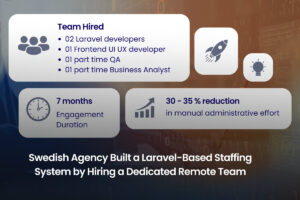
Swedish Agency Built a Laravel-Based Staffing System by Hiring a Dedicated Remote Team