Table of Contents

Toronto has firmly established itself as North America’s third largest tech hub, creating a high-stakes environment for SaaS platforms looking to scale. For a Chief Technology Officer or a VP of Engineering, the challenge is no longer just about building a product, it is about maintaining a resilient, scalable, and cost-effective infrastructure that can handle rapid user acquisition without compromising on performance.
As these platforms mature, the complexity of cloud operations Toronto increases significantly. Managing multi-region deployments, ensuring data residency compliance, and optimizing cloud spend require a level of expertise that is becoming increasingly difficult to find locally. This article serves as a strategic guide for leadership teams evaluating how to hire cloud engineers Toronto and build a robust operational framework that supports long-term business goals.
Scaling SaaS Platforms in Toronto’s Competitive Tech Ecosystem
The SaaS market in Toronto is characterized by rapid innovation and intense competition for technical talent. When a platform moves from the initial product-market fit stage to scaling for thousands of enterprise users, the underlying infrastructure must transition from a reactive setup to a proactive, managed environment. Decision-makers often find that their core development team is too bogged down by server issues to focus on feature releases, which is the first sign that you need to specialized help to manage cloud operations effectively.
The Shift from Maintenance to Innovation
Early-stage SaaS companies often rely on full-stack developers to handle infrastructure. However, as the user base grows, the risks of downtime or data breaches become too high to leave to generalists. Cloud operations Toronto experts focus specifically on the “Always On” nature of the business. By delegating infrastructure management to specialists, your core engineering team can focus on the product roadmap, ensuring that technical debt does not stifle your market growth.
Balancing Performance and Latency
For SaaS platforms serving a global audience from a Toronto base, latency is a critical metric. High latency leads to churn, especially in B2B environments where performance is tied to productivity. Professional cloud engineers understand how to leverage Content Delivery Networks (CDNs), edge computing, and regional data centers to ensure that a user in London or Singapore has the same seamless experience as one in Ontario. This level of architectural foresight is why many leaders choose to hire cloud & DevOps engineers who have experience with high-traffic distributed systems.
Data Residency and Compliance Requirements
Operating a SaaS platform in Canada often involves navigating strict data residency laws, such as PIPEDA. If your platform serves healthcare or financial sectors, the complexity doubles. Infrastructure must be designed so that sensitive data stays within geographic boundaries while still being accessible for processing. When you hire cloud engineers Toronto, you are looking for professionals who understand these regulatory nuances and can build compliant environments by default, rather than as an afterthought.
Scaling a SaaS platform requires more than just great code.
Get expert guidance on building a resilient cloud infrastructure, optimizing costs, and ensuring compliance for your Toronto-based SaaS platform.
Strategic Benefits When You Hire Cloud Engineers Toronto
The decision to hire cloud engineers Toronto is often driven by the need for high-level architectural oversight combined with operational execution. In a market where senior talent is expensive and scarce, finding the right balance between local leadership and remote execution is key. Many Toronto-based firms are now moving toward a hybrid model, where they retain a local CTO or Architect but leverage dedicated remote pods for 24/7 cloud monitoring and management.
Bridging the Talent Gap with Remote Talent
The local talent war in Toronto often leads to high turnover and inflated salaries. By expanding your search, you can access a broader pool of talent that offers the same technical proficiency at a more sustainable cost. WeblineGlobal specializes in providing pre-vetted cloud engineers who integrate directly into your existing team structure. This approach allows you to scale your operational capacity without the six-month lead time usually required for local hiring. It is often beneficial to hire IT consultants who can audit your current roadmap before you commit to a long-term hiring strategy.
Operational Continuity and 24/7 Coverage
SaaS platforms do not sleep. If a critical failure occurs at 3:00 AM EST, having a team that is already active in a different time zone can be the difference between a five-minute blip and a four-hour outage. Remote teams based in India, for example, provide a natural “follow the sun” model. This ensures that maintenance, updates, and incident responses happen in real-time, providing the reliability that enterprise clients demand from their SaaS vendors.
Evaluating Experience Levels for SaaS Infrastructure
When interviewing candidates, CTOs must look beyond just certifications. While AWS, Azure, or GCP certifications are a baseline, the real value lies in experience with “Infrastructure as Code” (IaC) and automated recovery. Ask candidates how they have handled a major outage in the past or how they managed a sudden 10x spike in traffic. If you want to review cloud setup protocols, look for engineers who prioritize automation over manual intervention, as this is the only way to scale sustainably.
Core Competencies for Cloud Operations Toronto
Effective cloud operations Toronto is not just about keeping the lights on, it is about optimizing the entire environment for cost and speed. A well-managed cloud setup should feel invisible to the end-user while providing deep insights to the management team. This requires a specific set of technical competencies that go beyond basic sysadmin skills.
Automation and Infrastructure as Code (IaC)
Modern cloud management relies on tools like Terraform, Ansible, or CloudFormation. These tools allow engineers to treat infrastructure as software, meaning it can be versioned, tested, and deployed with high reliability. When you hire cloud engineers Toronto, ensure they are proficient in these automation frameworks. This reduces the risk of human error, which is the leading cause of cloud outages globally. Automation also ensures that if you need to replicate your environment for a new region, it can be done in minutes rather than weeks.
Cost Optimization and FinOps
One of the biggest “surprises” for growing SaaS companies is the monthly cloud bill. Without active management, costs for storage, egress fees, and idle instances can spiral out of control. An expert cloud engineer will implement “FinOps” practices, continuously monitoring usage and right-sizing instances. They can identify where to use Reserved Instances or Spot Instances to save up to 60 percent on compute costs. If your current cloud spend is growing faster than your revenue, it is time to manage cloud operations with a focus on financial efficiency.
Security and Zero-Trust Architecture
In a SaaS environment, security cannot be a perimeter-based approach. It must be integrated into every layer of the cloud stack. This involves implementing Zero-Trust architectures, where every request is authenticated and authorized regardless of its origin. Professionals in cloud operations Toronto should be well-versed in IAM (Identity and Access Management) roles, encryption at rest and in transit, and continuous vulnerability scanning. This proactive security posture is essential for maintaining the trust of your SaaS subscribers.
Struggling with cloud scalability, high infrastructure costs, or DevOps bottlenecks?
Our pre-vetted cloud engineers help Toronto SaaS companies build automated, secure, and high-performance cloud environments.
Evaluating Vendors for SaaS Cloud Management
Choosing between building an in-house team or partnering with a managed service provider is a pivotal decision for a growing platform. For many Toronto founders, the overhead of managing a full-time, local DevOps department is prohibitive. This is where staff augmentation and dedicated pods become an attractive alternative. Partnering with a firm like WeblineGlobal allows you to access specialized skills on a month-to-month basis, providing the flexibility to scale up during a launch or scale down during a quiet phase.
Comparing Onshore, Nearshore, and Offshore Models
While hiring locally in Toronto offers proximity, the cost can be 40 to 60 percent higher than remote alternatives. Offshore teams, particularly those in India, offer a massive scale of talent. The key is finding a partner that provides US-based or local assurance to mitigate delivery risks. The RelyShore℠ model used by WeblineIndia, for example, combines the cost benefits of offshore execution with the communication and quality standards expected by North American CTOs. This helps you hire cloud & DevOps engineers who are technically elite and culturally aligned with your business processes.
Managing Integration Risks
The biggest fear when hiring remote engineers is “siloing.” To avoid this, cloud operations must be integrated into your existing CI/CD pipelines. Remote engineers should participate in your daily stand-ups and use the same communication tools like Slack or Jira. When you hire IT consultants to help with this transition, they focus on building the bridges between your local product team and the remote operational team, ensuring that there is a single source of truth for all infrastructure changes.
IP Protection and Security Protocols
When working with remote teams, intellectual property (IP) protection is non-negotiable. Ensure that your vendor has strict NDAs, secure access controls (VPNs/VDI), and a clear policy on data handling. At WeblineGlobal, we emphasize transparent pricing and rigorous access controls, ensuring that our clients retain full project control and ownership of their infrastructure code at all times.
Monitoring, Observability, and Proactive Scaling
The final pillar of successful cloud operations Toronto is observability. Unlike simple monitoring, which tells you if a server is up or down, observability tells you why a system is behaving a certain way. For a SaaS platform, this means tracking the entire journey of a user request from the frontend to the database and back.
Implementing Advanced Monitoring Tools
Tools like Datadog, New Relic, or Prometheus provide deep insights into application performance. However, these tools are only as good as the engineers who configure them. Expert cloud engineers set up custom dashboards and intelligent alerting systems that filter out “noise” and highlight genuine issues before they affect the end-user. If you want to review cloud setup efficiency, look at your Mean Time to Resolution (MTTR). A high MTTR usually indicates a lack of observability in your stack.
Predictive Scaling for Traffic Peaks
A SaaS platform must be able to handle “bursty” traffic. Whether it is a marketing campaign, a seasonal peak, or a viral moment, your infrastructure should scale automatically. This involves setting up auto-scaling groups and load balancers that respond to real-time demand. When you hire cloud engineers Toronto, they design these systems to be “elastic,” meaning they not only scale up to meet demand but also scale down to save costs when traffic subsides. This elasticity is one of the primary ROI justifications for investing in high-end cloud talent.
Closing the Decision Gap for Toronto SaaS Leaders
Managing cloud operations for a Toronto-based SaaS platform is a balancing act between technical excellence and fiscal responsibility. As you evaluate your next steps, consider whether your current team has the bandwidth to handle the increasing complexity of a growing cloud footprint. Hiring locally in Toronto provides proximity, but the speed and cost-efficiency of a dedicated remote pod can provide a significant competitive advantage.
The goal is to build an infrastructure that is not just a cost center, but a foundation for innovation. By focusing on automation, security, and cost optimization, you ensure that your platform is ready for the next level of growth. Whether you need a single specialist to fill a gap or a full pod to take over your infrastructure management, the right talent is available. Contact us, and we help you navigate the complexities of the modern cloud landscape.
Social Hashtags
#CloudOperations #DevOps #SaaSInfrastructure #CloudEngineering #DevOpsEngineers #TorontoTech #SaaSScaling #CloudAutomation #FinOps
#InfrastructureAsCode #CloudSecurity #TechLeadership #HireDevelopers #CloudManagement #StartupInfrastructure
Ready to optimize your SaaS infrastructure and ensure 24/7 operational reliability?
Partner with experienced cloud and DevOps engineers who help Toronto SaaS platforms scale securely and efficiently.
Frequently Asked Questions
Most SaaS companies see a cost reduction of 40 to 60 percent when compared to hiring local Toronto-based talent. This includes savings on base salary, benefits, office space, and recruitment overhead, while maintaining high technical standards through pre-vetted remote models.
A "follow the sun" model is often the most effective. By having a remote team in a different time zone, you gain 24/7 operational coverage. Overlap hours are scheduled for daily syncs and handovers, ensuring that communication remains fluid and project momentum is never lost.
Yes. Experienced cloud engineers can design and manage infrastructure within Canadian regions of AWS or Azure to ensure PIPEDA compliance. The location of the engineer does not affect where the data is stored, as long as the correct architectural controls and access protocols are in place.
While local hiring in Toronto can take 3 to 6 months, a dedicated remote partner can usually provide qualified developer profiles within 48 hours. This allows SaaS platforms to respond quickly to new funding rounds, sudden growth, or critical project deadlines.
Essential tools include Terraform or Ansible for infrastructure as code, Kubernetes for container orchestration, and Datadog or New Relic for observability. Proficiency in these tools is a primary requirement when you hire cloud engineers to manage complex SaaS environments.



Success Stories That Inspire
See how our team takes complex business challenges and turns them into powerful, scalable digital solutions. From custom software and web applications to automation, integrations, and cloud-ready systems, each project reflects our commitment to innovation, performance, and long-term value.
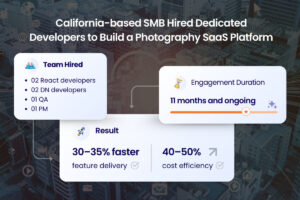
California-based SMB Hired Dedicated Developers to Build a Photography SaaS Platform
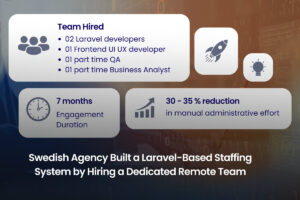
Swedish Agency Built a Laravel-Based Staffing System by Hiring a Dedicated Remote Team