
Table of Contents

INTRODUCTION What Caused the CodeIgniter 4 Data Discard in Our AI Pipeline
While working on a FinTech invoice processing pipeline, our engineering team encountered a frustrating data persistence issue. We were building an automated document extraction engine where an AI model parsed complex vendor invoices, outputted structured JSON, and fed the data into a CodeIgniter 4 backend for storage. Given the financial nature of the application, strict data integrity was non-negotiable.
During the integration phase, we realized that our database inserts were failing silently. Even though our JSON mapper successfully extracted over twenty specific fields like supplier names, tax IDs, and invoice totals, the CodeIgniter 4 insert function discarded almost everything. After the database write operation, only the foreign key for the document ID was saved. Every other column in the table was set to NULL.
This challenge exposed a deeper architectural issue involving dynamic property mutation, character encoding failures, and framework-level security mechanisms. This scenario inspired this article so other engineering teams can avoid similar pitfalls when dealing with AI-to-database data mapping in PHP environments. Whether you build your systems internally or hire software developer teams to scale your operations, understanding how ORMs handle schema boundaries is critical for production stability.
PROBLEM CONTEXT Where Did the Data Mapping Fail in the Architecture
Our application architecture utilized an AI extraction layer that returned JSON payloads with human-readable, localized keys. To securely map these raw inputs to our normalized database schema, we used a configuration table that linked the raw JSON keys to standardized snake_case column names.
The flow was designed to be robust. First, we parsed the JSON payload. Next, we matched the raw keys against our internal mapping dictionary. We then constructed an array of data keyed by the normalized database column names. Finally, we passed this array to our CodeIgniter 4 model for insertion.
CodeIgniter 4 models enforce a strict security feature called allowed fields. To prevent mass-assignment vulnerabilities, the model requires developers to explicitly define an array of columns that are permitted to be populated during insert or update operations. Any data passed to the model whose key does not exist in the allowed fields array is automatically stripped out before the database query is built. Our model explicitly defined every target column in standard lowercase format. However, the data simply was not landing in the database.
WHAT WENT WRONG Why Was CodeIgniter 4 Dropping Mapped Array Data
To diagnose the symptom, we implemented aggressive logging at every step of the insertion phase. Our logs confirmed that the array mapping function worked perfectly. The raw insert data array contained perfectly formatted snake_case keys corresponding to the correct values extracted by the AI.
The failure point appeared during the array intersection against the model’s allowed fields. When we logged the output of the model’s allowed fields array, we discovered a major anomaly. Instead of the lowercase snake_case column names hardcoded in the model class, the logs outputted uppercase keys matching the original raw JSON headers. Worse, these uppercase keys contained severe character encoding issues, commonly known as mojibake, where accented characters were replaced with mangled symbols.
Because the allowed fields array had mutated into mangled uppercase strings, the framework’s internal filtering logic saw no overlap between our clean snake_case insertion array and the corrupted allowed fields array. The only key that matched was the primary document ID, which bypassed the dynamic mapping. As a result, CodeIgniter faithfully discarded the rest of the payload, assuming it was an unauthorized mass-assignment attempt.
HOW WE APPROACHED THE SOLUTION What Fixes Did We Consider for the Allowed Fields Issue
Identifying the symptom was only half the battle. We needed to understand how a protected property in a PHP class was mutating at runtime. We evaluated several approaches to resolve the problem and restore data integrity.
Could We Bypass the CI4 Model Using Raw Queries
Our immediate thought was to bypass the model layer entirely and use the framework’s raw query builder to forcefully insert the mapped array. While this would immediately solve the insertion block, it violated our core architectural principles. Bypassing the model meant losing framework-level event triggers, automated timestamping, and future data validation rules. We quickly discarded this workaround. Companies looking to hire php developers for scalable data systems should ensure teams do not sacrifice architectural integrity for quick fixes.
Should We Force Global UTF8 Decoding
Because the allowed fields output displayed severe mojibake, we suspected a fundamental encoding mismatch. We considered wrapping all incoming JSON streams and database connections in aggressive UTF-8 decoding functions. While ensuring proper UTF-8 handling is best practice, this approach only addressed the visual symptom of the mangled text. It did not explain why the raw uppercase headers were replacing the hardcoded internal schema in the first place.
Did Dynamic Property Mutation Cause the Schema Mismatch
We dug deeper into the application architecture and discovered the actual root cause. A legacy base model, which our AI data model extended, contained a dynamic constructor. This legacy logic was designed to auto-discover allowed fields by querying the database schema mapping table. Because of a logic flaw, it overwrote the strictly defined property in our child class with the raw external display names rather than the internal column names.
Coupled with a database connection that lacked explicit UTF-8 collation enforcement in the legacy module, the raw strings were fetched with corrupted encoding and injected directly into the active model’s memory state. This combination of dynamic schema mutation and encoding failure created the perfect storm.
FINAL IMPLEMENTATION How Did We Secure the CodeIgniter Insertion and Character Encoding
Our final solution required removing the dynamic mutation, enforcing strict boundaries, and handling character encoding explicitly. We rebuilt the model and the insertion controller to ensure absolute predictability.
First, we decoupled the legacy base model from our specific pipeline. We hardcoded the allowed fields as originally intended and removed any dynamic overrides.
namespace AppModels;
use CodeIgniterModel
class InvoiceDataModel extends Model
{
    protected $table            = 'extracted_invoice_data';
    protected $primaryKey       = 'id';
    protected $useAutoIncrement = true;
    protected $useTimestamps    = false;
    // We removed dynamic overrides to ensure strict adherence to this schema
    protected $allowedFields = [
        'document_id',
        'supplier_name',
        'supplier_address',
        'supplier_tax_id',
        'invoice_number',
        'invoice_total',
        'tax_amount'
    ];
}
Next, we fortified the insertion controller. We implemented explicit UTF-8 encoding checks on the incoming JSON strings to prevent mojibake. We also built a strict filtering layer that validates the mapped data exclusively against the model’s defined schema.
public function processExtractedData(int $document_id, string $jsonPayload): void
{
    // Ensure strict UTF-8 encoding before decoding
    $cleanPayload = mb_convert_encoding($jsonPayload, 'UTF-8', 'auto');
    $extractedData = json_decode($cleanPayload, true);
    if (json_last_error() !== JSON_ERROR_NONE) {
        throw new RuntimeException('Invalid JSON encoding detected.');
    }
    $invoiceModel = new AppModelsInvoiceDataModel();
    $mappedData = ['document_id' => $document_id];
    // Standardize and map keys
    foreach ($extractedData as $rawKey => $value) {
        $normalizedKey = $this->mapToDatabaseColumn($rawKey);
        if ($normalizedKey) {
            $mappedData[$normalizedKey] = $value;
        }
    }
    // Rely on CodeIgniter internal security rather than manual array flipping
    try {
        $invoiceModel->insert($mappedData);
    } catch (Exception $e) {
        log_message('error', 'Insertion failed: ' . $e->getMessage());
    }
}
By preventing runtime modifications to the allowed fields array and ensuring the data boundary handled encoding properly, CodeIgniter could finally validate and insert the complete dataset.
LESSONS FOR ENGINEERING TEAMS What Architectural Practices Prevent Data Loss
This scenario underscores the importance of strict boundaries in software engineering. Engineering teams should keep the following insights in mind to prevent similar issues.
- Avoid Dynamic Schema Mutations Modifying model properties at runtime based on external configurations creates unpredictable side effects. Models should define their structure declaratively.
- Verify Encoding at the Boundary Never trust external data encodings, especially when extracting data from AI tools or legacy systems. Always enforce UTF-8 conversion before processing payloads.
- Understand Framework Security When using modern ORMs, understand how mass-assignment protection works. If data is dropping silently, check the intersection logic of your framework.
- Log the Intersections When mapping data, log both the incoming mapped array and the model’s allowed schema just before the insert operation. This visibility is crucial for debugging.
- Isolate Legacy Code If you inherit base classes with “magic” behaviors, carefully isolate new critical pipelines from them. Unpredictable inheritance is a massive risk in enterprise applications.
For organizations looking to scale robust AI integrations, having experienced architects is essential. When you hire ai developers for production deployment, ensure they understand how to securely map non-deterministic AI outputs into deterministic relational databases.
WRAP UP Ready to Strengthen Your Application Architecture
The journey from a frustrating silent failure to a stable, strictly enforced data pipeline highlighted the dangers of dynamic configuration and encoding mismatches. By locking down the CodeIgniter model boundaries and cleaning the data at the source, we restored full visibility and integrity to our FinTech integration. If your organization is tackling similar architectural hurdles and needs experienced engineering support, contact us to explore how our dedicated teams can accelerate your technical delivery.
Social Hashtags
#CodeIgniter4 #CodeIgniter #PHP #PHPDevelopment #WebDevelopment #SoftwareDevelopment #SoftwareEngineering #BackendDevelopment #AIIntegration #GenerativeAI #FinTech #Database #JSON #APIDevelopment #Debugging
Frequently Asked Questions
CodeIgniter implements a mass-assignment vulnerability protection feature. It strictly compares the array keys you pass into the insert method against the allowed fields property defined in the model. Any key not present in that array is silently discarded to protect your database schema from unauthorized input.
Mojibake occurs when text is interpreted using the wrong character encoding. To prevent it, ensure your database connection uses strict UTF-8 collation, explicitly convert external string payloads using PHP multi-byte string functions before processing, and serve your application headers consistently in UTF-8.
While possible via database reflection, it is generally considered an architectural anti-pattern. Dynamically populating allowed fields bypasses the developer's explicit control over which columns are modifiable, making the application harder to debug and exposing it to potential security risks.
AI payloads can be unpredictable. You should extract the JSON, validate the structure against a predefined DTO (Data Transfer Object), map the external localized keys to internal normalized standard keys, and then pass that sanitized array to your database abstraction layer.

Success Stories That Inspire
See how our team takes complex business challenges and turns them into powerful, scalable digital solutions. From custom software and web applications to automation, integrations, and cloud-ready systems, each project reflects our commitment to innovation, performance, and long-term value.
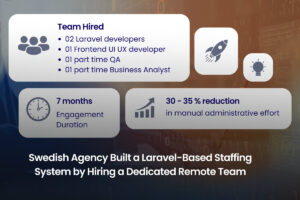
Swedish Agency Built a Laravel-Based Staffing System by Hiring a Dedicated Remote Team
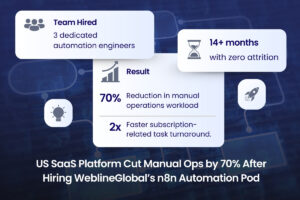
US SaaS Platform Cut Manual Ops by 70% After Hiring WeblineGlobal’s n8n Automation Pod