Table of Contents

We have witnessed a dramatic revolution in the past few years. Enterprises all over the world no longer communicate with clients with plain text or simple speech bots. According to Global Market Insights, the AI avatars market was valued at US $6.3 billion in 2025 and is likely to shoot up from US $8.4 billion in 2026 to US $93.4 billion by 2035. This shows an expansion at a 30.6% CAGR.
Now, there are two choices: hire AI avatar developers or use ready-made AI avatar platforms for your business flows. Both would help you handle customers, their queries and reply with logical answers. But then, a question arises: whether you should get an AI avatar developer or buy something that is already available on the market.
Let’s talk about what the actual levels are at which regular software fails and employing specialist developers is the better commercial decision.
Need a Custom AI Avatar for Your Business?
Go beyond ready-made platforms with custom AI avatars built for your brand, real-time interactions and enterprise workflows.
Understanding the Shift in Modern Digital Interactions
Today’s audiences want real-time, personal video experiences, not static answers. Off-the-shelf technologies do a good job of simple marketing videos, but dynamic applications need unique structures that ordinary SaaS packages just can’t handle under huge demands.
For interactive AI avatars, effective AI intent understanding helps systems interpret user queries accurately and deliver more relevant, context-aware responses during live conversations.
- Users demand low-latency responses during live customer service chats instead of waiting for cloud rendering queues to finish processing standard video files.
- Brands require distinct visual identities that do not mirror the template choices used by thousands of other competing businesses across global markets.
- Multinational teams need deep localization engines capable of matching regional dialect nuances perfectly without breaking character alignment constraints.
- Interactive learning modules function best when virtual instructors adapt dynamically to student inputs rather than reading rigid, pre-recorded text scripts.
If you’re designing interactive learning modules, virtual instructors work best if they can dynamically respond to student interaction, instead of reading a static, pre-recorded text script.
As organisations examine their online presence, they quickly realise that consumer patience is thin. For a slide deck that’s just for internal use or a fast teaser for social media, a generic presenter from a stock library could be suitable. But when clients go on a mission-critical support site or a high-stakes financial dashboard, they instantly sense the “cookie-cutter” vibe.
Standard platforms confine you to their default look, voice libraries and rendering pipelines. If your company philosophy is hyper-personalized care, these limits become an artificial ceiling on your user experience strategy.
And often, the technical integration needs show the friction spots of inflexible software. Software out of the box normally runs in closed web wrappers or proprietary cloud environments. Directly linking them to your internal CRM, unique database structures or private inventory systems means uncomfortable webhooks and irritating API rate constraints. Building a custom pipeline, technical teams integrate the rendering engine right where it’s needed, creating a seamless loop between user data and real-time visual feedback.
Limitations of Off-the-Shelf Avatar Software for Enterprise Scaling
Subscription software offers rapid deployment for basic promotional needs, but licensing restrictions, recurring credit caps and rigid templates create severe bottlenecks when your organization scales operations across international markets and high-volume customer touchpoints.
- Monthly credit limitations on standard tiers cause unexpected budget spikes when video generation volume scales up during peak seasonal marketing pushes.
- Restricted source code access prevents internal engineering teams from patching bugs or customizing backend rendering speeds to suit specific network conditions.
- Generic branding guidelines make it nearly impossible to implement proprietary facial rigging, custom wardrobe assets or unique company mascot designs.
- SaaS terms of service often forbid heavy automation pipelines, forcing human operators to manually click through web dashboards for bulk tasks.
We are going to see thousands of digital humans… They will look like us, talk like us and interact with us. They will become companions, assistants and co-workers.
— Jensen Huang
Third-party dependency leaves your primary customer-facing channel vulnerable if the software vendor suffers server outages or changes its pricing model overnight.
In short, you are turning over your most important customer-facing channel to a third party that can take its servers down due to an outage at the software provider or change its pricing plan overnight. Another hidden disadvantage of relying on subscription-based technologies altogether is financial predictability. A monthly cost may sound affordable at first, but credit-based charging mechanisms penalise success. The more effective your campaign is, the more credits you burn through and the higher enterprise upgrade prices become.
In contrast, you spend capital on custom engineering, which implies you own the underlying asset. Once built, the marginal cost of running your system plummets, freeing your operating costs from arbitrary vendor pricing tiers.
You should also examine data security standards closely. Fintech, healthcare and legal businesses cannot afford to send private client data across multi-tenant public cloud infrastructure held by third-party SaaS vendors.
So when you collaborate with committed technical staff, you may deploy your application on secure, isolated private clouds or on-premises servers. This level of control enables full compliance with demanding regulations such as GDPR, HIPAA or local data residency requirements, protecting your firm’s reputation from external data breaches.
Why Companies Choose to Hire AI Avatar Developers for Custom Solutions
Hiring specialized technical expertise allows organizations to bypass generic platform constraints, build proprietary visual assets and construct robust pipelines tailored to precise operational workflows and high-performance computing requirements.
For businesses seeking greater control over branding, real-time interactions and enterprise integrations, the decision to hire AI avatar developers can provide the technical flexibility needed to build scalable, customized solutions.
- Proprietary Neural Rendering: Custom development enables teams to train rendering models directly on proprietary studio footage, capturing exact brand ambassadors accurately and without distortion.
- Edge Optimization: Engineers can optimize rendering pipelines specifically for edge devices, ensuring smooth mobile application performance even under low-bandwidth network constraints.
- Enterprise Integration: Deep integration with existing enterprise software stacks ensures a seamless, unified flow of data across underlying databases, language models and visual outputs.
Often, the push for bringing in outside developers stems from a specific strategic impediment. This includes a marketing team spending weeks attempting to force a rigid template tool to adhere to strict brand guidelines. But this only results in unnatural lip-syncing when processing complex technical terminology.
The specialised AI developers know the math behind neural radiance fields, audio-to-face mapping and real-time streaming protocols. They can tweak the frame rates, alter weights in the standard ML models and remove any uncanny valley effects that will have consumers running.
Custom developments also offer architectural versatility. When your business model evolves from pre-recorded marketing films to live, interactive virtual sales agents, a ready-made platform will leave you high and dry.
Custom solutions are designed for future growth. As your product roadmap changes, your technical team can upgrade to newer large language models, upgrade voice synthesis engines or add multi-user room features to keep your digital presence ahead of the technology curve.
Ready to Move Beyond Ready-Made AI Avatar Platforms?
Hire custom AI avatar developers to build branded, interactive digital humans with real-time capabilities and seamless enterprise integrations.
Core Capabilities Delivered Through Specialized AI Avatar Development Services
Professional engineering agencies provide comprehensive end-to-end technical frameworks. It may range from custom neural network training and bespoke voice cloning to complex enterprise system integrations designed for hefty multi-channel deployment across global platforms.
- Advanced voice cloning pipelines can gain emotional inflection, regional accents and natural breathing pauses that are far better than standard text-to-speech tools.
- Custom UI/UX wrappers can be designed tailored to your product environment, whether deployed on desktop web browsers, iOS apps or touch kiosks.
- Proprietary 3D model rigging ensures organic body language along with expressive eye contact. Plus, you also have realistic micro-expressions during long interactions.
- Robust API development helps us connect real-time language models directly to visuals. This further renders layers with minimal processing latency.
- Real-Time Speech Processing, to ensure smooth, responsive conversations, developers must optimize real-time speech processing pipelines to reduce delays between user speech, AI-generated responses and avatar animations.
- A dedicated AI and data science team can design scalable cloud architecture to support thousands of concurrent AI avatar sessions while minimizing latency and maintaining reliable performance.
- Comprehensive quality assurance protocols that test audio-visual synchronization across different device types and operating system configurations.
When organisations work with professional AI avatar creation services, they gain access to a level of technological depth that product dashboards simply can’t equal. Standard platforms have a predetermined menu of functionality. A specialised development team works as an extension of your technical department. They look at your exact latency needs, understand the target user hardware and select the best technology stack from WebGL, Unreal Engine streaming or bespoke mobile SDKs.
Such a level of customisation is critical for projects requiring strong emotional intelligence or domain-specific accuracy. For example, a medical teaching platform cannot afford lip-sync errors when pronouncing complex pharmacological terminology.
When it comes to fine-tuning pronunciation, hardcore devs can easily tweak phonetic dictionaries and retrain models to get things dead-on accurate. Customer service avatars are getting smarter too—they can actually pick up on frustration in someone’s voice and instantly adjust their facial expressions to look way more reassuring and empathetic.
Assessing Cost Structures: SaaS Subscriptions Versus Custom Engineering
Crunching the numbers on these tech investments means looking way past the basic sticker price. You really have to map out the long-term ROI, how scaling will affect your budget, infrastructure overhead and those annoying productivity hits you take when rigid software holds you back.
- SaaS models are quite appealing at first because they have a low barrier to entry. They’re great if you’re just running a quick pilot project or want to test a proof-of-concept without breaking the bank.
- Custom builds, on the other hand, require a much heavier upfront investment for engineering hours. But the upside is that you completely ditch those recurring per-video licensing fees and frustrating credit caps.
- Enterprise subscriptions on mainstream platforms can easily increase into thousands of dollars a month. Over time, those monthly costs can easily match (or even surpass) what it would take to just build a custom solution from scratch.
- Internal maintenance is still something you have to fix into your custom project budgets. Someone’s going to handle ongoing model updates, security patches and fixing broken API integrations over time.
Internal maintenance overhead is part of custom projects to keep models up to date, security patches applied and API compatibility fixes in place. Budgeting for digital presenter technology isn’t always simple. On paper, paying twenty or fifty dollars a month for a SaaS subscription is a steal. But video production costs can easily spiral and finance teams often miss this. If your business needs hundreds of localised training films per month or if you want to roll out a live conversational kiosk to fifty retail stores, those subscription credits go away fast. Enterprise surcharges are far more than the original estimates.
In contrast, custom engineering has to see the whole cost of ownership. You pay for the Discovery Phases, the Architecture Design, the Model Training and the Thorough Testing. Sure, the upfront expenditure is bigger, but the financial model swings in your favour over a multi-year timeframe.
So you own the code, you control the infrastructure cost and you’re not subject to abrupt price or policy changes forced on you by external software providers. Custom ownership is a sound financial decision for firms who view virtual presenters as a vital element of their offering, not a passing marketing experiment.
Data Privacy, Ownership and Security Considerations
Protecting sensitive user data and maintaining absolute ownership of proprietary visual models are strictly non-negotiable operational priorities for modern enterprises operating under stringent regulatory frameworks and fierce competitive market pressures.
- Proprietary data isolation ensures that your customer interaction logs and training videos never feed into public third-party machine learning models.
- Intellectual property ownership remains entirely with your company, preventing software vendors from claiming rights over your custom-trained characters.
- Compliance with regional data residency mandates becomes straightforward when deploying infrastructure on private cloud servers you control.
- End-to-end encryption protocols protect video and audio streams against unauthorized interception during live customer support sessions.
- Rigorous access control management prevents internal leaks and restricts administrative privileges to authorized personnel within your organization.
Data governance is a familiar roadblock in evaluating enterprise software. Many commercial avatar systems do video production and speech synthesis on their own shared cloud servers.
Now if your employees are uploading internal corporate training materials or customer service transcripts containing personally identifiable information, you are exposing your firm to compliance problems. Standard terms of service often provide vendors permission to utilise processed data to enhance models, generating huge confidentiality problems.
Building a custom system sidesteps those legal grey areas. When your technical staff or hire AI avatar developers design the pipeline from scratch, every data flow is mapped and secured to your exacting compliance standards.
You determine where the models are hosted, how long the interaction logs are maintained and who holds the encryption keys. For enterprises that manage sensitive customer records, this level of infrastructure sovereignty is worth every rupee or dollar spent on custom engineering.
Step-by-Step Checklist Before You Partner with External AI Developers
Before committing vital financial capital to external technical partnerships, enterprise project leaders must carefully evaluate internal technical readiness, define precise project scope, establish clear performance benchmarks and verify relevant industry experience.
- Audit your current workflow bottlenecks to confirm whether off-the-shelf platforms or custom engineering solutions address your specific operational hurdles.
- Review portfolios of prospective development partners to verify hands-on experience with neural rendering, real-time streaming and voice cloning tech.
- Establish strict Key Performance Indicators regarding latency, rendering speed, lip-sync accuracy and cross-device compatibility before signing contracts.
Embarking on a custom digital presenter project requires careful preparation. Jumping straight into development without a clear technical blueprint often leads to scope creep, missed deadlines and bloated budgets.
So, start by mapping out your exact user journey. Do you need a simple pre-recorded video generator for marketing campaigns or do you require a live, interactive conversational agent that answers complex product queries in sub-second timeframes? Knowing this distinction helps you communicate your vision clearly to prospective engineering partners.
Equally important is vetting your potential technology partners. Look past flashy marketing demos and ask hard questions about their underlying architecture.
Before you hire AI developers, explore the essential enterprise hiring checklist to evaluate technical expertise, project readiness and long-term development capabilities.
- Can they handle custom voice cloning without audio artifacts?
- Have they successfully deployed real-time web applications under low-bandwidth constraints?
Request reference projects, check code quality standards and ensure they offer post-launch maintenance support. Taking these deliberate steps ensures your investment yields a robust, high-performance asset that drives real business growth for years to come.
Comprehensive Comparison: Ready-Made Platforms vs Custom AI Avatar Developers
| Evaluation Metric | Ready-Made AI Avatar Platforms (SaaS) | Custom AI Avatar Development |
| Primary Use Case | Basic promotional videos, simple marketing teasers and internal slide-deck presentations. | High-stakes financial dashboards, mission-critical support sites, live interactive customer kiosks and specialized enterprise training. |
| Visual Identity & Branding | Restricted to default lookbooks, generic voice libraries and rigid templates shared by thousands of competitors. | Fully unique visual identities, proprietary facial rigging, custom wardrobe assets and specialized company mascot designs. |
| Performance & Latency | Higher latency with delays as users wait for cloud rendering queues to process standard video files. | Low-latency, real-time responses optimized for edge devices and high-volume live customer interactions. |
| System & CRM Integration | Closed web wrappers and proprietary cloud environments requiring awkward webhooks and tight API rate caps. | Deep enterprise integration connecting language models, internal databases and private inventory systems seamlessly. |
| Cost & Financial Predictability | Low upfront barrier to entry, but recurring credit-based pricing can cause unexpected budget spikes as scale increases. | Higher initial capital investment for engineering, but eliminates recurring per-video licensing fees and arbitrary credit caps. |
| Security & Compliance | Data processed on shared public clouds; SaaS terms often permit vendors to use inputs to improve public models. | Infrastructure sovereignty with secure private clouds or on-premises deployment ensuring strict GDPR, HIPAA and data residency compliance. |
| Data Ownership | Vendor maintains control over underlying software models, rendering pipelines and terms of service. | Complete ownership of underlying source code, custom-trained character models and encryption keys. |
Partnering with WeblineGlobal for Custom Avatar Solutions
Creating a realistic, high-functioning virtual assistant is more than simply piecing together some basic software components. It involves deep technical knowledge and expertise, a solid architecture and a good eye for a seamless user experience.
WeblineGlobal offers a powerful network of AI developers and engineers who are skilled in designing custom digital presentation solutions that are built to perfectly align with your operational process organisational security requirements and branding goals. If you want to break free from rigid subscription constraints, reduce cloud-rendering delays or construct a secure, real-time conversational agent from the ground up, contact us to scale up your AI avatar developers’ team to work on your idea.
Together, let’s transform your vision of creative digital engagement into a scalable and high-impact reality. Ready to build a custom AI avatar? Contact WeblineGlobal to discuss your project requirements and explore the right AI development team for your business.
Social Hashtags
#CustomAIAvatars #AIAvatarDevelopment #DigitalHumans #ConversationalAI #EnterpriseAI #AIAgents #GenerativeAI #RealTimeAI #AIAvatarPlatforms #WeblineGlobal
Build Your Custom AI Avatar with WeblineGlobal
Turn your AI avatar vision into reality. Connect with WeblineGlobal’s developers to discuss your requirements, integrations and scalable development needs.
Frequently Asked Questions
Hire AI avatar developers when your business needs custom branding, real-time interactions, advanced voice features or complex system integrations. They can build solutions that match your workflows, security needs and long-term business goals.
Custom AI avatars offer more control over branding, features, performance and data security. Ready-made platforms work well for basic videos and simple presentations. The right choice depends on your business needs and future growth plans.
The cost of custom AI avatar development depends on design complexity, features, integrations and deployment needs. While initial costs are higher, custom solutions can reduce recurring subscription fees and offer better long-term value.
AI avatar development companies provide custom avatar design, voice cloning, facial animation, lip-sync technology and AI integration. They also build real-time interaction systems, mobile applications and secure enterprise solutions based on business requirements.
WeblineGlobal can help you hire top AI avatar developers who are experienced in AI models, 3D animation, voice technology and enterprise integrations. We have a professional network of AI avatar developers handpicked after verifying their portfolios, client feedback and technical expertise.
Success Stories That Inspire
See how our team takes complex business challenges and turns them into powerful, scalable digital solutions. From custom software and web applications to automation, integrations, and cloud-ready systems, each project reflects our commitment to innovation, performance, and long-term value.

Recruitment Operations Automation with Offshore Software Dev Team
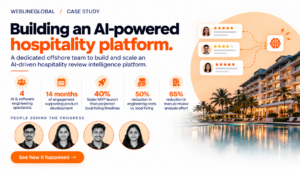
Hospitality Review Intelligence Product Development with Offshore AI Team