Table of Contents

Ohio has rapidly emerged as a significant technology hub, with cities like Columbus, Cleveland, and Cincinnati hosting a dense concentration of Fortune 500 companies and fast-growing startups. As these enterprises move toward cloud-native architectures and integrated intelligence, the traditional friction between development and operations has become a primary bottleneck. CTOs and VPs of Engineering are now faced with a critical strategic choice: should they invest in building a permanent in-house DevOps department, or should they leverage dedicated remote pods to handle the complexities of modern delivery pipelines? This decision is no longer just about headcounts, it is about speed to market, cost predictability, and the ability to integrate advanced capabilities like machine learning and automated agents.
The pressure to modernize is compounded by a tightening labor market. In the Midwest, finding senior DevOps engineers who understand the nuances of Kubernetes, Terraform, and multi-cloud security is increasingly difficult and expensive. Many Ohio-based firms are finding themselves competing for the same limited pool of talent as coastal tech giants. This competitive landscape is forcing leadership to look beyond local borders to maintain their innovation velocity. Whether you are leading a legacy manufacturing firm or a high-growth fintech startup, understanding the structural impact of your hiring model is the first step toward long-term operational excellence.
The Current Talent Landscape for Ohio Enterprises
The technology sector in Ohio is currently experiencing a paradox of growth and scarcity. While the state offers a lower cost of living and a stable business environment, the specific high-end skills required for modern DevOps and cloud orchestration are in short supply. Local enterprises often find that their internal HR teams are not equipped to vet specialized engineering talent, leading to long hiring cycles that can last six months or more. This delay creates a massive opportunity cost, particularly when competitors are shipping features weekly.
The Geographical Talent Gap
Ohio firms often look toward major tech hubs as a benchmark for excellence. For instance, many leadership teams believe they must hire AI developers from traditional centers of innovation to stay ahead of the curve. However, the cost of competing in these markets is astronomical. When you attempt to hire AI developers locally in Ohio, you are fighting a scarcity battle. If you look elsewhere, you are fighting a price battle. This reality is pushing many towards a dedicated pod model where they get the expertise without the local recruitment friction.
Competing with Coastal Benchmarks
It is common for Columbus-based enterprises to compare their tech stacks with those in Silicon Valley or Manhattan. This comparison often leads to the conclusion that specialized talent is the only way forward. For many, the first instinct is to hire AI developers who have experience in high-frequency environments. This is why many regional leaders investigate how to hire AI developers Ohio to bring that coastal rigor to their Ohio-based operations. However, the logistics of managing remote Ohio talent often prove as complex as the hiring itself.
Struggling to Choose Between In-House and Dedicated DevOps Teams?
Get a personalized DevOps strategy tailored for your Ohio enterprise. We’ll help you evaluate cost, scalability, AI-readiness, and delivery risk — before you make a hiring decision.
The True Cost of In-House DevOps Teams
Building an in-house team is often seen as the “safest” route because of the perceived control it provides. However, the total cost of ownership (TCO) for a full-time DevOps engineer in Ohio is far higher than the base salary suggests. Beyond benefits, taxes, and office space, there are the hidden costs of toolchain management and continuous training. In a field that changes as fast as DevOps, an in-house team can quickly become an echo chamber of legacy practices if not constantly challenged by external perspectives.
Recruitment and Retention Challenges
Hiring a senior DevOps professional in the current market requires more than just a competitive salary. You are competing against remote-first companies that offer global flexibility. For an Ohio enterprise, the risk of losing a key engineer to a coastal firm is a constant threat to project stability. When a key member of your in-house team leaves, the institutional knowledge gap they leave behind can stall your delivery pipeline for months. This is especially true when trying to hire AI agent developers or other niche roles that require months of onboarding.
Skill Stagnation and Technical Debt
In-house teams are often bogged down by day-to-day maintenance, leaving little room for experimentation with new technologies. This lack of exposure can lead to technical debt as the team sticks to “what works” rather than what is most efficient. To avoid this, many organizations choose to separate research and delivery functions, ensuring that one part of the team is focused on future-proofing while the other maintains the current infrastructure. Without this separation, your in-house team may struggle to implement the latest AI-driven automation tools effectively.
Advantages of the Dedicated DevOps Pod Model
A dedicated DevOps pod is a cohesive team of engineers provided by a partner like WeblineGlobal, who work exclusively on your projects. Unlike traditional staff augmentation, a pod comes with its own internal management structure and proven workflows. This model allows Ohio enterprises to scale their engineering capacity instantly without the long-term commitment of permanent hires. It provides a level of agility that is impossible to achieve through traditional HR processes.
Rapid Onboarding and Scalability
When you choose a dedicated team, the time-to-productivity is measured in days rather than months. These teams are already accustomed to working together and bring a library of pre-built scripts, templates, and best practices to your project. This is particularly valuable for businesses that need to review AI team structure and implement new cloud configurations quickly. If your project scope increases, you can add more engineers to the pod within a few weeks, providing a level of elasticity that in-house teams simply cannot match.
Access to Specialized Innovation
Dedicated pods often have experience across a wide range of industries and technologies. This cross-pollination of ideas is a major advantage. While an in-house team might only know your specific stack, a remote pod brings knowledge from dozens of other successful implementations. For companies looking to hire AI agent developers to automate internal operations, the dedicated model provides immediate access to experts who have already solved similar problems elsewhere, reducing the risk of expensive trial-and-error.
See Pre-Vetted DevOps & AI Engineers Ready to Deploy
Skip 6-month hiring cycles. Review curated developer profiles specialized in Kubernetes, Terraform, MLOps, AI agents, and fintech compliance — available to join within days.
No obligation. Just qualified talent aligned to your project goals.
Hiring AI Developers Ohio vs. Remote Dedicated Teams
Many decision-makers in the Midwest assume that the highest quality of engineering talent resides in the Ohio financial district or the tech hubs of Brooklyn. While it is true that these areas have a high concentration of talent, the logistical and financial hurdles of trying to hire AI developers Ohio are significant. The salary expectations in Ohio are often 50 to 100 percent higher than in the Midwest, and the competition for those individuals is fierce.
The Price of Coastal Talent
If you decide to hire AI developers Ohio, you are not just paying for their skills, you are paying for the Ohio cost of living. For an Ohio enterprise, this often results in a mismatched ROI. You can often hire a full dedicated pod of senior developers from a specialized vendor for the same price as one or two senior engineers in Manhattan. This allows you to achieve much more with your budget while still maintaining high standards of quality and communication.
The Distributed Team Reality
Modern DevOps is inherently a remote-friendly discipline. The tools used by these engineers, such as GitHub, Slack, and Jira, are designed for asynchronous and distributed work. Therefore, the physical location of the developer matters less than their ability to integrate into your workflow. Whether you choose to hire AI developers Ohio or opt for an offshore team in India, the management challenges are similar. The key differentiator is the delivery model and the level of accountability the vendor provides.
Fintech AI Hiring and Security Considerations
For Ohio’s growing financial services sector, the stakes are even higher. Fintech AI hiring requires a unique blend of data science expertise and a deep understanding of regulatory compliance. Security cannot be an afterthought; it must be baked into the DevOps process from the very beginning. When hiring for these roles, it is crucial to find engineers who understand SOC2, PCI-DSS, and the complexities of securing AI models in production environments.
Balancing Innovation and Compliance
In the fintech world, the tension between moving fast and staying secure is constant. Dedicated DevOps pods specialized in fintech can help bridge this gap by implementing automated compliance checks within the CI/CD pipeline. This allows you to hire AI developers who can focus on building features while the DevOps pod ensures that every deployment meets strict security standards. This specialized focus is often missing in generalist in-house teams.
Maintaining Data Integrity in AI Workflows
As you integrate machine learning into your financial products, the infrastructure must support large-scale data processing while maintaining strict access controls. This is where fintech AI hiring becomes a strategic infrastructure decision. Your DevOps team must be capable of managing data lakes and feature stores that are both performant and secure. Choosing a partner who understands these requirements is essential for any Ohio financial institution looking to modernize.
Managing the AI Research vs Delivery Teams
A common mistake made by many enterprises is failing to distinguish between the needs of research and the needs of delivery. Ai research vs delivery teams have fundamentally different goals and timelines. Researchers are focused on model accuracy and experimentation, which can be unpredictable. Delivery teams, on the other hand, are focused on reliability, scalability, and uptime. If you do not separate research and delivery functions, you risk creating a bottleneck where research projects never make it into a production environment.
Defining Clear Roles and Responsibilities
When you review the AI team structure, it becomes clear that DevOps acts as the glue between these two worlds. A dedicated DevOps pod can provide the standardized environment that researchers need to test their models, while also ensuring that those models can be deployed as robust microservices. This separation of concerns allows each team to focus on its core strength. This is why many successful Ohio firms choose to separate research and delivery early in their AI journey.
The Role of MLOps in Modern DevOps
The convergence of machine learning and operations, known as MLOps, is the next frontier for DevOps teams. This requires a specific set of skills that goes beyond traditional infrastructure management. When you hire AI developers Ohio or look for dedicated remote pods, you should specifically look for experience in model monitoring and automated retraining. Without these capabilities, your AI initiatives will struggle to scale beyond the initial pilot phase.
Evaluating Risk and Ensuring Delivery
Regardless of the hiring model you choose, managing delivery risk is the top priority for any VP of Engineering. With in-house teams, the risk is often centered on recruitment and retention. With remote pods, the risk is centered on communication and alignment. At WeblineGlobal, we mitigate these risks through our RelyShore model, which combines the scale of Indian engineering with the accountability of US-based management. This ensures that Ohio enterprises get the cost benefits of offshore hiring without sacrificing quality or control.
IP Protection and Communication Protocols
When working with remote teams, concerns about intellectual property and data security are paramount. It is essential to partner with a vendor that has strict NDAs, secure access controls, and a transparent communication structure. You should be able to review the AI team structure and see exactly who is working on your project and their progress at any given time. Regular stand-ups and transparent reporting are the foundation of a successful dedicated pod engagement.
The Strategic Advantage of Flexibility
One of the greatest risks in technology is being locked into a rigid structure that cannot adapt to market changes. The dedicated pod model offers a month-to-month flexibility that in-house hiring cannot match. If your business priorities shift, you can pivot your engineering resources without the pain of layoffs or expensive severance packages. This adaptability is a key reason why more Ohio-based CXOs are moving away from permanent hiring and toward a more elastic engineering workforce.
The Path Forward for Ohio Tech Leadership
Choosing between an in-house team and a dedicated DevOps pod is not a one-time decision, it is an ongoing strategic evaluation. For most Ohio enterprises, a hybrid approach often works best. Keeping a small, core in-house team to manage high-level strategy and architectural decisions while using dedicated pods for execution and specialized tasks provides the best of both worlds. This allows you to hire AI agent developers and other experts on a project basis while maintaining your internal culture.
As you evaluate your options, consider the long-term goals of your organization. Are you looking to build a massive internal department, or are you looking to build a fast, lean, and agile delivery machine? Contact us to leverage remote talent and specialized pods, and you can compete with the tech giants of Ohio and Silicon Valley while staying rooted in the Ohio business community. The future of engineering is not defined by where your team sits, but by how efficiently they can turn ideas into production-ready code.
Social Hashtags
#DevOps #MLOps #CloudEngineering #AIInfrastructure #CIO #OhioTech #ColumbusTech #ClevelandTech #CincinnatiTech #MidwestTech #TechHiring #RemoteTeams #OffshoreDevelopment #EngineeringLeadership #DigitalTransformation #FintechAI #AIAgents
Ready to Scale Without Hiring Delays?
Build a dedicated DevOps pod aligned to your delivery roadmap — fully managed, secure, and accountable. Reduce costs, accelerate releases, and integrate AI capabilities without long-term hiring risk. Let’s design your execution model today.
Frequently Asked Questions
While local hires offer face-to-face interaction, the scarcity and high cost of senior talent in Ohio make remote pods a more scalable and cost-effective choice for most enterprises. Pods provide immediate access to a broader range of skills and can be scaled up or down based on your project needs.
Successful alignment starts with a robust onboarding process and a clear communication framework. Using a model like RelyShore ensures that there is a bridge between your business goals and the technical execution, with regular checkpoints and transparent reporting to keep everyone on the same page.
Most organizations see a cost reduction of 40 to 60 percent when compared to the total cost of ownership of an in-house team. These savings come from reduced recruitment costs, lower base salaries, and the elimination of benefits and overhead associated with full-time employees.
Yes, provided the vendor follows strict security protocols such as SOC2 compliance and uses secure VPNs and encrypted environments. Dedicated pods can be integrated into your existing security framework to ensure that all compliance requirements are met while maintaining high delivery velocity.
Typically, we can provide a shortlist of vetted developers within 48 hours, and a full pod can be operational within two to three weeks. This is significantly faster than the three to six months usually required to hire an in-house senior DevOps engineer in the Ohio market.


Success Stories That Inspire
See how our team takes complex business challenges and turns them into powerful, scalable digital solutions. From custom software and web applications to automation, integrations, and cloud-ready systems, each project reflects our commitment to innovation, performance, and long-term value.
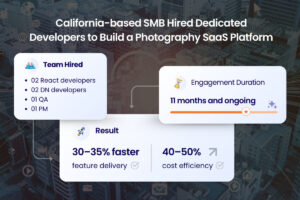
California-based SMB Hired Dedicated Developers to Build a Photography SaaS Platform
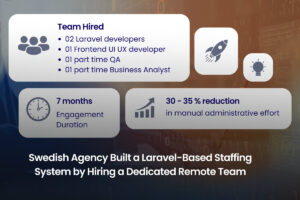
Swedish Agency Built a Laravel-Based Staffing System by Hiring a Dedicated Remote Team