Table of Contents

Canadian enterprises are currently facing a complex crossroads in technical talent acquisition. As the demand for digital transformation, cloud migration, and AI integration accelerates, the domestic pool of engineering talent in hubs like Toronto, Vancouver, and Montreal has become increasingly competitive and expensive. For a CTO or VP of Engineering, the challenge is no longer just about finding a developer, it is about building a sustainable, high-velocity engineering engine that can scale without the prohibitive overhead of local market wars. This realization is driving a significant shift toward distributed engineering models that leverage global talent while maintaining the rigorous standards required by Canadian corporate governance.
Managing these distributed teams effectively requires more than just a Slack channel and a Jira board. It demands a sophisticated approach to vendor selection, cultural integration, and operational synchronization. When you decide to hire dedicated developers Canada enterprises often look for partners who understand the nuances of the North American business landscape while providing the scalability of offshore centers. The goal is to move away from simple staff augmentation toward a “pods” model where external teams act as a seamless extension of the internal engineering department, sharing the same goals, quality benchmarks, and delivery accountability.
Understanding the Landscape of Distributed Engineering Canada Enterprises
The Canadian enterprise sector is unique due to its heavy emphasis on regulatory compliance, data residency, and a highly collaborative work culture. Navigating these requirements while working with teams thousands of miles away requires a deliberate strategy. Leaders must evaluate how a distributed model fits into their existing product roadmap and whether their internal infrastructure is ready to support a hybrid workforce.
The Talent Deficit and the Push for Global Reach
The primary driver for looking beyond Canadian borders is the sheer scarcity of specialized roles. Whether it is a backend engineer proficient in legacy system modernization or a frontend expert specialized in React, the time to hire locally can often exceed six months. This delay represents a significant opportunity cost. By choosing to hire enterprise developers from established global hubs, companies can reduce the time-to-hire to a matter of weeks, ensuring that critical projects stay on track and market windows are not missed.
Evaluating Technical Debt and Future Scalability
Enterprises often carry significant technical debt that requires careful handling during team expansion. A distributed team must be capable of not only writing new features but also understanding the architectural constraints of existing systems. This is why the evaluation process must focus on senior-level experience rather than just junior headcount. When you hire dedicated developers Canada, the focus should be on their ability to integrate with your current tech stack and provide long-term maintainability.
Assessing the Cost of Local Seniority
The cost of a senior engineer in a Canadian city can often exceed 150,000 to 200,000 CAD per year, excluding benefits and overhead. When you multiply this across a team of ten, the burn rate becomes a board-level concern. Transitioning to a distributed model in India can reduce these costs by 40 to 60 percent, allowing the same budget to fund a much larger, more diverse engineering team.
Schedule a Consultation to evaluate your distributed team requirements.
Strategic Decision-Making: How to Hire Dedicated Developers Canada
Choosing a partner to help you scale is perhaps the most critical decision a technical leader will make. The market is saturated with agencies, but very few understand the “enterprise” part of the equation. It is not just about coding, it is about communication, security, and consistent delivery. You need a partner that acts as a consultant, helping you navigate the pitfalls of remote management while providing the right talent for your specific use case.
The Shift from Individual Hires to Dedicated Pods
While hiring a single developer can fill a temporary gap, enterprises benefit most from dedicated “pods.” A pod typically includes a mix of developers, a QA lead, and sometimes a project manager or Scrum Master. This structure ensures that the team is self-governing and reduces the management burden on your internal tech leads. To truly optimize your workflow, it is often better to hire IT consultants who can help design these team structures before the first line of code is written.
Identifying the Right Skill Composition
A common mistake is hiring a team of “generalists” for a specialized project. If you are building a SaaS platform, you need developers who understand multi-tenancy and high-availability architectures. If you are working on a FinTech application, security and data integrity are paramount. Decision-makers should demand detailed profiles that highlight project-specific experience, not just a list of programming languages. This level of vetting ensures that when you hire dedicated developers Canada, the team is ready to contribute from day one.
The Importance of Senior Oversight
Every distributed team needs a “bridge” person, a senior engineer or architect who understands the business requirements and translates them into technical tasks. Without this oversight, technical drift is inevitable. We often recommend that our clients identify an internal champion to work closely with the offshore lead to ensure alignment on architectural standards and coding practices.
Request Developer Profiles for your upcoming enterprise project.
Operational Governance and Synchronicity
The biggest fear most CTOs have regarding distributed engineering Canada enterprises is the loss of control. How do you know people are working? How do you ensure code quality? The answer lies in governance. By establishing clear KPIs, daily stand-ups that overlap with Canadian business hours, and automated CI/CD pipelines, you can maintain the same level of oversight as you would with an in-office team.
Time Zone Management and Communication Stacks
Working with a team in India while based in Toronto or Vancouver requires a specific communication rhythm. Usually, a 2 to 3-hour overlap in the morning or evening is sufficient for synchronous meetings. The rest of the work can be done asynchronously. This “follow-the-sun” model can actually be an advantage, as the offshore team can resolve bugs or implement features while the Canadian team is asleep, leading to a 24-hour development cycle. To make this work, you need to support enterprise delivery by investing in clear documentation and robust project management tools.
The RelyShore Model: Quality and Accountability
At WeblineGlobal, we utilize the RelyShore model to bridge the gap between India-based delivery and North American expectations. This involves a US-based management layer that provides accountability and ensures that the technical output meets the highest standards. It provides Canadian enterprises with the peace of mind that their intellectual property is protected and that there is a local point of contact for any escalation or strategic planning.
Automating Code Reviews and Quality Gates
Automation is the best friend of a distributed manager. By implementing strict linting rules, automated unit tests, and mandatory peer reviews, you can ensure that the code coming from your remote team is indistinguishable from your local team’s output. This removes subjectivity from performance evaluations and focuses entirely on the technical truth of the codebase.
Hire Dedicated Developers to scale your engineering capacity today.
Risk Mitigation: Security, IP, and Compliance
For any Canadian enterprise, especially those in healthcare, finance, or government contracting, security is non-negotiable. When you hire dedicated developers Canada, you must ensure that the vendor has stringent physical and digital security measures in place. This includes secure ODC (Offshore Development Center) environments, encrypted hardware, and strict access controls that align with your corporate security policies.
Legal Protections and Data Residency
One of the first questions board members ask is about Intellectual Property. It is vital to work with a partner who provides clear, US or Canada-governed contracts that explicitly state that all IP belongs to the client. Furthermore, while the developers may be remote, the data should stay on your servers. Modern cloud infrastructure allows remote teams to work within your VPC (Virtual Private Cloud), ensuring that sensitive data never leaves your controlled environment. It is always wise to review distributed teams and their security protocols before signing a long-term contract.
Vetting for Communication and Soft Skills
A developer who is a genius at coding but cannot explain their logic is a liability in a distributed environment. Soft skills are as important as technical ones. We focus heavily on vetting for English proficiency, proactive communication, and the ability to ask the right questions. This reduces the “ping-pong” effect where tasks are misunderstood and time is wasted on rework.
Cultural Alignment and Team Integration
Successful distributed engineering Canada enterprises treat their remote developers as part of the family. This means including them in company all-hands meetings, sharing the broader business vision, and celebrating milestones together. When a developer feels a sense of ownership over the product, their productivity and loyalty increase significantly, leading to lower turnover and higher quality output.
Schedule a Consultation to discuss your security and compliance needs.
Cost-Benefit Analysis: The ROI of Distributed Teams
The financial justification for distributed engineering is usually the easiest part of the conversation, but it must be viewed holistically. It is not just about the lower hourly rate, it is about the total cost of ownership. This includes recruitment fees, office space, hardware, benefits, and the hidden costs of management overhead. When these are factored in, the savings are often even more substantial than initially projected.
Scalability and Month-to-Month Flexibility
Enterprise needs fluctuate. You might need a surge of twenty developers to hit a product launch date and then scale back to a core maintenance team of five. Local hiring makes this nearly impossible due to labor laws and the difficulty of finding talent on short notice. A dedicated team model offers the flexibility to scale up or down with relatively short notice, providing the agility that modern enterprises require to stay competitive. This is why many leaders choose to hire enterprise developers through a flexible engagement model.
Case Study: Reducing Time-to-Market by 40 Percent
Consider a scenario where a mid-sized Canadian insurance firm needed to rebuild its customer portal. By hiring a dedicated pod in India, they were able to bypass the local 4-month hiring cycle. The pod started within three weeks and, using an agile methodology, delivered the MVP two months ahead of the original internal estimate. The cost savings were reinvested into a new AI-driven analytics feature that gave them a significant market advantage.
Long-term Value vs. Short-term Savings
The goal is never just to save money in the short term, it is to build a long-term partnership that yields continuous value. A stable distributed team gains deep institutional knowledge over time, making them faster and more efficient with every sprint. This “compounding interest” of knowledge is what truly drives the ROI of distributed engineering Canada enterprises.
Establishing the Right Framework for Success
Managing distributed engineering teams is a journey of continuous improvement. It requires a shift in mindset from “managing people” to “managing outcomes.” When you have the right partner, the right talent, and the right governance in place, the geographical distance becomes irrelevant. The focus shifts back to where it belongs: building great products that drive business growth.
Choosing Your Partnership Path
Do you need a few individual contributors to boost your velocity, or do you need a fully managed pod to take over a specific product line? Assessing your internal management capacity is the first step. If your current tech leads are underwater, a managed pod with its own lead is the better choice. If you have strong internal management but just need more hands on deck, staff augmentation is the way to go. To make an informed choice, you should hire IT consultants to audit your current workflow and recommend the best path forward.
Final Thoughts for Canadian Tech Leaders
The decision to expand your engineering team internationally is no longer a radical move; it is a strategic necessity. Contact us to leverage the vast talent pool in India. WeblineGlobal is a trusted partner that Canadian enterprises can have to overcome the local talent crunch, significantly reduce costs, and maintain the high standards of delivery their customers expect. The future of engineering is distributed, and the leaders who embrace this now will be the ones who lead the market in the years to come.
Moving Forward with Confidence
As you look to review distributed teams and plan your next hire, remember that transparency and alignment are your most valuable assets. Start small if you must, but start with a partner who understands your long-term vision and has the infrastructure to support it. The transition to a distributed model is an investment in your company’s future agility and competitive edge.
Social Hashtags
#DistributedEngineering #RemoteTeams #HireDevelopers #CanadianTech #TechLeadership #OffshoreDevelopment #GlobalTalent #CTOInsights #EngineeringManagement #DigitalTransformation #AIIntegration #CloudMigration #StartupScaling #ITOutsourcing #AgileDevelopment
Schedule Developer Interviews to find your next engineering lead.
Frequently Asked Questions
We typically establish a daily overlap period of 2 to 3 hours for synchronous meetings and handovers. The rest of the work is managed through clear documentation and asynchronous communication tools, creating a continuous 24-hour development cycle that can actually speed up project delivery.
Yes, we use US or Canada-governed contracts that guarantee full IP ownership to our clients. Additionally, we implement strict security protocols, including working within your secure cloud environment, ensuring that data never leaves your control.
We can typically provide a shortlist of pre-vetted candidates within 48 hours. Depending on your interview process and the complexity of the roles, most teams are fully onboarded and productive within 2 to 3 weeks.
Absolutely. You have full control over the selection process. We present you with vetted profiles, and you can conduct as many rounds of technical and cultural interviews as you need to feel confident in the team.
We offer a month-to-month flexibility model. If a developer is not meeting your expectations, we will work to resolve the issue or provide a replacement at no extra cost, ensuring your project momentum remains uninterrupted.



Success Stories That Inspire
See how our team takes complex business challenges and turns them into powerful, scalable digital solutions. From custom software and web applications to automation, integrations, and cloud-ready systems, each project reflects our commitment to innovation, performance, and long-term value.
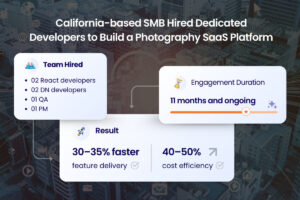
California-based SMB Hired Dedicated Developers to Build a Photography SaaS Platform
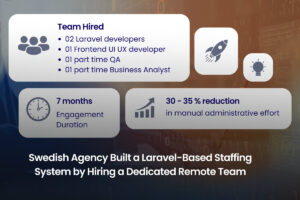
Swedish Agency Built a Laravel-Based Staffing System by Hiring a Dedicated Remote Team