Table of Contents

The race to integrate artificial intelligence within the California tech ecosystem has created a unique set of challenges for CTOs and founders. While the region remains the global epicenter for innovation, the rush to deploy generative models and automated systems often leads to foundational errors that can drain venture capital and stall product-market fit. Many leaders find themselves caught between the need for speed and the reality of high local engineering costs, leading to a landscape where technical debt is accrued faster than actual product value.
Operational success in AI does not just come from the complexity of the algorithms but from the structure of the team and the robustness of the data pipeline. Decision-makers often underestimate the shift from a prototype to a production-ready system, resulting in predictable but avoidable pitfalls. By understanding these nuances, leaders can more effectively hire AI developers who understand the balance between research-heavy experimentation and the engineering discipline required for enterprise-grade software.
The Strategic Pitfall: Solving Problems That Do Not Exist
One of the most frequent early stage ai mistakes California companies make is falling in love with the technology before identifying a concrete business problem. In a market saturated with AI hype, it is easy to dedicate significant resources to building complex LLM wrappers or predictive models that lack a clear ROI. This often leads to hiring expensive local talent to build features that customers do not actually want or need. When you hire AI developers, the focus should be on their ability to translate business requirements into technical specifications rather than just their proficiency in specific libraries.
Building for the Demo Versus Building for the Customer
Early-stage startups often prioritize the “wow factor” of an AI demo to secure the next funding round. While this is necessary for investor relations, it often creates a gap in the operational roadmap. A common mistake is neglecting the long-term maintenance and monitoring requirements of AI systems. If the decision-makers do not review AI readiness early in the process, they risk building a fragile system that fails once it encounters real-world data variability. This strategic misalignment is a primary reason why many California AI projects struggle to scale past the seed stage.
The High Cost of Misaligned Talent
Hiring for a research-oriented role when the project needs a production engineer is a costly error. Many founders look to hire AI developers with PhDs in machine learning, only to realize that 80 percent of the work involves data cleaning and API integration. This mismatch leads to high turnover and wasted capital, especially in the competitive California talent market, where salaries are at an all-time high.
To mitigate these risks, many organizations are now looking at specialized delivery models like the RelyShore℠ model. This approach combines US-based strategic assurance with the technical scale of India-based teams. By doing so, companies can avoid early AI mistakes related to over-hiring for the wrong skill sets at the wrong stage of the project.
Building AI too fast can cost you millions in rework and missed market fit. Avoid the most common early-stage AI mistakes with expert guidance before you scale.
The Talent Acquisition Bottleneck in Silicon Valley
The pressure to hire AI developers California founders face is immense. Local competition from tech giants means that early-stage startups are often outbid for top-tier talent. This scarcity leads to a hiring compromise where companies either overpay for mediocre local talent or hire junior developers who lack the experience to navigate complex AI deployments. Understanding the trade-offs between local and remote teams is critical for maintaining a sustainable burn rate while achieving technical milestones.
The Hidden Costs of Local Recruitment
Beyond the base salary, the operational overhead of maintaining an entirely local team in California includes significant benefits packages, office space, and the continuous risk of talent poaching. When founders attempt to hire AI developers California exclusively, they often limit their ability to scale their engineering pods quickly. A more balanced approach involves keeping a core leadership team in the US while leveraging dedicated offshore teams for the heavy lifting of development and testing. This strategy helps to avoid early AI mistakes associated with scaling too slowly or running out of runway before the product is ready for market.
Speed to Market and Team Composition
In the AI space, speed is a competitive advantage. Waiting three to six months to find the perfect local hire can be a death sentence for an early-stage project. By expanding the search to pre-vetted remote developers, companies can receive shortlists within 48 hours and have a full team integrated within weeks. This agility allows leaders to review AI readiness and pivot their strategy based on real-time feedback rather than waiting on a stagnant hiring pipeline.
Effective team composition often requires a mix of data scientists, backend engineers, and DevOps specialists. Many leaders fail to hire cloud & devops engineers early enough, leading to bottlenecks during deployment. Without the right infrastructure support, even the most advanced AI models will fail to perform consistently in a live environment.
Data Architecture and Infrastructure Oversights
A recurring theme in early stage ai mistakes California startups experience is the lack of a robust data strategy. AI is only as good as the data it is trained on, yet many teams treat data ingestion as an afterthought. This leads to “garbage in, garbage out” scenarios where models produce unreliable results, damaging the product’s credibility with early adopters. Leaders must ensure that when they hire AI developers, they are also investing in the data engineering necessary to fuel those models.
The Pipeline Problem: Why Models Fail in Production
Transitioning from a Jupyter notebook to a production-scale pipeline is where most AI projects falter. The lack of standardized data versioning and automated testing is a hallmark of an immature AI operation. To prevent this, it is essential to hire cloud & devops engineers who can build resilient CI/CD pipelines specifically for machine learning (MLOps). These engineers ensure that the model remains performant as new data flows in and that any drifts in accuracy are detected and corrected immediately.
Cost Management in the Cloud
Early-stage AI projects can quickly rack up massive cloud bills if the infrastructure is not optimized. Many founders do not review AI readiness from a financial perspective, leading to shock when they see the cost of GPU instances and data storage. Proper cloud orchestration is vital for keeping costs under control. When you hire cloud & devops engineers, their role includes optimizing these resources to ensure the project remains viable as it scales from ten users to ten thousand.
Leveraging a month-to-month hiring flexibility model, such as the one offered by WeblineGlobal, allows startups to adjust their team size based on current infrastructure needs. This flexibility is key to managing the ebbs and flows of early-stage development without the long-term commitment of high local salaries. It allows companies to avoid early AI mistakes related to rigid, high-cost internal structures.
Struggling with hiring the right AI talent or scaling your data pipelines? Access pre-vetted AI engineers, DevOps specialists, and flexible teams aligned to your project stage.
Integration and Deployment Challenges
Even with great talent and a solid model, the integration phase is where many operational mistakes occur. AI is rarely a standalone product; it must integrate with existing SaaS platforms, mobile apps, or enterprise systems. Failure to account for these integration points early on is a common mistake among California startups. Leaders need to hire AI developers who possess strong full-stack or backend skills to ensure the AI components work harmoniously within the larger software ecosystem.
Bridging the Gap Between Research and Engineering
There is often a cultural divide between pure AI researchers and software engineers. Researchers focus on accuracy and novelty, while engineers focus on stability and latency. A major operational mistake is allowing these two groups to work in silos. To avoid early AI mistakes, leaders should implement cross-functional pods where research and engineering happen concurrently. This ensures that the technical requirements of the deployment environment are considered from day one of the research phase.
Security, IP Protection, and Compliance
For California-based companies, protecting intellectual property and ensuring data privacy is paramount. When you hire AI developers California or elsewhere, you must have strict NDAs and access controls in place. The RelyShore℠ model emphasizes IP protection and transparent pricing, providing US-based assurance for offshore delivery. This level of security is necessary to review AI readiness for enterprise clients who demand high standards of data governance.
Maintaining Performance at Scale
As the user base grows, the AI system must maintain its response times and accuracy. This requires ongoing monitoring and periodic retraining of models. If a company fails to hire cloud & devops engineers to manage this lifecycle, the user experience will inevitably degrade. Scaling an AI project is a continuous process, not a one-time event, and the team structure must reflect that reality.
A Strategic Roadmap for AI Hiring
The decision to hire AI developers California founders make should be driven by a clear understanding of the project’s phase and technical requirements. For many, the most effective path involves a hybrid model. By maintaining a local product and strategy lead in California and a dedicated engineering pod in India, companies can achieve the perfect balance of cost, speed, and quality. This approach allows the organization to avoid early AI mistakes of overspending on local talent while still maintaining full control over the project’s direction.
Evaluating Vendors and Engineering Partners
When selecting a partner to help scale your AI team, look for established firms with a track record of delivery. WeblineGlobal, with over 25 years of experience and more than 3,500 projects delivered, provides the quiet credibility needed for such high-stakes decisions. The ability to shortlist vetted talent within 48 hours and offer 40 to 60 percent cost savings over local hiring makes it a compelling option for those looking to review AI readiness and execute quickly.
Final Considerations for CTOs
Building an AI product in the current California landscape requires more than just technical brilliance; it requires operational maturity. Every hiring decision should be evaluated based on its impact on delivery risk and scalability. Whether you need to hire AI developers for a new feature or hire cloud & devops engineers to stabilize your platform, the goal is to build a team that can adapt to the rapid changes in the AI field without compromising on business fundamentals.
By learning from the common early stage ai mistakes California startups often fall into, you can position your company for long-term success. Focus on clear objectives, robust data pipelines, and a flexible hiring strategy that leverages the best global talent available. This strategic approach ensures that your AI initiatives move beyond the hype and deliver real, sustainable value to your customers.
Social Hashtags
#AIStartups #ArtificialIntelligence #MachineLearning #AITalent #TechStartups #MLOps #DataEngineering #AIProjects #StartupGrowth #SiliconValley #AIHiring #CloudComputing #DevOps #AIInnovation #TechLeadership
Ready to build scalable AI without overspending on local talent? Let’s design your ideal team structure and roadmap for faster, cost-efficient execution.
Frequently Asked Questions
The most common mistakes include hiring expensive research talent too early, neglecting data infrastructure, and building products without a clear business ROI. Many founders also fail to plan for the long-term cloud costs and the operational complexities of maintaining AI models in production.
While local hires offer proximity, the high cost and scarcity of talent in California can slow down development. A hybrid model, where strategic leadership is local and a dedicated engineering pod is remote, often provides the best balance of speed, cost efficiency, and technical quality.
To avoid these mistakes, start with a clear problem statement, prioritize data engineering alongside model development, and review AI readiness frequently. Using flexible hiring models like staff augmentation allows you to scale the team as the project's needs evolve without being locked into high overhead costs.
You should hire cloud & devops engineers as soon as you move beyond the initial prototyping phase. They are essential for building the MLOps pipelines and infrastructure required to deploy, monitor, and scale AI models reliably in a production environment.
WeblineGlobal provides pre-vetted remote developers from India with a US-based delivery model (RelyShore℠). We provide shortlists within 48 hours, allowing you to hire specialized AI and cloud talent at 40 to 60 percent lower costs than local California hiring, while ensuring IP protection and project control remain with the client.

Success Stories That Inspire
See how our team takes complex business challenges and turns them into powerful, scalable digital solutions. From custom software and web applications to automation, integrations, and cloud-ready systems, each project reflects our commitment to innovation, performance, and long-term value.
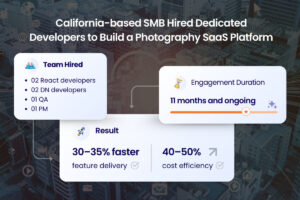
California-based SMB Hired Dedicated Developers to Build a Photography SaaS Platform
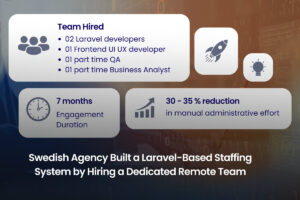
Swedish Agency Built a Laravel-Based Staffing System by Hiring a Dedicated Remote Team