Table of Contents

The financial technology landscape in New York is currently defined by a high-stakes race to integrate generative AI and predictive modeling into consumer-facing products. However, seasoned CTOs and VPs of various enterprises are discovering a painful truth: the brilliant researchers who build breakthrough models are rarely the right people to ensure those models run reliably at scale. This friction has led to a fundamental shift in organizational design where research is isolated from the product delivery pipeline to protect the stability of the core platform.
By separating these functions, leadership teams can allow data scientists to experiment without the constraints of production uptime, while engineering teams focus on the rigors of deployment, security, and cost-efficiency. This transition highlights a critical need for specialized infrastructure support. Many firms now look beyond local talent pools to hire cloud engineers in California to leverage the deep scaling expertise born in Silicon Valley, ensuring that their AI innovations do not crumble under the weight of real-world financial traffic.
The Strategic Conflict Between Discovery and Delivery
Defining the Research Mindset
AI research is inherently experimental and non-linear. Researchers need the freedom to fail, to iterate on datasets, and to explore architectural variations that may never see a production environment. When these teams are forced into the same sprint cycles as product delivery, the pressure to ship often stifles the very innovation the company is trying to foster. For a FinTech firm, this can mean the difference between a mediocre chatbot and a market-leading predictive trading engine. Leaders are realizing that to move fast in the lab, you must remove the burden of the factory.
The Rigor of Product Delivery
On the other side of the fence, product delivery is about predictability, security, and user experience. In the FinTech world, there is no room for “hallucinations” or system downtime. Delivery teams must focus on high-availability, SOC2 compliance, and latency. When research code is pushed directly into production without a proper engineering handoff, the result is often technical debt that takes years to clear. This is why many organizations choose to hire IT consultants to audit the bridge between these two distinct cultures and establish better delivery protocols.
Balancing Innovation and Stability
The core challenge for a CXO is finding the equilibrium. If you lean too hard into research, you have a science project that earns no revenue. If you lean too hard into delivery, you risk being disrupted by a more innovative competitor. Establishing a dedicated delivery pod that specializes in taking raw models and hardening them for the cloud is the most effective way to solve this. When you hire cloud engineers California style, you are essentially buying the experience of developers who have handled the massive scale of Big Tech, which is vital for New York firms facing rapid user growth.
Scaling AI Without Risk Starts With the Right Architecture
New York FinTech leaders are separating AI research from product delivery to protect uptime, security, and cloud spend.
Talk with our cloud strategy experts to understand where your delivery pipeline is at risk—before scale exposes it.
Infrastructure as the Foundation of AI Success
The Hidden Costs of AI Scaling
Scaling AI is not just about computing power; it is about data orchestration and cost management. Without a dedicated infrastructure team, the cloud bill for a new AI feature can quickly eclipse the revenue it generates. This is where optimizing cloud costs becomes a primary business objective rather than a technical afterthought. Decision-makers must evaluate whether their current team has the bandwidth to manage both the product logic and the underlying Kubernetes clusters or serverless environments that power the AI.
Why Infrastructure Scaling Fails in Silos
When research teams manage their own infrastructure, they often over-provision resources to ensure their experiments run quickly. While this works in a lab, it is a disaster for a company’s bottom line in production. Effective infrastructure scaling requires a dedicated focus on automation and resource tagging. By choosing to hire cloud engineers California talent markets or via remote dedicated pods, FinTechs can implement the sophisticated orchestration required to scale down resources during low-traffic periods, directly impacting the ROI of the entire AI initiative.
Leveraging Cloud Native Expertise
Cloud-native development is a specific discipline that many traditional FinTech developers are still learning. The move toward microservices and containerized AI models requires a deep understanding of the cloud ecosystem. Many New York leaders are finding that local hiring is too slow and expensive for these specialized roles. As a result, they are turning to staff augmentation models to quickly hire cloud and DevOps engineers who can hit the ground running without the overhead of a six-month local recruitment cycle.
Optimizing the Talent Mix for FinTech Growth
The Case for Staff Augmentation in Infrastructure
Hiring a full-time, local team for every niche infrastructure need is rarely sustainable for a growing FinTech. The volatility of the AI market means your talent needs might change in six months. This is why the ability to plan hiring during optimization is so valuable. It allows leadership to keep a lean core team of strategic architects while using remote pods to handle the heavy lifting of migration, monitoring, and cloud cost optimization hiring. This flexibility ensures that the company can pivot without the pain of large-scale layoffs or talent shortages.
Bridging the Geo-Gap in Engineering Culture
There is a distinct difference in engineering culture between the financial centers of the East Coast and the tech hubs of the West Coast. New York firms often excel at domain-specific logic, while West Coast engineers excel at platform scale. By looking to hire cloud engineers California or remote teams trained in those methodologies, FinTech leaders can inject a “platform-first” mentality into their delivery pipeline. This cultural blend is often the secret sauce for startups that manage to scale to millions of users without major outages.
Risk Mitigation in Vendor Selection
When selecting a partner to help scale your engineering team, the criteria must go beyond price. For CXOs, the primary concerns are delivery risk and IP protection. Working with an established entity like WeblineGlobal assures a US-based presence combined with the scale and cost-efficiency of offshore developers in India. This model ensures that while you hire cloud engineers California or remote hubs, your project management and legal protections remain robust and transparent, mitigating the risks typically associated with remote scaling.
Turn AI Experiments Into Production-Ready FinTech Systems
If your data scientists are stuck in deployment or your cloud bills are climbing, it’s time to reinforce delivery.
We help FinTechs hire cloud and DevOps engineers experienced in scaling AI platforms securely and cost-efficiently—without long local hiring cycles.
The Economics of Separating Research and Delivery
Calculating the ROI of Specialized Teams
On the surface, maintaining two separate tracks for AI sounds expensive. However, when you factor in the cost of delayed releases and the high salaries of data scientists doing “grunt work” on infrastructure, the specialized model is actually more cost-effective. Data scientists are at their highest value when they are refining algorithms. If they are spending 40 percent of their time debugging deployment scripts, the company is losing money. It is more efficient to hire cloud and DevOps engineers who can build the pipelines that allow researchers to deploy with a single click.
Addressing Cloud Cost Optimization Hiring
As AI models grow in complexity, the compute requirements grow exponentially. Hiring specifically for cloud cost optimization is no longer a luxury for FinTechs. You need engineers who understand how to use spot instances, how to optimize data egress fees, and how to right-size GPU clusters. These are highly specific skills. When you hire cloud engineers California or utilize dedicated pods from WeblineGlobal, you gain access to professionals who have seen these cost patterns before and know how to prevent “bill shock” after a major product launch.
Scalability as a Competitive Advantage
In a market where multiple companies are offering similar AI features, the winner is often the one who can provide the fastest, most reliable service. Scalability is a feature in itself. If your AI-driven credit scoring takes thirty seconds because of poor infrastructure, you will lose to the competitor whose system takes three seconds. This is why the decision to plan hiring during optimization is so critical. You aren’t just cutting costs, you are improving the product performance that drives customer retention.
A Strategic Roadmap for FinTech Leaders
Phase 1: Audit and Separation
The first step for any CTO is to audit where their team’s time is actually going. Are your researchers stuck in DevOps hell? If so, it is time to draw a hard line between the “Research Lab” and the “Product Factory.” This separation should be reflected in your hiring plan. You don’t need more data scientists; you likely need to hire IT consultants to help architect the handoff process and identify the gaps in your delivery pipeline.
Phase 2: Targeted Talent Acquisition
Once the gaps are identified, the focus shifts to talent acquisition. For many NY-based firms, the fastest way to bridge the gap is to hire cloud engineers California or look toward pre-vetted remote developers. This allows the firm to scale the delivery side of the house without waiting months for local hires to clear the background checks and notice periods of other local banks. Remote pods can be integrated into existing Slack and Jira workflows in as little as 48 hours, providing immediate relief to overstretched teams.
Phase 3: Continuous Infrastructure Scaling
Engineering is not a “one and done” task. As user behavior changes and AI models evolve, the infrastructure must adapt. By maintaining a relationship with a flexible staffing partner, FinTechs can scale their cloud engineering team up or down based on the product roadmap. This level of agility is what allows smaller FinTechs to outmaneuver legacy banks that are bogged down by rigid, local-only hiring mandates and outdated infrastructure.
Choosing the Right Partner for the Journey
Why WeblineGlobal for FinTech Infrastructure
Navigating the complexities of FinTech requires more than just coding skills, it requires a partner who understands the stakes of the financial industry. WeblineGlobal has spent over two decades helping global brands like Siemens and ICICI scale their engineering efforts. Our RelyShore model is designed to provide the cost benefits of developers in India while maintaining the high standards of communication and delivery expected by US-based leaders. We enable you to hire cloud engineers California quality at a fraction of the cost, ensuring your AI product delivery is as innovative as your research.
Retaining Control and IP Security
One of the biggest hurdles in remote hiring is the fear of losing control over the project or the IP. At WeblineGlobal, we prioritize transparency. Our clients retain full control over the development process, and our developers operate as a natural extension of your internal team. With robust NDAs and IP protection protocols, you can focus on scaling your infrastructure and AI capabilities without worrying about the security of your core intellectual property. This makes it easier to plan hiring during optimization phases without compromising on safety.
Building for the Future of Finance
The separation of research and delivery is not just a trend, it is the new standard for high-growth FinTech. As the industry moves toward more complex AI applications, the need for robust, scalable, and cost-efficient cloud infrastructure will only grow. By choosing to hire cloud engineers California or leveraging our dedicated remote pods, you are positioning your firm to lead the next wave of financial innovation with a foundation that is built to last.
Social Hashtags
#FinTech #AIinFinance #FinTechLeadership #CloudEngineering #AIInfrastructure #DevOps #ProductDelivery #CTOStrategy #FinTechScaling #GenerativeAI #CloudCostOptimization #TechLeadership #NYFinTech
Build AI That Scales—Without Compromising Stability or IP
Whether you need a dedicated delivery pod, cloud cost optimization experts, or California-grade cloud engineers, we provide pre-vetted remote specialists who integrate seamlessly into your team.
Get access to proven engineers who have scaled AI systems for high-growth FinTechs—without delivery risk or IP concerns.
Frequently Asked Questions
Local hiring in New York for cloud roles is highly competitive and often leads to long lead times and excessive salaries. Hiring remote cloud engineers, particularly through the RelyShore model, allows you to access a broader talent pool and fill roles in days rather than months, while reducing costs by 40 to 60 percent.
Researchers often prioritize model accuracy over compute efficiency. By having a dedicated delivery team, you can ensure that models are optimized for production, which includes implementing auto-scaling and resource management strategies that significantly lower cloud bills.
With WeblineGlobal, we can often provide a shortlist of pre-vetted candidates within 48 hours. This allows you to start the interview process and have developers integrated into your team much faster than traditional recruitment methods.
Yes, provided you work with a partner that has established security protocols. We emphasize IP protection, secure access controls, and compliance-aware development practices to ensure your data and systems remain secure, regardless of where the developer is located.
Absolutely. Many of our clients start with one or two augmented developers to solve an immediate bottleneck and then transition to a dedicated pod as their product delivery needs become more complex and require a cohesive team structure.



Success Stories That Inspire
See how our team takes complex business challenges and turns them into powerful, scalable digital solutions. From custom software and web applications to automation, integrations, and cloud-ready systems, each project reflects our commitment to innovation, performance, and long-term value.
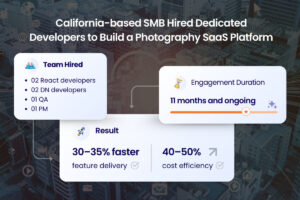
California-based SMB Hired Dedicated Developers to Build a Photography SaaS Platform
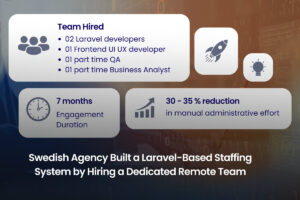
Swedish Agency Built a Laravel-Based Staffing System by Hiring a Dedicated Remote Team