Table of Contents

INTRODUCTION
While working on a customized workflow automation platform for a rapidly scaling SaaS provider, our team deployed an instance of n8n on a modern cloud Platform-as-a-Service (PaaS). The system was designed to orchestrate complex internal pipelines, which required deep integration with enterprise tools, specifically Google Workspace services like Gmail and Google Sheets.
Everything functioned flawlessly until we attempted to authenticate the Google services via OAuth2. During a routine integration test, we encountered a hard-blocking Google OAuth Error 400: invalid_request. The error explicitly stated that the application did not comply with Google’s OAuth 2.0 policy, halting our automation flows entirely.
In a production-grade automation system, authentication failures create immediate downstream bottlenecks. Data synchronization stops, alerts fail to fire, and business processes grind to a halt. We quickly realized this was not a simple typo in a configuration screen, but a deeper misalignment between the PaaS routing layer, the automation engine’s internal environment variables, and Google’s stringent security validations. This challenge inspired the following architectural breakdown, detailing how we diagnosed and resolved the problem so other engineering teams can avoid the same deployment trap.
PROBLEM CONTEXT
The business use case required deploying a dedicated, scalable n8n instance to automate user onboarding and data reporting workflows. To maintain infrastructure agility, the application was hosted on a container-based PaaS utilizing ephemeral routing domains. The architecture relied on an ingress reverse proxy managing SSL termination and routing traffic to the internal n8n container.
To enable the Google integrations, we configured a standard Google Cloud OAuth 2.0 Client ID. We extracted the client ID and client secret and populated them securely into the n8n credentials manager. The intention was simple: allow internal administrators to authenticate their Google accounts so the automation engine could programmatically read from specific spreadsheets and send triggered emails.
WHAT WENT WRONG
Despite setting up the OAuth consent screen in testing mode and explicitly adding the administrator’s email as a test user, any attempt to authenticate triggered a Google block screen. The exact error surfaced as:
Access blocked: Authorization Error
Error 400: invalid_request
You can't sign in to this app because it doesn't comply with Google's OAuth 2.0 policy
The immediate instinct was to inspect the request payload. In the error URL, the redirect URI was visibly appended:
redirect_uri=https://automation-instance.cloud-paas.dev/rest/oauth2-credential/callback
We verified the Google Cloud Console. The exact same URI was registered under the “Authorized redirect URIs” section. The match was 100% character-for-character. The application was in Testing mode, and the user attempting to log in was definitively listed in the test users array. Symptoms pointed toward a hidden mismatch or a missing platform-level verification that caused Google to reject the callback context entirely.
HOW WE APPROACHED THE SOLUTION
When redirect URIs match visually but an OAuth provider still throws a policy error, the root cause usually lies in HTTP headers, domain trust, or underlying environment variables dictating how the application constructs its callback state.
We systematically evaluated the deployment architecture. First, we reviewed the PaaS ingress rules. When an application sits behind a load balancer or reverse proxy, the proxy handles HTTPS, but forwards the request to the application container via HTTP. If the application is unaware it sits behind a proxy, it might generate internal states or subsequent API calls expecting HTTP instead of HTTPS, causing subtle validation failures during the OAuth token exchange.
Next, we analyzed Google’s Trust & Safety mechanisms. Google frequently updates its OAuth 2.0 policies to combat phishing. Shared or ephemeral domain suffixes (like the default subdomains provided by cloud hosting platforms) are often heavily scrutinized. Even if the full URI is authorized, the top-level or registered domain must be explicitly whitelisted in the OAuth Consent Screen’s “Authorized domains” list.
Finally, we examined the n8n container configuration. By default, n8n attempts to infer its webhook and callback URLs from the incoming request headers. If the reverse proxy modifies or strips the Host or X-Forwarded-Proto headers, the application constructs an inconsistent internal URL map, failing Google’s strict state and origin checks.
FINAL IMPLEMENTATION
To permanently resolve the Error 400, we implemented a three-part configuration update targeting the container environment variables, reverse proxy trust, and Google Cloud domain policies.
1. Explicit Application Environment Variables
We updated the container deployment file to explicitly define the application’s base URL and webhook endpoints, forcing it to stop relying on incoming proxy headers for URL generation.
WEBHOOK_URL=https://automation-instance.cloud-paas.dev
N8N_HOST=automation-instance.cloud-paas.dev
N8N_PROTOCOL=https
N8N_EDITOR_BASE_URL=https://automation-instance.cloud-paas.dev
2. Reverse Proxy Trust Configuration
Because the container was deployed on a PaaS with an ingress layer, we had to instruct the node application to trust the reverse proxy. We appended the proxy hops variable to ensure X-Forwarded-Proto headers were respected during the OAuth sequence.
N8N_PROXY_HOPS=1
3. Google Cloud Consent Screen Domain Whitelisting
In the Google Cloud Console, navigating simply to “Credentials” and adding the Redirect URI was insufficient. We navigated to the “OAuth consent screen” settings, scrolled down to “Authorized domains”, and explicitly added the root domain of our PaaS provider (e.g., cloud-paas.dev). Google requires the base domain of any callback URI to be registered here, a step easily missed when utilizing auto-generated PaaS subdomains.
Following a container restart and a flush of the browser cache, the OAuth flow completed seamlessly. The internal state matched the external URI perfectly, and the reverse proxy correctly forwarded the SSL context.
LESSONS FOR ENGINEERING TEAMS
Resolving cloud integration errors requires a comprehensive understanding of network topology, application state, and third-party security policies. Here are the core insights engineering leaders should apply:
- Never Rely on Implicit URL Generation: Always hardcode your base URLs and webhook URIs in your production environment variables. Applications inferring their own hostnames behind load balancers invite subtle OAuth mismatches.
- Understand Proxy Trust: Modern platforms terminate SSL at the edge. Ensure your backend applications are configured to trust reverse proxies so they correctly interpret secure forwarded headers.
- Authorized Domains Matter: A matching redirect URI is not enough for modern identity providers. The root domain must always be whitelisted in the identity provider’s consent configuration.
- Evaluate PaaS Domain Scrutiny: Shared subdomains provided by cloud hosts are often flagged by OAuth providers. Whenever possible, bind a custom, verified domain to your production instances.
- Align Technical Expertise: Debugging layer-7 networking and integration issues requires deep full-stack knowledge. When teams hire software developer talent, they must ensure candidates understand the infrastructure layers beneath the code. If your organization is looking to hire backend developers for API integrations, prioritize those with strong proxy and identity management experience. Likewise, if you plan to hire cloud architecture developers for PaaS deployments or hire automation developers for workflow systems, ensuring they understand OAuth policies is critical for system resilience.
WRAP UP
The Google OAuth Error 400 invalid_request in cloud-hosted automation environments is rarely a simple typo. By establishing explicit environment variables, configuring reverse proxy trust, and aligning with Google’s strict domain policies, we restored full functionality to our client’s critical workflow platform. Architecture is about controlling the variables you know and securing the boundaries between the systems you don’t. If your enterprise is navigating complex deployment architectures and needs experienced engineering partners, feel free to contact us.
Social Hashtags
#n8n #OAuth #GoogleOAuth #WorkflowAutomation #DevOps #CloudArchitecture #APIIntegration #BackendDevelopment #AutomationTools #PaaS #CloudDeployment #GoogleCloud #SoftwareEngineering #TechTutorial #DeveloperGuide
Frequently Asked Questions
Google evaluates more than just the exact string match. It verifies the Authorized Domains in the consent screen, the origin of the request, and internal security policies regarding shared or ephemeral domains often used by PaaS providers.
It tells the application how many reverse proxies sit in front of it. This allows the application to trust the X-Forwarded-For and X-Forwarded-Proto headers, ensuring it knows the original request was made over HTTPS rather than internal HTTP.
While Testing status requires you to manually add test user emails, it does not bypass domain authorization checks. Even in Testing mode, your base domain must be whitelisted, and your webhook URLs must be securely configured.
Yes. Utilizing a verified custom domain instead of a shared PaaS subdomain significantly reduces the likelihood of automated security blocks from third-party APIs like Google and Microsoft.

Success Stories That Inspire
See how our team takes complex business challenges and turns them into powerful, scalable digital solutions. From custom software and web applications to automation, integrations, and cloud-ready systems, each project reflects our commitment to innovation, performance, and long-term value.
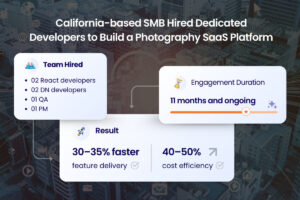
California-based SMB Hired Dedicated Developers to Build a Photography SaaS Platform
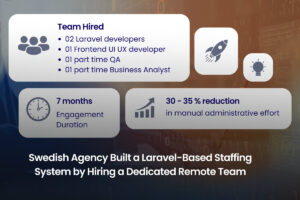
Swedish Agency Built a Laravel-Based Staffing System by Hiring a Dedicated Remote Team