Table of Contents

INTRODUCTION
Visual workflow automation tools often mask the complex asynchronous realities of the underlying code. During a recent project for a global logistics SaaS platform, our team was tasked with building a high-throughput order processing and routing engine using N8N. The workflow integrated multiple external APIs, legacy ERP systems, and a central MySQL database.
We encountered a situation where the visual representation of our workflow directly contradicted the actual execution order in production. We had placed a MySQL write node at the very beginning of the flow to log an “Order Processing Started” status, and another at the very end to log “Order Processing Completed”. Bizarrely, the final “Completed” log was being written to the database before the “Started” log.
Initially, this felt like a simple timing issue, but even after inserting artificial delays—using “Sleep” nodes—the behavior persisted. The N8N execution logs revealed that the first MySQL node was essentially stuck in a state of “waiting for end of stream,” deferring its commit until the entire pipeline finished executing. This anomaly threatened our system’s audit trail integrity.
When engineering leaders hire software developer teams to build scalable automations, they expect bulletproof state management. This challenge inspired this article, detailing how we uncovered the underlying Node.js stream mechanics and enforced strict execution order to avoid out-of-sequence database operations.
PROBLEM CONTEXT
In our logistics use case, real-time auditability was non-negotiable. Customer service agents relied on the database to track exactly where a shipment was in the automated routing process. Our N8N workflow architecture was designed sequentially:
- Step 1: Webhook receives raw shipment data.
- Step 2: MySQL Node writes an initial tracking record (Status: PENDING).
- Step 3: Multiple HTTP Request nodes fetch routing requirements from third-party APIs.
- Step 4: Data Transformation nodes normalize the API responses.
- Step 5: MySQL Node updates the tracking record (Status: ROUTED).
In a synchronous paradigm, Step 2 must finish before Step 3 begins. However, when we queried the MySQL database during execution, the Step 5 update would appear, and milliseconds later, the Step 2 insert would overwrite or conflict with the state. The workflow’s visual graph showed sequential lines, but the database connection pooling and Node.js event loop were telling a different story.
WHAT WENT WRONG
To understand the failure, we had to peel back the visual layer of N8N and analyze its Node.js foundation. N8N processes items in arrays and relies heavily on asynchronous promises and streams for performance.
When the first MySQL node executed its query, it opened a stream. Instead of resolving the database commit synchronously and closing the connection before passing the data payload to the next node, the MySQL driver (in conjunction with the node’s internal promise resolution) kept the stream open, waiting for an “end of stream” signal. Because Node.js is non-blocking, N8N passed the data object forward to the HTTP Request nodes while the first MySQL query remained pending in the background.
The workflow raced ahead. By the time it reached the final MySQL node, the workflow triggered its final flush. The closure of the workflow execution finally sent the “end of stream” signal back to the pending promises. Because the final node’s query was smaller or executed differently, it committed to the database just before the first node’s buffered stream finally flushed and committed.
Adding a “Sleep” node in the middle did not solve the problem because `setTimeout` (which powers the sleep function) merely pauses the traversal of the execution graph; it does not force an open database stream to flush and close.
HOW WE APPROACHED THE SOLUTION
Our goal was to enforce strict synchronous blocking. We needed the database to guarantee the commit of Step 2 before the N8N engine was allowed to invoke Step 3. We considered three architectural approaches:
- Approach 1: Connection Pooling Tuning. We looked at modifying the MySQL node connection settings to disable streaming entirely. While possible at the driver level, native N8N nodes abstract much of this away, making it a brittle solution that could break on updates.
- Approach 2: Custom Code Node. We considered writing a custom JavaScript node using the `mysql2` npm package with forced `await` promises to handle the inserts manually. While this works, it defeats the purpose of using a low-code automation platform’s native integrations.
- Approach 3: Sub-Workflow Isolation. We evaluated using the “Execute Workflow” node to modularize the database writes. By placing the initial write in a sub-workflow and configuring the parent workflow to wait for its complete resolution, we could force a synchronous execution boundary.
We opted for Approach 3, combined with explicit data mapping isolation, to ensure scalability. When you hire database developers for enterprise integrations, ensuring that transaction boundaries are respected across microservices or workflow engines is a primary architectural mandate.
FINAL IMPLEMENTATION
We resolved the issue by breaking the monolithic workflow into modular, synchronous components. Here is the technical implementation we deployed to production.
1. Implementing Sub-Workflow Boundaries
Instead of placing the MySQL write directly in the main flow, we moved it to a dedicated sub-workflow called “DB-Write-Pending-State”. In the main flow, we replaced the first MySQL node with an Execute Workflow node.
Crucially, we configured the Execute Workflow node with the setting: Wait for execution to finish set to true. This forced the parent workflow’s Node.js event loop to block progression until the sub-workflow fully resolved, inherently closing any open database streams and guaranteeing the commit.
2. Sanitizing the Item Array
N8N passes data as an array of items. Sometimes, a MySQL node keeps a stream open if it anticipates more items in the array. We added an Item Lists node before the Execute Workflow node to ensure only a single, explicit JSON object was passed to the database, signaling to the query executor that the batch was complete.
3. Verifying the Execution
To validate the fix, we implemented a custom snippet in a Code Node immediately following the sub-workflow to retrieve the auto-increment ID generated by MySQL. If the ID was missing, the workflow would throw a hard error and halt, preventing race conditions.
// Validation Code Node Payload
const dbResult = $items("Execute Workflow - Initial DB Write")[0].json;
if (!dbResult || !dbResult.insertId) {
  throw new Error("Synchronous DB commit failed. Halting workflow to prevent out-of-order execution.");
}
// Pass the validated ID forward to subsequent API calls
return [{
  json: {
    ...$input.item.json,
    internalTrackingId: dbResult.insertId
  }
}];
This implementation successfully forced the MySQL nodes to execute and commit in the exact sequential order required by the business logic.
LESSONS FOR ENGINEERING TEAMS
Workflow automation engines require the same rigorous architectural thinking as traditional software development. When organizations hire backend developers for workflow automation, these are the lessons they should apply:
- Visual Sequentiality is an Illusion: Just because two nodes are connected by a line does not guarantee synchronous execution at the infrastructure level. Always account for asynchronous streams and Node.js event loop mechanics.
- Sleep Does Not Flush Streams: Inserting artificial delays pauses execution traversal but does not close open promises, streams, or uncommitted database connections. Rely on architectural boundaries, not timers.
- Use Sub-Workflows as Transaction Boundaries: Modularizing workflows into sub-workflows with strict “wait for completion” toggles is the safest way to enforce synchronous data commits.
- Validate Before Proceeding: Always query the result of a critical database operation (like an insert ID) and evaluate it in the next step before triggering external API calls. This guarantees the data was written.
- Manage Batch Sizes: Be aware of how automation tools pass arrays. Ensure that data structures are explicitly flattened or chunked to prevent the engine from waiting for additional stream data.
WRAP UP
Debugging an asynchronous out-of-order execution bug inside a visual workflow tool reminds us that low-code platforms are still governed by code. By understanding the underlying Node.js stream behavior and leveraging sub-workflows to enforce hard execution boundaries, we stabilized the logistics platform’s data integrity.
Building reliable, enterprise-grade automated systems requires deep understanding of both the tools and the runtime environments they operate on. If your organization is facing similar integration complexities and needs dedicated expertise, contact us to learn how WeblineGlobal can help you scale your engineering capabilities.
Social Hashtags
#n8n #WorkflowAutomation #MySQL #NodeJS #AsyncProgramming #AutomationTools #DevOps #BackendDevelopment #LowCode #ProcessAutomation #DatabaseManagement #SoftwareEngineering #APIIntegration #SaaSDevelopment #TechDebugging
Frequently Asked Questions
n8n is built on Node.js and processes data in memory. For databases like MySQL, streaming prevents memory exhaustion when dealing with large datasets by processing rows in chunks rather than loading an entire massive result set or payload into memory at once.
The Sleep node utilizes Node.js timers (`setTimeout`). It pauses the execution of subsequent nodes, but it does not tell the Node.js event loop to flush open I/O streams or resolve pending database connection promises from previous nodes.
While sub-workflows are the cleanest architectural pattern, you can sometimes force synchronous behavior by writing custom promises in a Code node, or by chaining a direct read query immediately after the write query to force the driver to await the commit.
When workflows scale beyond simple point-to-point data transfers and begin handling complex orchestrations, parallel processing, custom API integrations, and database transaction management, dedicated Node.js expertise is critical to prevent race conditions and memory leaks.



Success Stories That Inspire
See how our team takes complex business challenges and turns them into powerful, scalable digital solutions. From custom software and web applications to automation, integrations, and cloud-ready systems, each project reflects our commitment to innovation, performance, and long-term value.
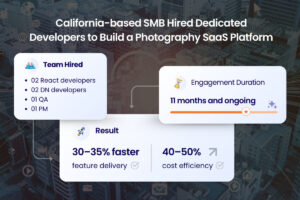
California-based SMB Hired Dedicated Developers to Build a Photography SaaS Platform
Swedish Agency Built a Laravel-Based Staffing System by Hiring a Dedicated Remote Team