Table of Contents

As a technology leader in the Pennsylvania corridor, from the rising tech hubs of Pittsburgh to the established financial and healthcare corridors of Philadelphia, you face a unique set of challenges when scaling a digital portfolio. Managing a single application is a standard engineering task, but coordinating the user experience across a multi-product platform is a strategic exercise in systems thinking. When your organization expands from one core product to a suite of interconnected services, the frontend is no longer just a layer of the stack, it becomes the glue that holds your brand identity and user trust together. Hiring for this level of complexity requires more than just finding someone who knows CSS and JavaScript, it requires a plan that accounts for shared component libraries, cross-application state management, and unified design language.
The local talent market in Pennsylvania is competitive, with major institutions and tech giants often vying for the same pool of senior engineers. For a CTO or VP of Engineering, the decision of how to scale a team must balance the need for deep domain knowledge with the reality of budget constraints and speed to market. This guide provides a framework for Pennsylvania-based leaders to navigate the intricacies of frontend hiring for complex, multi-product environments. We will explore how to identify the right talent, structure your teams for maximum efficiency, and leverage offshore expertise to augment your local core without sacrificing quality or delivery speed.
The Strategic Burden of Multi-Product UI Architecture
When a company operates multiple products, the frontend team faces a exponential increase in complexity. You are no longer building isolated features, you are building a ecosystem. This shift requires a different breed of developer, one who understands how changes in a shared component library might impact five different products simultaneously. If you do not plan your hiring with this in mind, you risk creating a fragmented user experience that feels like five different companies built five different tools. This fragmentation leads to higher cognitive load for users and significantly increased maintenance costs for your engineering department.
Transitioning from Product-Centric to Platform-Centric Frontend
The first step in your hiring plan is recognizing that multi-product platforms require platform engineers who specialize in frontend. These developers focus on the underlying architecture that supports multiple user interfaces. When you look to hire frontend developers, you must evaluate their experience with monorepos, micro-frontends, and shared design systems. A developer who has only worked on standalone SaaS applications may struggle with the collaborative and systemic requirements of a platform-wide UI strategy.
The Importance of Design System Governance
A multi product ui survives or fails based on its design system. Hiring a lead frontend developer who can double as a design system architect is a priority. This individual should be able to bridge the gap between your UX designers and the engineering team, ensuring that reusable components are not just built, but documented and versioned correctly. This role is critical for Pennsylvania firms that need to maintain a cohesive brand presence across diverse verticals such as fintech, healthcare, and industrial IoT.
Evaluating Systemic Thinking in Interviews
During the vetting process, ask candidates how they would handle a breaking change in a shared navigation component. Their answer will reveal if they think about the immediate fix or the ripple effect across the entire product suite. This distinction is vital when you need to plan frontend capacity for long-term growth.
Planning a Multi-Product Frontend Platform?
Scaling a multi-product UI requires more than hiring developers—it needs the right frontend architecture and team model. Speak with experts who’ve helped Pennsylvania companies avoid costly UI fragmentation and technical debt.
Navigating the Pennsylvania Talent Market for Frontend Excellence
The Pennsylvania tech landscape is diverse, but it has its limitations. While cities like Philadelphia and Pittsburgh offer a strong pool of talent from top-tier universities and established tech firms, the demand for senior engineers often outstrips the supply. Local companies must compete with New York and DC salaries, making it difficult to scale a large frontend team entirely with local hires. This economic reality necessitates a hybrid approach where high-level strategy is handled locally, while execution is supported by a global talent pool.
The Cost vs. Value Equation in Local Hiring
Hiring a senior developer in Philadelphia or Pittsburgh comes with a high price tag, often exceeding six figures plus benefits and overhead. When you need to hire React.js developers for a multi-product platform, you are likely looking for someone with at least five to seven years of experience. For many Pennsylvania startups and mid-market firms, hiring four or five such individuals is a significant financial burden. The goal is to maximize the value of these local hires by positioning them as team leads or architects who oversee broader delivery teams.
Why Companies Hire Frontend Developers Pennsylvania via Hybrid Models
A hybrid model allows you to maintain a core presence in Pennsylvania while leveraging the cost efficiencies of offshore teams. This approach provides the best of both worlds: local leaders who understand the business context and the time-zone benefits of a domestic presence, paired with the scale and speed of a dedicated offshore pod. WeblineGlobal has helped many organizations navigate this balance, providing pre-vetted talent that integrates seamlessly into existing Pennsylvania-based workflows. This ensures that the review multi-product UI needs are handled with both local context and global execution power.
Building Dedicated Frontend Pods for Multi-Product Success
For organizations managing multiple product lines, the “pod” model is often more effective than a generic resource pool. A pod is a cross-functional team that stays dedicated to a specific product or a set of shared services. This structure fosters deep domain knowledge and accountability. When you search for hire frontend developers, consider how those individuals will fit into a pod structure that might include a product manager, a designer, and backend engineers.
Benefits of Dedicated Frontend Developers Pennsylvania
By utilizing dedicated frontend developers Pennsylvania leaders can ensure that their team members are not constantly context-switching between unrelated tasks. Context switching is the enemy of productivity, especially in a multi-product environment where the business logic of one tool might be drastically different from another. A dedicated developer understands the nuances of the specific product they are building, leading to fewer bugs and faster feature delivery.
Ensuring Communication and Cultural Alignment
One of the biggest risks in hiring remote or offshore developers is the potential for communication silos. In a multi-product setup, the frontend team must be in constant sync. We recommend a model where communication is transparent and integrated into your existing Slack or Jira environments. This ensures that whether a developer is sitting in Pittsburgh or working remotely, they are fully aligned with the product roadmap and the specific needs of the multi product ui.
Struggling to Scale Frontend Teams in Pennsylvania?
Whether you need platform architects, React specialists, or a dedicated frontend pod, we help PA companies extend their teams with vetted remote engineers—without sacrificing quality, communication, or delivery speed.
Vetting Technical Depth for Multi-Product Architectures
The technical requirements for a multi-product frontend are significantly higher than for a standard website. You need developers who are comfortable with complex state management, performance optimization at scale, and internationalization. If your platform serves different industries, the UI must be flexible enough to accommodate various user personas and regulatory requirements. This is why when you hire React.js developers, you shouldn’t just look for React knowledge, but for an understanding of the broader ecosystem.
Beyond the Basics: Advanced Frontend Skills
A senior developer in this space must be proficient in TypeScript to ensure type safety across large codebases. They should also understand how to optimize build tools like Webpack or Vite to manage large-scale applications efficiently. If your Pennsylvania-based company is scaling rapidly, you cannot afford the technical debt that comes from a “move fast and break things” mentality. You need a “build fast and scale reliably” approach.
The Role of Automated Testing in UI Scaling
In a multi-product environment, manual testing is impossible to sustain. Every new feature has the potential to break something in another part of the ecosystem. Therefore, your frontend hires must be advocates for automated testing, specifically unit tests with Jest and end-to-end testing with tools like Cypress or Playwright. This is a non-negotiable requirement when you plan frontend capacity for a mature enterprise platform.
Managing Delivery Risk and ROI in Frontend Outsourcing
Outsourcing frontend development is a common strategy for Pennsylvania companies looking to accelerate growth, but it is not without risks. The key to a successful engagement is not just finding the lowest cost, but finding a partner who understands the business implications of frontend decisions. A poor UI can lead to user churn, while a poorly architected frontend can slow down your entire development cycle for years. ROI is found in the balance of speed, cost, and long-term maintainability.
Mitigating Risks with Vetted Talent
The biggest risk in hiring remote developers is the “vouch factor.” How do you know if the person you are hiring is actually a senior-level engineer? This is where the RelyShore model from WeblineGlobal provides value. By pre-vetting developers for both technical skills and communication ability, we remove the guesswork from the hiring process. This allows Pennsylvania CTOs to review multi-product ui needs with confidence, knowing that the team assigned to them has already been tested in high-stakes environments.
Intellectual Property and Security Compliance
For industries like healthcare and finance, which are prominent in Pennsylvania, security and IP protection are paramount. Any hiring plan must include strict NDAs and secure development environments. When you engage with a vendor to hire frontend developers, ensure they have the infrastructure to protect your data and your source code. This includes secure access controls and a clear understanding of US-based compliance standards.
Financial Planning: Budgeting for a Multi-Product Frontend Team
Budgeting for a frontend team requires looking beyond the monthly invoice. You must consider the total cost of ownership, including the time spent by your internal team on management, the cost of potential delays, and the long-term cost of maintenance. A well-planned team structure can save a Pennsylvania company 40 to 60 percent compared to a purely local team, but only if the quality remains high.
Avoiding the Trap of “Cheap” Labor
There is a massive difference between a low-cost developer and a high-value offshore developer. The former often leads to a “rewrite” situation within 18 months, which effectively triples your costs. The latter integrates into your team, contributes to architectural decisions, and writes clean, maintainable code. When you hire React.js developers, focus on their track record with complex applications rather than just their hourly rate. This is the only way to ensure the long-term health of your multi product ui.
Flexibility and Scalability
One of the primary reasons Pennsylvania companies choose staff augmentation is the flexibility it offers. You can scale your team up during a major platform overhaul and scale back down once the project enters a maintenance phase. This month-to-month flexibility is crucial for managing burn rate while still hitting aggressive product milestones. When you plan frontend capacity, always look for partners who offer this level of agility.
Making the Final Hiring Decision
Deciding how to staff your frontend team is a high-stakes decision that will impact your product’s success for years. For Pennsylvania companies, the path forward involves a clear-eyed assessment of local talent limitations and a strategic embrace of global engineering resources. By focusing on systemic thinkers, prioritizing design system governance, and choosing a partner that understands the nuances of multi-product platforms, you can build a frontend that is as scalable as your business vision. Contact us if you need a single specialist or a full dedicated pod, as we provide solutions with no flaws in quality, communication, and architectural integrity.
Social Hashtags
#FrontendHiring #PennsylvaniaTech #MultiProductPlatforms #FrontendDevelopment #ReactDevelopers #TechHiring #CTOInsights #UIArchitecture #DesignSystems #StaffAugmentation #HireDevelopers
Get Pre-Vetted Frontend Developers for Your Platform
Review real developer profiles experienced in multi-product platforms, shared design systems, and large-scale React architectures. No obligation—just proven talent aligned with your technical and business goals.
Frequently Asked Questions
If you are managing more than two distinct products or a complex platform with a shared design system, a pod model is usually better. A pod provides a mix of skills and ensures that the frontend is not a bottleneck for your entire engineering organization. It also provides better coverage and reduces the risk associated with a single point of failure.
Beyond basic hooks and components, look for experience with federated modules, complex state management libraries like Redux or Recoil, and a deep understanding of React's rendering lifecycle. Experience with component-driven development tools like Storybook is also essential for maintaining a multi product ui.
We use a multi-stage vetting process that includes technical assessments, live coding sessions, and communication evaluations. Our developers are experienced in working with US-based firms and understand the expectations for code quality, documentation, and proactive problem-solving. This is part of our commitment to helping you hire frontend developers who can contribute from day one.
Yes, we encourage our clients to conduct their own interviews and technical screenings. We provide a shortlist of pre-vetted candidates, usually within 48 hours, so you can make an informed decision and find the perfect fit for your team's culture and technical requirements.
Most Pennsylvania-based companies see a cost reduction of 40 to 60 percent compared to hiring locally. These savings include not just the salary, but also the costs associated with benefits, office space, hardware, and recruiting fees. This allows you to reallocate your budget toward other growth initiatives while still maintaining a high-performing frontend team.

Success Stories That Inspire
See how our team takes complex business challenges and turns them into powerful, scalable digital solutions. From custom software and web applications to automation, integrations, and cloud-ready systems, each project reflects our commitment to innovation, performance, and long-term value.
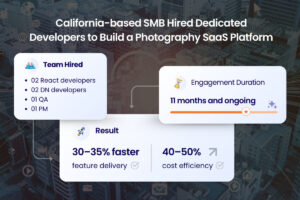
California-based SMB Hired Dedicated Developers to Build a Photography SaaS Platform
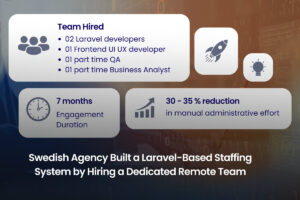
Swedish Agency Built a Laravel-Based Staffing System by Hiring a Dedicated Remote Team