
Table of Contents

HOW DID WE DISCOVER THE DUAL KNOWLEDGE GRAPH RETRIEVAL OVERLAP IN OUR RECENT PROJECT?
While working on an enterprise HR compliance platform for a global workforce management client, we encountered a fascinating architectural challenge. The system was designed to answer complex regulatory questions by cross-referencing internal corporate HR policies against regional labor laws. Given the strict accuracy requirements of legal and compliance data, we built a Graph-RAG (Retrieval-Augmented Generation) system powered by a dual-Knowledge Graph (KG).
During the initial testing phases of our QA pipeline, we realized a significant conceptual overlap. Our system was successfully connecting policy nodes to law nodes using an implementation edge, but the actual retrieval performance was not dramatically outperforming our baseline hybrid search (Dense Vector + BM25 + Reciprocal Rank Fusion + Reranker). We encountered a situation where traversing the graph felt like an expensive, indirect version of the exact same hybrid search we used to populate the graph in the first place.
This raised a critical architectural concern: if a Knowledge Graph is highly dependent on an original vector retrieval pipeline for edge creation, how do we ensure it provides independent, measurable value during query execution? This challenge inspired this article, aiming to help engineering teams properly utilize and evaluate KG-RAG systems without falling into the trap of redundant retrieval loops. Often, when organizations decide to hire software developer teams for advanced AI solutions, navigating these nuanced architectural trade-offs is where true engineering maturity shines.
WHY CONNECT TWO KNOWLEDGE GRAPHS IN A GRAPH RAG ARCHITECTURE?
The business use case demanded an engine capable of multi-source reasoning. If an employee asked, “Does our maternity leave policy comply with recent state regulations?”, the system needed to fetch the internal policy, fetch the relevant state law, compare them and generate an authoritative compliance check.
To support this, we modeled two distinct ontologies in Neo4j:
- Policy KG: Hierarchical representation of internal company handbooks, clauses and HR guidelines.
- Law KG: Structured representation of labor laws, statutes and regulatory articles.
To connect them, we established a relationship edge named IMPLEMENTS. The workflow for creating these edges during data ingestion was rigorous:
- Retrieve candidate law articles mapped to a specific policy article using hybrid retrieval.
- Pass the candidates through an LLM prompt to determine if and how the policy implements the law (e.g., complies, more favorable, less favorable, conflict).
- Store the validated relationships and metadata as IMPLEMENTS edges bridging the two KGs.
Conceptually, this created a rich, interconnected graph ready for complex compliance querying. However, introducing this architecture into the real-time retrieval flow introduced unexpected bottlenecks.
WHY DID GRAPH TRAVERSAL FEEL REDUNDANT COMPARED TO HYBRID SEARCH?
The issue surfaced when analyzing the query execution traces for compliance questions. We noticed that our retrieval strategy was unnecessarily convoluted.
In our initial indirect approach, the user’s question would trigger a vector search to find relevant Policy articles. The system would then traverse the IMPLEMENTS edge to fetch the connected Law articles. The problem was that these IMPLEMENTS edges were originally discovered using hybrid retrieval during data ingestion. Traversing the edge at query time was essentially replaying a static version of the vector search.
In contrast, a direct approach simply used the question to run a simultaneous hybrid retrieval against both the Policy and Law databases independently. This direct path was faster, less complex and often yielded the exact same pairs of documents.
The core oversight was treating the Knowledge Graph purely as a retrieval expansion tool rather than a deterministic reasoning layer. If a KG only adds relationships without aiding ontology reasoning or providing metadata that a vector search cannot, its real-time value diminishes. When tech leaders look to hire AI developers for production deployment, understanding the boundary between vector retrieval and graph traversal is a critical competency they expect.
HOW DID WE APPROACH THE SOLUTION FOR EFFECTIVE KNOWLEDGE GRAPH UTILIZATION?
To resolve this, we had to redefine the purpose of the KG in our retrieval pipeline. We stopped asking “How does the graph retrieve better?” and started asking “What unique context does the graph provide that vector similarity ignores?”
We mapped out the execution strategies for different query types (Compliance Check, Dual-Source Lookup, Policy-Only, Law-Only) and evaluated the trade-offs of relying on hybrid search versus graph traversal.
WHICH KNOWLEDGE GRAPH RETRIEVAL STRATEGIES DID WE CONSIDER?
We evaluated several distinct approaches for integrating the KG during the QA phase:
- Approach 1: Graph-driven Expansion (Context Bloat). Retrieving top matches via hybrid search, then fetching all connected nodes via the IMPLEMENTS edge. We discarded this because it artificially inflated the context window, slowing down the LLM and increasing costs without guaranteeing higher relevance.
- Approach 2: Graph as a Fallback (Siloed Search). Relying entirely on direct hybrid search, only querying the KG if the LLM flagged a lack of context. This proved too latent for real-time user queries.
- Approach 3: Same-Context Metadata Injection. Running direct hybrid search to fetch a fixed budget of Policy and Law articles, then querying the KG to see if those specific retrieved articles share an IMPLEMENTS edge. If they do, we inject the edge metadata (e.g., the LLM-generated compliance label and reasoning from ingestion) directly into the prompt.
- Approach 4: Multi-hop Reasoning Guardrails. Using the KG strictly for complex routing. For example, returning a policy answer but automatically querying the KG for conflict edges to warn the user of potential legal discrepancies.
We determined that Approaches 3 and 4 were the most robust. The KG is genuinely useful not as a blind retrieval mechanism, but as an explanation and reasoning layer that provides deterministic metadata to guide the LLM’s final generation.
HOW DID WE FINALIZE THE IMPLEMENTATION AND EVALUATION FRAMEWORK?
We implemented a context-budgeted routing architecture. The system intelligently alters its retrieval logic based on the intent of the question.
For a Compliance Check, the system executes a simultaneous hybrid search for the Top 3 Policy and Top 3 Law articles. It then passes these specific document IDs to the graph database to retrieve any connecting IMPLEMENTS edges. The LLM receives the source texts plus a structured JSON block detailing exactly how these texts are legally related based on the pre-computed graph metadata.
To prove that this Graph-RAG system mathematically outperformed standard setups, we designed a strict evaluation framework.
HOW DID WE EVALUATE AND COMPARE THE RAG SYSTEMS FAIRLY?
A common mistake in evaluating Graph-RAG is giving the graph model a larger context window than the baseline model, which skews results. We designed three systems with a strictly fixed context budget:
- System A: Basic BM25 RAG (Top 3 Policy, Top 3 Law).
- System B: Hybrid + Rerank (Top 3 Policy, Top 3 Law).
- System C (Fixed-Budget Graph RAG): Hybrid + Rerank (Top 3 Policy, Top 3 Law) + KG Metadata (pre-computed compliance labels, conflict reasons).
By keeping the text payload size identical across System B and System C, any improvement in generation quality could be definitively attributed to the Knowledge Graph’s structural metadata.
// Generic Implementation Logic for System C (Context Fixed)
function buildPromptPayload(query, retrievedPolicies, retrievedLaws) {
    let payload = {
        context: { policies: retrievedPolicies, laws: retrievedLaws },
        kgRelations: []
    };

    // Check graph for deterministic edges between retrieved documents
    const edges = graphClient.findEdgesBetween(
        retrievedPolicies.map(p => p.id),
        retrievedLaws.map(l => l.id),
        "IMPLEMENTS"
    );

    if (edges.length > 0) {
        payload.kgRelations = edges.map(edge => ({
            policy: edge.policyId,
            law: edge.lawId,
            status: edge.complianceStatus,
            rationale: edge.reasoning
        }));
    }
    return payload;
}
For evaluation metrics, a small curated QA set (50-100 highly complex legal questions) evaluated by domain experts is infinitely better than 1,000 auto-generated generic queries. We utilized RAGAS framework for structural metrics (Faithfulness, Context Precision, Answer Relevancy) and developed Custom Metrics specifically for the enterprise use case: Citation Accuracy (did it cite the correct law sub-clause?) and Compliance Classification Accuracy (did it correctly identify a conflict vs. an alignment?).
WHAT LESSONS CAN ENGINEERING TEAMS APPLY TO GRAPH RAG EVALUATIONS?
Implementing a dual-Knowledge Graph requires more than just connecting nodes. The architecture must serve a clear computational purpose. Here are actionable insights for teams designing complex AI workflows:
- Do not conflate search with reasoning. Use dense/hybrid vectors to find semantically relevant text. Use the Knowledge Graph to inject deterministic relationships, constraints and business logic that vectors cannot comprehend.
- Enforce a fixed context budget during A/B testing. If your KG simply stuffs more documents into the prompt than your baseline RAG, your evaluation is flawed. Test the KG’s impact by keeping the document count identical and only adding the graph’s relational metadata.
- Pre-compute heavy relationships during ingestion. If you use an LLM to evaluate compliance, do it once during the data pipeline and store it as an edge. Do not force the runtime LLM to re-evaluate raw texts if a validated relationship already exists in the graph.
- Rely on custom metrics for specialized domains. Generic RAGAS metrics track hallucination, but Custom Citation Accuracy and logical classification accuracy are mandatory for legal, medical and financial use cases.
- Dynamic routing is non-negotiable. Not every query requires a graph traversal. Build a query classifier that routes simple lookups to the vector database and complex multi-hop comparisons to the graph query engine.
- Hire specialized talent for data architectures. Graph databases require different optimization strategies than relational or vector stores. If you plan to hire Python developers for scalable data systems, ensure they possess hands-on experience with ontology mapping and graph traversal optimization.
WHAT ARE THE KEY TAKEAWAYS FOR HYBRID GRAPH RAG ARCHITECTURES?
Our journey connecting two distinct Knowledge Graphs revealed that the value of a graph in a RAG system isn’t always in finding new documents, but in explaining the relationship between the documents you already found. By shifting from a redundant retrieval loop to a fixed-budget metadata injection strategy, we significantly increased citation accuracy and compliance reasoning without bloating response times or token costs.
Building resilient, enterprise-grade AI systems requires architectural foresight, rigorous evaluation frameworks and a deep understanding of data layer trade-offs. If your organization is navigating complex data workflows and is looking to build dedicated engineering capabilities, contact us to explore how our pre-vetted teams can accelerate your technical delivery.
Social Hashtags
#GraphRAG #HybridRAG #KnowledgeGraph #RAG #RetrievalAugmentedGeneration #GenerativeAI #LLM #VectorSearch #AIEngineering #EnterpriseAI #Neo4j #RAGEvaluation
Frequently Asked Questions
Use vector search when queries rely on semantic similarity, fuzzy matching or unstructured concept retrieval. Introduce a Knowledge Graph when queries require multi-hop reasoning, deterministic rule enforcement or explicit relationship mapping (e.g., hierarchical permissions, regulatory compliance states) that vector proximity cannot guarantee.
Yes. If the edges of your Knowledge Graph are solely generated by unverified vector similarity scores, traversing the graph yields no independent value. Graph edges must contain validated, explicit relationships—often enriched by structured metadata, human review or secondary LLM reasoning—to provide value beyond the initial retrieval.
For highly specialized domains like law or enterprise policy, a meticulously curated set of 50-100 edge-case questions is sufficient for directional evaluation and A/B testing, provided the answers are scored by domain experts. It is highly preferable to thousands of synthetically generated, shallow questions. Many companies that hire dotnet developers for enterprise modernization use small, high-fidelity datasets to benchmark legacy migrations.
The system should degrade gracefully. If a hybrid search retrieves a Policy and a Law, but the KG shows no explicit IMPLEMENTS edge, the prompt should dynamically instruct the LLM to analyze the raw text for potential compliance, while explicitly stating in the generated answer that no pre-established legal connection exists in the corporate repository.
Context Precision measures whether the retrieved documents actually contain the information needed to answer the query (evaluating the retrieval layer). Answer Relevancy measures whether the final generated response directly addresses the user's question without adding unprompted or off-topic information (evaluating the generation layer).
Success Stories That Inspire
See how our team takes complex business challenges and turns them into powerful, scalable digital solutions. From custom software and web applications to automation, integrations, and cloud-ready systems, each project reflects our commitment to innovation, performance, and long-term value.
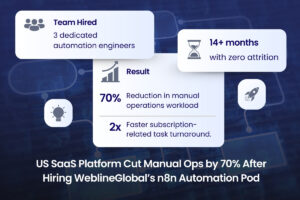
US SaaS Platform Cut Manual Ops by 70% After Hiring WeblineGlobal’s n8n Automation Pod
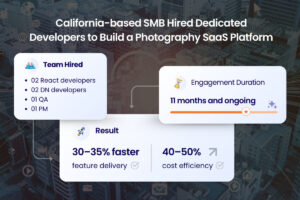
California-based SMB Hired Dedicated Developers to Build a Photography SaaS Platform