Table of Contents

Vancouver has long been celebrated as a premier tech hub, but for many founders, the period following initial product-market fit is where the real pressure begins. Once a startup moves beyond the seed stage and gains traction, the complexity of engineering management shifts from building a prototype to maintaining a high-performance engine. This transition brings a unique set of growth challenges faced by Vancouver startups after initial traction, primarily centered on the scarcity of senior talent and the skyrocketing costs of local overhead.
When you are in the growth phase, every hire is a strategic gamble. The local market in British Columbia is hyper-competitive, with global giants like Amazon and Microsoft often outbidding smaller firms for the same pool of talent. For a CTO or Founder, the objective shifts from simply finding a coder to identifying a sustainable way to scale. This is where the decision to hire dedicated developers in Vancouver becomes a pivotal part of the conversation, allowing leadership to bypass local recruitment bottlenecks and focus on delivery milestones rather than administrative hurdles.
The Engineering Talent Gap in the Pacific Northwest
The tech ecosystem in Vancouver is vibrant, but it is also constrained by its own success. As more capital flows into the region, the demand for senior engineering talent has far outpaced the local supply. This imbalance creates a significant hurdle for companies experiencing growth after traction Vancouver. Founders often find themselves in a perpetual cycle of recruiting, only to lose top-tier candidates to companies with deeper pockets or US-based remote offers.
The High Cost of Local Seniority
Maintaining an in-house team in downtown Vancouver involves more than just competitive salaries. You are looking at office space costs, local payroll taxes, benefits packages, and the high cost of living adjustments that candidates now expect. When you are trying to extend your runway, these fixed costs can become a weight that slows down your product roadmap. This financial pressure is one of the leading growth challenges faced by Vancouver startups after initial traction.
Competition with Global Tech Giants
Vancouver serves as a significant satellite hub for Silicon Valley firms. While this validates the local talent pool, it also means that your startup is competing for the same developers as trillion-dollar companies. These giants offer compensation packages that most growth-stage startups cannot match. To maintain your development velocity, you need a strategy that doesn’t rely solely on the local postal code. Many leaders choose to hire IT consultants to help bridge the gap between their current capacity and their long-term architectural goals.
Is your engineering team struggling to keep up with the roadmap? Schedule a consultation to discuss how to scale your capacity.
Technical Debt vs. Feature Velocity
One of the most common growth challenges faced by Vancouver startups after initial traction is the sudden realization that their “startup code” cannot support ten times the current user base. In the early days, speed is everything, and technical debt is a necessary evil. However, once you hit the growth phase, that debt starts accruing interest. You need engineers who can refactor existing systems while simultaneously shipping new features that investors and customers expect.
The Need for Specialized Knowledge
Scaling a database or moving to a microservices architecture requires a different mindset than building a Minimum Viable Product. You often need specific expertise in cloud orchestration, security protocols, or backend optimization that your original core team might lack. When you hire dedicated developers Vancouver, you gain the ability to bring in these specific skill sets on a dedicated basis, ensuring that your core team can stay focused on the product vision while the dedicated pod handles the heavy lifting of infrastructure scaling.
Balancing Maintenance and Innovation
It is a classic trap: the entire engineering team spends 80 percent of their time on bug fixes and 20 percent on new features. This is a recipe for losing market share. Growth-stage leaders often find that they need to hire full-stack engineers who can jump between frontend user experience and backend logic, providing the flexibility needed to address both maintenance and new development without doubling the headcount costs.
Architectural Scalability and Reliability
As traffic grows, system downtime becomes more expensive. The pressure to maintain 99.9 percent uptime while deploying code daily is a significant stressor for growth-stage startups. This requires rigorous QA processes and DevOps maturity. If your current team is stretched thin, the risk of a catastrophic failure increases. Bringing in an external dedicated team helps standardize these processes without the six-month lead time required for local hiring.
Don’t let technical debt stall your momentum. Hire developers who specialize in scaling high-growth platforms.
Financial Strategy for Sustainable Scaling
Capital efficiency is the metric that keeps founders awake at night. In the current economic climate, investors are looking for sustainable growth rather than growth at any cost. This shift makes the financial aspect of hiring even more critical. Startups in British Columbia must be extremely strategic about how they allocate their Series A or B funding. Spending the majority of your capital on a small local team can be a risky move if you need a larger workforce to hit your targets.
Reducing Burn Rate Without Sacrificing Quality
By deciding to hire dedicated developers Vancouver through a remote model, companies can often reduce their engineering costs by 40 to 60 percent. This isn’t just about lower wages; it’s about the total cost of ownership. Remote pods through WeblineGlobal allow you to scale up or down based on your funding cycles and project requirements. This flexibility is a powerful tool for managing growth after traction Vancouver, allowing you to review growth readiness and adjust your team size in real-time.
The Opportunity Cost of Slow Hiring
How much does it cost your business to have a key engineering role vacant for three months? In a high-growth environment, that delay can result in missed market opportunities and delayed product launches. The traditional hiring process in Vancouver—sourcing, vetting, interviewing, and onboarding—is notoriously slow. Dedicated teams can often be integrated into your workflow within weeks, providing immediate relief to your existing staff and ensuring that your roadmap stays on track.
Ready to optimize your burn rate while accelerating delivery? Request developer profiles today and see our vetted talent.
Evaluating the “Dedicated Team” Model vs. Local Hiring
When facing the growth challenges faced by Vancouver startups after initial traction, the debate often comes down to “in-house vs. outsourced.” However, the dedicated developer or “pod” model offers a middle ground that provides the best of both worlds. Unlike traditional project-based outsourcing, a dedicated team functions as an extension of your own company, following your culture, your tools, and your sprints.
Integration and Communication Maturity
The primary concern with remote teams is often communication. However, for a Vancouver startup, working with a team in a different time zone can actually be an advantage. It allows for a “follow-the-sun” development model where code is written while the local team sleeps and reviewed when they start their day. When you hire dedicated developers Vancouver, the focus is on finding partners who have the communication maturity to handle complex requirements and the technical proficiency to execute without constant hand-holding.
Security and Intellectual Property Protection
For any growing tech company, IP is the most valuable asset. One of the growth challenges faced by Vancouver startups after initial traction is ensuring that their code remains secure as they expand their team. Working with an established vendor like WeblineGlobal ensures that strict NDAs, secure access controls, and IP protections are in place. This level of institutional security is often more robust than what a small startup can implement on its own with a group of individual freelancers.
The RelyShore℠ Advantage
WeblineGlobal utilizes the RelyShore model, which combines the cost benefits of offshore development with the reliability and accountability that US and Canadian businesses demand. This model is designed specifically to mitigate the delivery risks that often plague traditional outsourcing, making it an ideal fit for companies looking to scale after traction without losing control of their product quality.
Scale your engineering team with confidence. Hire remote developers through our proven RelyShore model.
Operational Hurdles in Post-Traction Growth
Beyond the code, the operational side of a growing startup undergoes massive changes. Management layers are added, workflows are formalized, and the “heroics” of a few founders are replaced by the processes of a professional organization. This shift is where many companies stumble, as they fail to adapt their hiring strategy to meet these new operational realities.
Standardizing the Development Lifecycle
As you add more developers, the need for standardized CI/CD pipelines, automated testing, and clear documentation becomes non-negotiable. If you hire dedicated developers Vancouver, you can often find teams that already have these best practices baked into their workflow. This allows your internal leadership to focus on “what” to build, while the dedicated team handles the “how” of professional-grade software delivery.
Managing Cultural Cohesion in a Hybrid World
Growth after traction Vancouver often means moving to a hybrid or fully remote team structure. Managing this transition requires a shift in leadership style. It is no longer about who is in the office, but about who is hitting their KPIs and contributing to the codebase. Dedicated teams are accustomed to this results-oriented environment, often providing a level of discipline and predictability that is hard to find in the chaotic early stages of a startup.
Addressing the “Culture Fit” Myth
A common objection is that remote teams won’t “fit the culture.” However, at the growth stage, culture should be defined by professional excellence, clear communication, and a shared commitment to the product’s success. Technical proficiency and a proactive attitude are the most important cultural traits for any engineer, regardless of where they are located.
Your Strategic Roadmap for Scaling in Vancouver
Navigating the growth challenges faced by Vancouver startups after initial traction requires a blend of local vision and global execution. The startups that thrive are those that realize they cannot do everything within the confines of a single city. By leveraging a global talent pool, you can preserve your capital, accelerate your roadmap, and build a more resilient organization.
The decision to hire dedicated developers Vancouver is not just a cost-saving measure; it is a strategic move to ensure that your engineering capacity can grow as fast as your customer base. Whether you need to hire full-stack engineers to build out new modules or hire IT consultants to audit your infrastructure, the key is to move quickly and decisively.
As you continue your journey of growth after traction Vancouver, remember that the goal is not just to hire more people, but to build a scalable engine of innovation. WeblineGlobal has been helping companies do exactly this since 1999, providing the technical muscle needed to turn initial traction into long-term market leadership. The path to scale is rarely smooth, but with the right dedicated team by your side, the hurdles become much easier to clear.
Social Hashtags
#VancouverStartups #StartupGrowth #TechStartups #ScaleUp #HireDevelopers #SoftwareDevelopment #StartupChallenges #EngineeringTeams #ProductScaling #DigitalTransformation #SaaS #Entrepreneurship
Is your operation ready for the next level? Schedule developer interviews to find your next key team members.
Frequently Asked Questions
Hiring in India through a dedicated model typically results in 40 to 60 percent cost savings compared to Vancouver. More importantly, it provides access to a much larger pool of senior talent, allowing you to fill roles in days or weeks rather than months, which is critical for maintaining velocity after initial traction.
The RelyShore model is WeblineGlobal's framework for ensuring delivery excellence. It combines the scale and cost-efficiency of Indian developers with the security, communication standards, and accountability that North American startups require. It minimizes the common risks associated with remote hiring like IP security and communication gaps.
Yes. In the dedicated team model, the developers act as your direct employees. You manage them using your own tools (Jira, Slack, GitHub), you set the priorities, and you define the sprints. The vendor handles the HR, payroll, and infrastructure, but you retain full project and technical control.
Most dedicated teams offer a window of overlapping hours for synchronous communication and meetings. Furthermore, the time difference can be used as a strategic advantage, creating a 24-hour development cycle where progress continues while your local team is offline, effectively doubling your daily output.
Absolutely. Speed to market is one of the primary reasons growth-stage companies use dedicated pods. We can typically provide shortlists of vetted candidates within 48 hours, allowing you to scale your engineering capacity almost instantly to meet new market demands or investor milestones.




Success Stories That Inspire
See how our team takes complex business challenges and turns them into powerful, scalable digital solutions. From custom software and web applications to automation, integrations, and cloud-ready systems, each project reflects our commitment to innovation, performance, and long-term value.
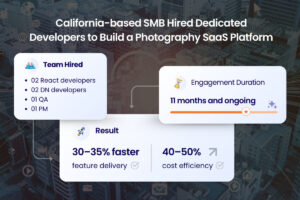
California-based SMB Hired Dedicated Developers to Build a Photography SaaS Platform
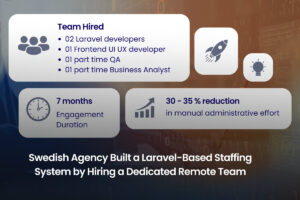
Swedish Agency Built a Laravel-Based Staffing System by Hiring a Dedicated Remote Team