Table of Contents

Most Project and Program Managers move toward a hybrid model because the math simply makes sense. In the US, the hunt for specialized talent is exhausting and expensive. But let’s be honest: the second you decide to hire a remote developer team, a new layer of anxiety rises. You start wondering if you are going to spend your entire day fixing bugs or repeating yourself in midnight meetings.
Successfully running a US team with offshore developers isn’t about being a better taskmaster. It’s about building a bridge so sturdy that the distance eventually stops mattering. You want your remote engineers to feel like they’re in the room with you, even if they’re halfway across the globe.
Here is how you make that happen without losing your sanity or your standards.
Choosing the Right Setup for Your Team
Before you look at a single resume, you have to decide how remote developers fit into your world. There isn’t a one-size-fits-all answer, but there are definitely wrong turns.

- Filling the Gaps (Staff Augmentation): This works if you just need an extra pair of hands for a specific sprint. But be careful—this puts the daily management load entirely on you.
- The Dedicated Pod: This is where the magic happens for most PMs. You aren’t just hiring a developer; you’re hiring a self-contained unit. They handle their own internal syncs, and you focus on the big-picture delivery.
- The Best of Both Worlds: At WeblineGlobal, we lean into the RelyShoreSM model. It’s designed to give you that India-based scale but with a US-based layer of accountability. It’s about having a local partner who speaks your language and understands your priorities, so you aren’t shouting into a void at midnight.
Fighting Distance-Issue in Code Quality
There is a natural tendency for quality to go down when people aren’t in front of you working. If you don’t have a rigid framework, ‘done’ starts to mean different things to different people. So, if you are someone with an on-premises team and want to augment your production capability with offshore or remote developers, you need to follow certain tactics. To keep a US team with remote developers performing at a high level, you have to treat quality as a shared responsibility, not a checklist you audit at the end of the month.
We’ve found that the best teams involve their offshore developers in understanding the business objectives. If they understand the business workflow and concerns, they’ll write better code. If they’re just checking boxes, you’ll get exactly what you asked for—even if what you asked for was a mistake.
Setting the Rules of Engagement
Quality has to be maintained from day one. You need to define what is ‘done,’ and milestones should be crystal clear. For a PM, this usually looks like:
- No code reaches the main branch without a peer review.
- Unit tests aren’t optional; they’re the ticket to entry.
- Automated checks catch the small stuff so you can focus on the logic.
Is your current workflow feeling a bit clunky? Let’s hop on a call and look at how to streamline your remote delivery.
What to Actually Look for When Hiring
If hiring remote developers fails, it’s rarely because the developer didn’t know Python or React. It’s almost always a communication breakdown. When you’re vetting talent, look for these three things:
- Thinking, Not Just Typing: During an interview, watch how they solve a problem they haven’t seen before. Are they asking you “why” or just agreeing to what you say? You want the person who questions the logic.
- Proactive Clarity: In a remote setup, silence is your biggest enemy. You need developers who aren’t afraid to say, “I don’t understand this requirement.”
- The “Ownership” Vibe: Does the remote developer care if the feature works for the end-user? A dedicated remote developer who understands the US market and your specific goals is worth three developers who are just following orders.
Making the Daily Workflow Feel Natural
The clock is either your enemy or your greatest asset. It all depends on how you handle the hand-off.
- The Golden Hours: Find those two or three hours where everyone is online at once. Don’t waste them on status updates that could have been an email. Use them for the hard stuff like brainstorming, unblocking issues, and planning.
- The Power of Writing Things Down: In a hybrid model, if it isn’t documented, it didn’t happen. Your Microsoft Team threads need to be the single source of truth so that when the US team goes to bed, the remote developers’ team in India has everything they need to keep moving.
- The Local Bridge: This is why a US presence matters. WeblineGlobal acts as your safety net. While your local team is focused on the next big release, our India-based software engineers are executing in the background, overseen by a model that ensures nothing is missed in translation.
Keeping the Risks at Bay
Every Program Manager worries about security and continuity. What happens if a key developer leaves? How do we keep our IP safe?
Quality also means reliability. You need a partner who has real, enforceable security protocols in place. This is where the who you hire matters more than the what. By using a model like RelyShoreSM, you’re getting the legal peace of mind of a US company with the sheer technical horsepower of India’s top talent. It takes the guesswork out of compliance.
Metrics: Measuring What Actually Matters
Let’s stop talking about the number of hours worked. It’s a vanity metric that tells you nothing about progress. If you want to know how your US team with offshore developers is really doing, look at:
- Predictability: Are we actually finishing what we said we’d finish in this sprint?
- Bug Leakage: How many “surprises” are popping up after we thought a feature was done?
- Onboarding Speed: How long does it take for a new hire to start contributing? If it takes a month, your process is too complex.
Want to see the kind of talent we’re talking about? We can put together a shortlist of pre-vetted developers who actually fit your culture.
Avoiding the All-Okay Culture
One of the biggest mistakes PMs make is treating their offshore team like a vending machine, that is, you put in a requirement and expect a feature to pop out. If you want high quality, you have to build a culture of feedback. Encourage your remote developers to push back. If a timeline is too tight, you want to hear it now, not two days before the deadline. When you move from managing a vendor to leading a global team, the quality naturally follows.
Scaling Without the Headaches
At the end of the day, a US team with remote developers is your secret weapon for growth. It’s about more than just saving a few dollars; it’s about having the capacity to build things your competitors can’t because you have access to a massive, global talent pool.
The secret isn’t some complex management software. It’s about finding the right people, setting clear expectations, and working with a partner who understands that their success is tied directly to your delivery. When you get that mix right, you don’t just have an offshore team; instead, you have a powerful software engineering department that never gets tired.
Social Hashtags
#OffshoreDevelopment #RemoteDevelopers #USTeams #GlobalDelivery #EngineeringLeadership #HybridWork #ProgramManagement #TechScaling #RelyShore #DistributedTeams
Frequently Asked Questions
We focus on a "Golden Hour" strategy, ensuring 2–3 hours of synchronous overlap for critical meetings and handoffs. The rest of the day relies on high-quality documentation and asynchronous workflows, allowing for a 24-hour development cycle.
Quality is maintained through a combination of mandatory peer code reviews, automated CI/CD pipelines, and a clear "Definition of Done." Our US-based assurance layer also provides local accountability to ensure your standards are never compromised.
It requires a shift from "vendor" to "partner" thinking. By involving remote teams in the "why" behind the product and including them in key discussions, they move from being order-takers to becoming invested members of your engineering department.
Our model focuses on team stability and knowledge redundancy. Because we manage the talent pool and use rigorous documentation, we can transition new developers into the team quickly without resetting your project velocity.




Success Stories That Inspire
See how our team takes complex business challenges and turns them into powerful, scalable digital solutions. From custom software and web applications to automation, integrations, and cloud-ready systems, each project reflects our commitment to innovation, performance, and long-term value.
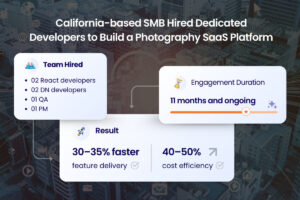
California-based SMB Hired Dedicated Developers to Build a Photography SaaS Platform
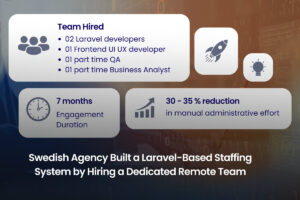
Swedish Agency Built a Laravel-Based Staffing System by Hiring a Dedicated Remote Team