
Table of Contents

The AI revolution is no longer a remote possibility. It is the defining technology shift of our era. All verticals, from finance and healthcare to retail and manufacturing, are racing to deploy machine learning models for their enterprises. The aim is simple but ambitious.
Companies want to use predictive analytics, automation, and generative capabilities to outpace their competitors and optimize their bottom lines. Yet, in the excitement of choosing an algorithm, GPU capacity, and model architecture, a critical reality is often missed. The success of any artificial intelligence endeavor depends entirely on the basis of the information it consumes.
When that foundation is not sound, the results are disastrous.
This article looks at the often overlooked, sometimes staggering costs of poor data quality for AI and the need for enterprises to make data integrity a top-tier business imperative. We’ll talk about the silent tax on innovation that bad data quality in AI represents and how the impact of bad data on AI models can undermine even the best-funded initiatives.
Finally, we will explore how organizations can successfully address these challenges and grow with the right partners.
Having trouble with data quality problems in your AI projects?
The AI Plug and Play Problem
Many executives are operating under the dangerous assumption that artificial intelligence is a plug and play solution. They think that if they just buy a fancy platform or hire a bunch of data scientists, the system will magically suck intelligence out of their existing data stores. This mindset is the single biggest cause of failure in the modern tech landscape. “The reality is that machine learning models are really statistical engines. They need fuel, and that fuel is data.
A high-performance engine running on low-grade fuel will eventually stall, sputter, or break down completely. That is exactly what happens with data quality issues in AI. No matter how sophisticated the neural networks are, they cannot compensate for inconsistent, noisy, or biased input. “Organizations that skip data cleaning for machine learning are essentially sabotaging their own technology stacks. The result is not only a failed project but a significant drain on company resources and loss of market momentum.
The Financial Loss from Substandard Data
The first and most obvious result of neglecting data integrity is a loss of money. One misconception is that the software license or hardware infrastructure is the biggest cost in an AI project. In fact, the most expensive part of any machine learning project is the work to prepare the data. Engineers can spend weeks or months trying to clean up disorganised datasets, stretching out the project timeline and accelerating the burn rate.
Measuring the Inefficiency
Consider the typical life cycle of an AI project. When teams face bad data quality in AI, it brings development to a standstill. Data scientists become data janitors Rather than writing elegant algorithms or optimizing model architectures, they are forced to spend eighty percent of their time manually scrubbing records, imputing missing values, and mapping disparate databases. This is the price of dirty data. It’s thousands of hours lost and millions of dollars in opportunity costs.
The effect of bad data on AI models doesn’t end with the salaries of developers. It also shows up in infrastructure costs. Training large models on noisy data requires substantially more computing power. The model needs more training cycles because it has difficulty converging a solution due to incoherent patterns in the input. That means higher cloud utility bills and longer time-to-market. If an organization chooses to ignore the need for streaming data cleaning for machine learning, it is essentially paying a premium for operational inefficiency.
The Technical Reality of AI Data Quality Issues
To get a sense of the technical burden, we need to look at how models learn. Machine learning is about the detection of patterns. If the data is messy, those patterns go away. AI data quality problems often come down to siloed systems, legacy databases and human error. If these sources are compiled without proper validation, the noise becomes indistinguishable from the signal.
Bias and Creativity
One of the most dangerous outcomes of poor data quality in AI is the introduction of systemic bias. Machine learning models are a reflection of the data they are fed. If a hiring algorithm is trained on historical data that contains human biases, the algorithm will systematise those biases at scale. This can lead to unethical decisions and serious damage to the reputation. In the same way, bad data can impact AI models in the case of generative AI and result in hallucinations. When you use conflicting data or no context, a model will generate responses. This is not OK in high-stakes environments like legal, medical, or financial consulting.
The only defence against these results is rigorous data cleaning for machine learning. This includes profiling, validation, and normalisation. Without these processes, the model is a black box that could give an answer that looks correct but is fundamentally wrong. Organisations should invest in automated pipelines that catch such issues before they reach the final output.
Cost of Inertia (Strategic)
The financial and technical costs are high, but the strategic costs can be existential. Agility is everything in a competitive market. Organisations that struggle with data quality in AI are stuck in a cycle of perpetual maintenance. They can’t innovate because they keep trying to fix the infrastructure they built yesterday.
This puts them at a competitive disadvantage. Your competitors are rolling out new value-driven features, while your team is bogging down trying to fix data quality issues in AI that should have been resolved months ago. This is what bad data really does to AI models. It’s an anchor on the organization and you can’t pivot, scale or innovate at the speed of the market.
Furthermore, trust is the currency of the digital age for customers. And if your AI-driven recommendations are wrong, or if your automated systems make tone-deaf mistakes, your customers will leave you. It’s much more expensive to gain a new customer than it is to protect a reputation. Not putting enough effort into data cleaning for machine learning is risking your most important asset: the trust of your user base.
Want to improve AI accuracy with clean data pipelines?
The Pillars of a Clean Data Strategy
Moving from reactive to proactive data strategy is the way companies need to succeed. This implies a cultural shift where data is viewed as a strategic asset, rather than as a byproduct of operations. This is about a number of core pillars.
“You have to start with good data profiling. Before you begin any training, you need to know the distribution, the frequency and the anomalies in your datasets. This lets you catch bad data quality in AI early in the process.
Second, you need automated tests. We need human intervention, but it is not scalable. You need to create pipelines to automatically flag duplicates, missing values and outliers. This is an important part of good data cleaning for machine learning.
Thirdly, you need strong governance. Who owns the data? What are the entry requirements? What do we do about updates? With no clear rules, your data lake will soon become a data swamp. To address AI data quality problems, there needs to be a central authority to hold all departments accountable for what they put in.
The Role of Synthetic Data & Augmentation
The problem isn’t necessarily that the data is messy; sometimes it’s that it’s not enough. Many companies do not have sufficient high-quality labelled examples to train their models. This is where the magic of synthetic data and data augmentation shines. Using AI, companies can augment their existing data sets with high-fidelity, clean data that reflects real-world distributions. But it needs to be done carefully. If the synthetic data is generated from tainted inputs, it will only make the poor data quality in AI worse. Hence, data cleaning for machine learning is still a necessary prerequisite for any augmentation strategy.
Collaborating to Address the Problem of Bad Data in AI Models
We have seen that data quality issues in AI are not just a technical challenge, but a business obstacle. Poor data can have a big impact on the deployment of large AI models, resulting in wasted money, bias, and competitive stagnation. But how do organisations circumvent this? The answer is experience and precision.
Now, many companies try to do this in-house, but often do not have the specialized skills to build efficient data pipelines. They are overwhelmed by the complexity of data cleaning for machine learning and the sheer volume of data they have to process.
Here is where expert partnerships turn into a strategic advantage. You don’t have to struggle with these complexities alone. You need a partner who understands the intersection of data engineering and business strategy.
Welcome to WeblineGlobal
Want to scale your enterprise high with a touch of acceleration, accuracy, and precision through AI? You need a partner that respects data. WeblineGlobal is a premier IT agency based in the US that specialises in bridging the gap between raw data and actionable intelligence. High-end IT staff augmentation services are provided by us, connecting your team with top-notch professionals who have mastered the art of data management.
Why WeblineGlobal?
WeblineGlobal understands that noise in the systems is the biggest problem for enterprises today. We help industries implement solutions that are built from scratch to have no messy data. We have the know-how to improve your architecture by feeding your models with clean, structured, and reliable information.
When you partner with us, you’re not just gaining additional headcount. You are getting a strategic partner that is committed to solving data quality problems in AI. We take a holistic approach. We don’t just clean your existing data; we develop the data pipelines and the governance structures required to avoid bad data quality in AI from happening again.
Here’s how we help your enterprise grow:
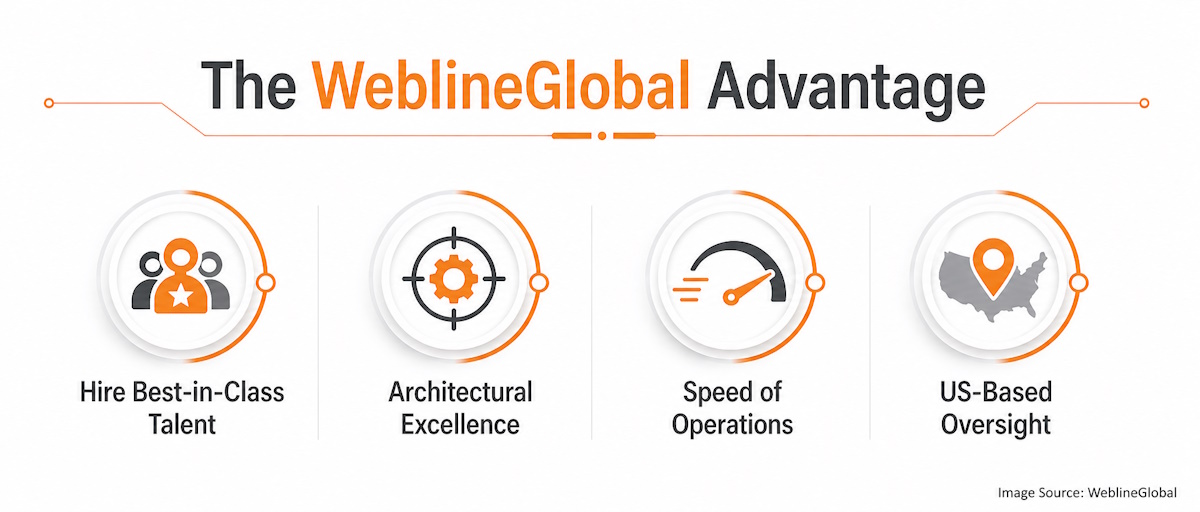
1. Hire Best-in-Class Talent: Leverage our curated network to hire data engineers and scientists experienced in data cleaning for machine learning. This lets you scale operations quickly without the friction of a slow hiring process.
2. Architectural Excellence: We design your data pipelines for resilience. “Looking at the architecture, we mitigate the effects of bad data on AI models before it even gets close to your production environment.
3. Speed of Operations: We relieve your own team of the pressure to maintain data. This enables your core staff to focus on what they do best – product building, innovating, and driving revenues.
4. US-Based Oversight: As a US-based agency, we emphasise communication, transparency, and alignment with your business goals. We build into your existing culture and processes.
Your organization’s success depends on how well you harness artificial intelligence. Don’t let the hidden cost of messy data undermine your vision. We’ve got you covered, whether you are dealing with legacy databases filled with errors or trying to prepare data for a new machine learning effort.
If you want to harness the power of an experienced AI development team to achieve unprecedented growth, accuracy, and precision, you need a partner that delivers results. The effects of bad data on AI models are real and also avoidable. The right approach and the right experts can make your data your biggest competitive advantage.
Get in touch with WeblineGlobal today. Let us help you remove the friction, clean up your data, and get your enterprise on a path to faster and accurate AI success. We’re ready to help you build the clean, intelligent future your business deserves.
Social Hashtags
#AI #ArtificialIntelligence #MachineLearning #DataQuality #DataScience #MLOps #DataEngineering #DataGovernance #CleanData #EnterpriseAI #GenerativeAI #AIImplementation #DigitalTransformation #ResponsibleAI #AIConsulting
Ready to turn messy data into growth opportunities?
Frequently Asked Questions
Data quality issues in AI pose a significant threat because machine learning models rely entirely on the information they ingest. If the input data is inconsistent, biased, or incomplete, the model will produce unreliable outputs. This leads to wasted financial resources, operational delays, and potential reputational damage, making it a high-priority risk for any enterprise.
The impact of bad data on AI models is multifaceted. Primarily, it causes inaccurate predictions, faulty decision-making, and the amplification of existing human or systemic biases. In generative AI, it can lead to hallucinations, where the model fabricates information. Ultimately, these factors render the AI tool ineffective for its intended business purpose.
Data cleaning for machine learning is the process of detecting and correcting corrupt or inaccurate records from a dataset. It involves identifying missing values, removing duplicate entries, normalizing formats, and filtering out noise. This rigorous preparation ensures that the data is structured correctly, which is the only way to train a reliable and accurate model.
Signs of poor data quality in AI include frequent model performance regressions, unpredictable results during testing, and high rates of error in automated outputs. If your team spends more time debugging the data than developing features, it is a clear indicator that your data pipelines require immediate remediation and cleaner input sources.
No, more data does not always equate to better performance. If you feed an AI model a large volume of low-quality or irrelevant information, you will simply get a larger volume of garbage output. High-quality, curated, and relevant data is far more valuable than sheer quantity. Precision and relevance are the keys to successful model training.
Data cleaning for machine learning is labor-intensive because it requires a deep understanding of both the data structure and the specific goals of the AI model. Engineers must manually validate, label, and transform unstructured data into a machine-readable format. Without specialized talent and automated tools, this stage often consumes up to 80 percent of the total project timeline.
Governance establishes the rules, accountability, and oversight needed to maintain consistent, reliable data across the enterprise. Without clear governance, even well‑designed pipelines can drift into inconsistency, leading to conflicting versions and unreliable AI outputs. Strong governance ensures that data remains trustworthy and usable over time.
Poor data quality slows down adoption because organizations lose confidence in AI outputs. In regulated industries like healthcare or finance, unreliable data can create compliance risks and erode trust with stakeholders. This hesitation prevents enterprises from scaling AI initiatives, even when the technology itself is mature and capable.
Yes, AI can assist in improving data quality by detecting anomalies, identifying duplicates, and flagging inconsistencies faster than manual processes. However, AI cannot replace the need for human oversight and structured governance. The most effective approach combines automated data quality checks with expert validation to ensure accuracy and reliability.
WeblineGlobal helps enterprises overcome these hurdles by providing expert IT staff augmentation tailored for data-heavy projects. We specialize in building pipelines that eliminate messy data, allowing your team to focus on scaling and innovation. If you want your enterprise to scale high with acceleration, accuracy, and precision through AI, contact us today to discuss how we can support your specific data infrastructure needs.


Success Stories That Inspire
See how our team takes complex business challenges and turns them into powerful, scalable digital solutions. From custom software and web applications to automation, integrations, and cloud-ready systems, each project reflects our commitment to innovation, performance, and long-term value.

California-based SMB Hired Dedicated Developers to Build a Photography SaaS Platform

Swedish Agency Built a Laravel-Based Staffing System by Hiring a Dedicated Remote Team