Table of Contents

The Pacific Northwest technology ecosystem, particularly in Washington, is defined by relentless innovation and a high bar for engineering quality. Today, that innovation centers intensely around autonomous AI Agents, transforming everything from customer service and internal operations to complex data analysis.
For CTOs, VPs of Engineering, and Product Leaders in Seattle, Bellevue, and across the state, the challenge isn’t deciding if to leverage AI agents, but how to rapidly acquire the highly specialized talent needed to build, integrate, and maintain them. The local talent pool is expensive and constrained, forcing leaders to look beyond immediate geographical boundaries. This guide outlines the essential strategy for Washington companies looking to successfully hire AI agent developers Washington requires for a competitive advantage, focusing on the dedicated team model.
The Strategic Imperative: Why Washington Needs Dedicated AI Agent Developers
Building effective AI agents goes far beyond standard machine learning (ML) or data science projects. It involves a fusion of prompt engineering, complex orchestration, tool integration, and enterprise system security. This specialized demand creates a critical hiring choke point in high-cost areas like Washington.
Your firm needs talent that can move quickly from proof-of-concept to production, integrating new large language model (LLM) capabilities without introducing significant delivery risk or technical debt. The key strategic shift is recognizing that AI agent development is fundamentally an orchestration and systems integration problem, supported by ML engineering.
Planning to Build AI Agents but Struggling to Find the Right Talent?
Washington’s AI agent talent is expensive and hard to secure. Get expert guidance on how dedicated AI agent developers can help you design, build, and deploy production-ready autonomous systems—faster and at lower risk.
Defining the AI Agent Role: Beyond Traditional ML Engineering
When you hire AI agent developers Washington for, you are not simply hiring traditional ML engineers who train models. AI agent developers are architects of autonomy. Their focus is less on model weights and biases, and more on enabling the agent to reason, access external tools, manage memory (context windows), and handle complex, multi-step tasks.
- Tool Interoperability: Agents must interact with internal APIs, databases, CRM systems, and external services. Developers must be expert integrators.
- Security and Guardrails: Implementing robust safeguards to prevent unintended actions, hallucinations, or data leakage is paramount, especially when connecting agents to sensitive enterprise systems.
- Orchestration Frameworks: Proficiency in modern frameworks like LangChain, LlamaIndex, or proprietary orchestration layers is non-negotiable for building complex workflows.
Cost and Speed Trade-offs in the Washington Market
Washington’s highly competitive tech labor market means specialized AI talent commands top-tier salaries, often delaying projects due to budgetary constraints or lengthy recruitment cycles. When a competitor launches an AI-powered feature six months before you can staff your team, the market advantage is lost.
Many Washington technology leaders address this by leveraging the dedicated team model, allowing them to access highly skilled engineers at a 40–60 percent cost saving, without compromising on technical quality or velocity. This model ensures you can scale rapidly to build specialized capabilities, such as those related to process automation, without the long-term overhead commitment of local hiring.
If you are exploring alternatives to costly local recruitment to accelerate your AI strategy, it is time to hire ai agent developers who fit your technical and budgetary needs efficiently. This strategic approach allows you to maintain control over the product roadmap while outsourcing the operational headache of talent acquisition.
The Need for Specialized AI Developer Vetting
The market is flooded with engineers who claim “AI experience.” Washington executives need rigorous vetting focused specifically on agent architecture skills, not just Python fluency. This includes evaluating hands-on experience with vector databases, prompt optimization techniques, and managing long-term agent memory.
When seeking specialized talent, it is crucial to review ai agent developer profiles that demonstrate successful deployment of autonomous agents, not just academic research projects. The goal is production-ready code, delivered at scale.
Evaluating Talent: What to Look for When You Hire AI Agent Developers Washington
A successful AI agent project hinges entirely on the quality and specific experience of the engineers involved. Vetting must be granular, moving beyond résumé buzzwords to practical, demonstrable knowledge of core agent tooling and architecture.
Core Technical Competencies
The AI Agent stack is rapidly evolving, but a few core competencies remain essential for any dedicated team you bring on board. These skills separate generalist developers from true dedicated AI agent developers Washington companies need.
- Orchestration Frameworks: Deep, practical experience with modern libraries (LangChain, AutoGen, CrewAI). The developer should understand when and why to choose one framework over another based on complexity and environment.
- Vector Databases and Retrieval Augmented Generation (RAG): Expertise in implementing RAG pipelines, including database selection (e.g., Pinecone, Weaviate, Milvus), embedding models, and optimization for retrieval latency and accuracy.
- API Tooling and State Management: The ability to write and manage code that enables the agent to utilize external tools effectively. This includes robust error handling and maintaining agent “state” across complex, multi-step interactions.
- Model Selection and Fine-Tuning: Understanding the capabilities and limitations of commercial LLMs (GPT-4, Claude) versus open-source alternatives (Llama 3, Mistral) and the trade-offs regarding cost, latency, and data sensitivity.
System Integration and Orchestration Experience
An AI agent is only as valuable as its ability to interact with your existing enterprise environment. Washington firms often deal with legacy systems, complex data silos, and stringent compliance requirements. Therefore, the ability to integrate agents securely and reliably is often more critical than mathematical modeling expertise.
Ask potential developers or dedicated teams about their history integrating AI components into mission-critical systems. How did they handle authentication? What risk mitigation steps were taken when providing the agent access to write data back to a financial ledger or a customer record? The best talent treats the agent as a highly privileged microservice.
Beyond Code: Assessing Business Acumen
For CXOs, ROI is the primary metric. You need developers who understand that an agent’s success is measured by its business impact, not just its technical elegance. They should be able to articulate how their design choices (e.g., choosing a cheaper, faster LLM for internal summarizing versus a more complex one for customer-facing dialogue) directly affect operating costs and user experience.
If your goal is to build intelligent, high-impact automation, a proven pathway is to discuss intelligent automation use cases with experts who specialize in defining the architecture and hiring the specialized skills needed to achieve them. This initial consultation clarifies the necessary skillset before the hiring process even begins.
Hire Dedicated AI Agent Developers—Without Local Hiring Delays
Access pre-vetted AI agent developers skilled in LLM orchestration, RAG pipelines, prompt engineering, and secure system integration. Skip months of recruiting and start building enterprise-grade AI agents in weeks.
The Dedicated Team Model: Scaling AI Agent Development Effectively
Staff augmentation and dedicated team models are not just about cost reduction; they are about scaling technical capacity rapidly with specific, pre-vetted skill sets. For Washington companies focused on competitive speed, this model provides the necessary leverage to build highly sophisticated AI agents.
Building Cross-Functional AI Agent Pods
AI agent development rarely works with a single developer. You need a dedicated, specialized “pod” or team structure. A typical effective AI Agent pod includes:
- The Agent Architect/Lead: Defines the multi-agent system, manages communication between agents, and enforces security protocols.
- Prompt Engineer/Developer: Focuses on optimizing LLM inputs and outputs, managing RAG processes, and handling tool definitions.
- Software Engineer (Backend): Handles system integrations, API development for agent communication, and deployment infrastructure (often DevOps/Cloud expertise is bundled here).
- Dedicated QA/Testing: Essential for verifying that autonomous agents meet specified guardrails and don’t introduce unexpected behaviors.
This structure allows for high throughput and minimizes the single point of failure risk inherent in relying on one or two local hires. When we help clients in Washington hire AI agent developers Washington, we focus on delivering these complete, high-functioning pods.
Mitigation of Delivery Risk with Global Teams
One primary concern when utilizing remote or global dedicated teams is mitigating delivery risk—IP protection, data security, and communication failure. Experienced partners, like WeblineGlobal, address this by implementing standardized contracts, controlled access environments, and adherence to US-centric IP laws, often through models like our RelyShore℠ delivery standard.
The goal is to provide the cost and scale benefits of global talent while delivering the assurance and accountability expected by high-profile Washington enterprises. You gain access to the specialized talent you need to hire ai developers with deep, modern expertise without inheriting the typical risks associated with unstructured freelance hiring.
Overcoming Common Objections to Remote AI Developer Hiring
Senior leaders in Washington often raise two core objections to outsourcing specialized roles like AI agent development: concerns about technical quality and fears of communication gaps. Both are valid concerns that must be addressed through strategic vendor selection and rigorous process.
Vetting for Communication and Collaboration Skills
In AI agent development, clear communication is critical because requirements are often fluid, and emergent behavior must be quickly triaged. Technical proficiency alone is insufficient. When sourcing dedicated AI agent developers Washington firms need, prioritize candidates who demonstrate fluent English, strong documentation habits, and experience working within agile, geographically distributed teams.
A structured interview process should test not just coding ability, but how the developer proposes solutions, asks clarifying questions, and manages scope creep in a remote setting. The best partners vet for both hard skills (LangChain, RAG) and soft skills (Proactivity, English proficiency).
Ensuring Time Zone Alignment and Project Oversight
While the developers may be remote, the project must run locally. The right remote staffing strategy ensures significant overlap with your core Washington business hours (PST). This is essential for daily stand-ups, rapid decision-making, and critical incident response.
Effective project oversight requires transparency. We recommend systems that provide real-time visibility into the team’s output, integrated with your existing project management tools (Jira, GitHub). This keeps the leadership team informed and ensures the dedicated AI team operates as a true extension of your in-house engineering capabilities.
To ensure high performance, every dedicated remote team should have an assigned engineering manager or Scrum Master who acts as a crucial liaison, ensuring smooth integration with your local technical leaders. Finding the right talent starts with immediate access to qualified candidates. You can swiftly review ai agent developer profiles that match the exacting standards required for enterprise-grade AI agent deployment.
The Framework for AI Agent Development Success
Successfully deploying AI agents requires more than just hiring talented developers; it requires a structured framework that mitigates the inherent volatility of working with LLMs. Washington companies should demand that their dedicated AI teams adhere to clear processes:
- Iterative Prototyping: Due to the emergent behavior of LLMs, development must be rapid and iterative, focusing on minimizing hallucination and maximizing reliability in each loop.
- Strict Version Control for Prompts: Treat prompts and system instructions as code. They must be version-controlled, tested, and documented rigorously, just like any other component of the software.
- Comprehensive Agent Testing: Beyond standard unit tests, the team must employ specialized methodologies (like adversarial testing) to probe the agent’s boundaries and ensure safety guardrails hold under stress.
This operational maturity is what differentiates a successful dedicated AI agent team from a collection of skilled but uncoordinated individuals. The most effective way to secure this high level of operational maturity is to partner with a vendor who can provide proven, dedicated teams rather than piecing together individual contractors.
By leveraging global talent pools, Washington tech leaders can effectively bypass local hiring friction, reduce costs, and accelerate their product roadmap. The focused strategy of hiring highly specialized, dedicated teams ensures that you can hire AI agent developers Washington needs today to dominate tomorrow’s market.
Social Hashtags
#HireAIAgentDevelopers #AIAgentDevelopersWashington #HireDevelopers #AIAgents #LLMDevelopment #GenerativeAI #AutonomousAgents #AIEngineering #RAG #LangChain #SeattleTech #EnterpriseAI #DedicatedDevelopers
Ready to Launch Secure, Scalable AI Agents with Confidence?
Review hand-picked profiles of senior AI agent developers who have successfully deployed autonomous AI systems for enterprise use cases. Validate experience, availability, and expertise before making a commitment.
Frequently Asked Questions
A lean, effective team typically consists of 3–5 people: an AI Architect/Lead (focusing on orchestration and tools), one or two dedicated prompt/agent developers (focused on RAG and LLM tuning), and a dedicated QA/Test engineer focused on safety and reliability.
We aim to provide a shortlist of thoroughly vetted developer profiles within 48–72 hours of receiving a detailed requirement specification. Because the developers are pre-vetted for technical depth and communication skills, the onboarding process is significantly faster than traditional recruitment, often allowing teams to start within 1–3 weeks.
Yes. When we help you hire ai agent developers, we ensure they have proven, hands-on expertise in the leading orchestration frameworks (LangChain, LlamaIndex), relevant vector databases, and cloud services (AWS, Azure, GCP) necessary for enterprise deployment. Our vetting focuses on practical deployment experience.
IP protection is mandatory. We enforce strict NDAs, use secure virtual environments with access controls, and ensure compliance with US legal frameworks. All client code, data, and IP remain the sole property of the client, backed by robust contractual agreements appropriate for Washington enterprises.
The dedicated team model dramatically increases speed by removing the 6–9 month lag time associated with local recruitment. Since the team is fully focused on your AI project, operates under your direct management, and is already technically cohesive, you achieve high velocity from day one, which is vital for emerging technologies like AI Agents.

Success Stories That Inspire
See how our team takes complex business challenges and turns them into powerful, scalable digital solutions. From custom software and web applications to automation, integrations, and cloud-ready systems, each project reflects our commitment to innovation, performance, and long-term value.
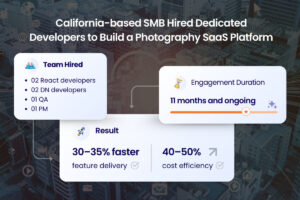
California-based SMB Hired Dedicated Developers to Build a Photography SaaS Platform
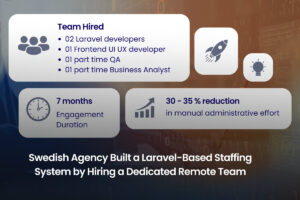
Swedish Agency Built a Laravel-Based Staffing System by Hiring a Dedicated Remote Team