Table of Contents

The technology landscape in Arizona, particularly across the Phoenix and Scottsdale corridors, has undergone a radical transformation. As the state cements its reputation as a burgeoning semiconductor and software hub, CTOs and VPs of any enterprise are under immense pressure to integrate generative AI and machine learning into their core products. However, the local talent pool is increasingly stretched thin, with competition from Silicon Valley transplants driving salaries to unsustainable levels. This environment has forced decision-makers to rethink their talent acquisition strategies, moving away from purely local mandates toward sophisticated distributed models.
For an Arizona based CTO, the decision to hire AI developers Arizona is no longer just about filling a seat in an office. It is about balancing the speed of innovation against the inherent complexities of emerging tech. Outsourcing has evolved from a simple cost-cutting measure into a strategic necessity for accessing specialized skills that are scarce in the local market. The challenge lies in navigating the vendor landscape to find partners who understand the nuances of enterprise delivery, data sovereignty, and the long-term maintenance of AI systems. This article serves as a strategic briefing for leaders looking to scale their AI capabilities while maintaining rigorous control over their engineering standards.
The Local Talent Gap and the Shift to Distributed AI Teams
The demand for high-level intelligence expertise in the Grand Canyon State is currently outpacing the supply of qualified senior engineers. While local universities are producing bright graduates, the senior-level experience required to lead complex AI initiatives often comes at a premium that can strain a mid-market company’s budget. When you look to hire AI developers, the primary goal is often to find engineers who can do more than just write Python scripts. You need architects who understand the mathematical foundations of model training and the practicalities of deployment at scale.
The Economic Reality of the Arizona Tech Market
Phoenix and Scottsdale have seen a significant influx of tech companies, which has spiked the cost of living and, consequently, salary expectations. For a startup or a growing enterprise, competing for the same few local experts as the global giants is a losing battle. By expanding the search radius, Arizona firms can access a broader spectrum of talent without the geographic price tag. This shift allows for a more flexible team composition, where local leadership manages a high-output offshore pod.
Why Traditional Recruitment Fails for Specialized AI Roles
Traditional recruiters often struggle with the nuances of AI and machine learning. They might present candidates who have surface-level knowledge of libraries like TensorFlow but lack the deep experience in RAG (Retrieval-Augmented Generation) or fine-tuning large language models. This leads to a prolonged hiring cycle that delays product launches. Transitioning to a model where you evaluate AI outsourcing partners allows you to tap into pre-vetted pools of talent, significantly reducing the time to hire from months to days.
Bridging the Communication Gap
One of the largest concerns for Arizona executives is the potential for communication breakdown. However, the modern distributed model, especially when backed by a US-based presence, ensures that the engineering team operates as an extension of the local office. This hybrid approach provides the cost benefits of offshore talent with the accountability of domestic project management.
If you are currently evaluating your team structure, it may be time to see how remote pods can accelerate your roadmap. You can schedule a consultation with our team to discuss your specific technical requirements and timelines.
Addressing AI Delivery Risk in Outsourcing Models
The most significant hurdle for any CTO considering a move to remote teams is the concept of AI delivery risk. Unlike traditional web or mobile development, AI projects are inherently experimental. There are uncertainties regarding data quality, model accuracy, and the ability to integrate these systems into existing workflows without causing regressions. Managing these risks requires a partner who treats AI development as a disciplined engineering process rather than a series of one-off experiments.
Establishing Rigorous Evaluation Frameworks
When you decide to review AI delivery risks, you must look at how a potential vendor handles data validation and model testing. A common mistake is focusing solely on the “cool” factor of the AI output while ignoring the infrastructure required to keep it running reliably in production. A mature partner will emphasize observability, monitoring, and the ability to retrain models as new data becomes available. This ensures that the investment does not become a technical debt anchor within eighteen months.
The Importance of IP Protection and Security
For many Arizona based firms, especially those in the defense, healthcare, or financial sectors, data security is non-negotiable. Outsourcing AI development requires a high degree of trust and ironclad legal protections. CTOs must ensure that their partners adhere to international security standards and provide full transparency regarding data handling. This is where the RelyShore model becomes invaluable, providing the security of US law and project oversight combined with global engineering scale.
Maintaining Full Project Control
A frequent objection to outsourcing is the fear of losing control over the development process. The best engagement models are those where the client retains full ownership of the IP and the code. The remote developers function as a dedicated pod, participating in your daily stand-ups and using your preferred project management tools. This level of integration is what separates successful outsourcing from failed “black box” projects.
Before moving forward with a new vendor, it is essential to vet their technical depth and past performance. To get started, you can Schedule Developer Interviews to see how our talent aligns with your vision and culture.
Choosing the Right Skill Sets for AI Implementation
The term “AI Developer” is incredibly broad. When you seek to hire AI developers Arizona, you must be specific about the architectural needs of your project. Are you building a customer-facing chatbot, or are you developing complex predictive analytics for supply chain optimization? Each requires a distinct set of competencies. CTOs need to distinguish between data scientists, machine learning engineers, and software developers who specialize in AI integration.
The Rise of AI Agent Developers
One of the most exciting shifts in the industry is the move toward autonomous agents. Companies are no longer looking for simple “if-then” logic; they want systems that can reason and execute tasks independently. To achieve this, many firms are looking to hire AI agent developers who understand the orchestration of multiple models and the integration of tools via APIs. This requires a higher level of cognitive architecture than standard backend development.
Full-Stack AI: Beyond the Model
A successful AI product is only as good as its user interface and the backend that supports it. This is why many Arizona CTOs prefer “pods” that include not just AI specialists, but also frontend and backend engineers who understand how to build a cohesive product. This holistic approach reduces the friction between the AI “engine” and the user experience, leading to higher adoption rates and better ROI.
Vetting for Communication and Soft Skills
Technical prowess is only half the battle. When hiring for remote roles, communication skills become the primary predictor of success. Developers must be able to explain why they chose a specific model architecture or how they plan to address biases in the training data. At WeblineGlobal, our vetting process ensures that every developer we provide is not only a technical expert but also a clear and proactive communicator.
Building a high-performing AI team does not have to be a multi-month ordeal. If you need to scale your engineering capacity quickly, you can Request Developer Profiles today to see the caliber of talent available for your project.
Evaluating the ROI of Outsourced AI Development
The cost of building an in-house AI team in Arizona can be staggering. Beyond the base salaries, there are the costs of benefits, office space, recruitment fees, and the ongoing investment in hardware and training. Outsourcing provides a way to convert these high fixed costs into variable costs, allowing for much greater fiscal agility. For many organizations, this results in a 40 to 60 percent reduction in total engineering spend without a drop in quality.
Scalability and Flexibility in Team Composition
AI projects often go through phases of high intensity followed by periods of stabilization. Hiring full-time employees for these peaks can lead to a bloated payroll during the troughs. By opting for a dedicated pod model, CTOs can scale the team up or down based on the current roadmap. This month-to-month flexibility is a powerful tool for managing capital and ensuring that resources are always aligned with business priorities.
Speed to Market as a Competitive Advantage
In the world of AI, the first-mover advantage is real. Delaying a project by six months because you cannot find the right local talent can be a fatal mistake. Leveraging a global talent network allows you to assemble a team and start development in a fraction of the time. When you hire AI developers through a structured program, you bypass the traditional recruitment bottlenecks and get straight to building.
Transparency in Pricing and Delivery
One of the hallmarks of a professional outsourcing partner is transparent pricing. There should be no hidden fees or “management overhead” that isn’t clearly defined. When you evaluate AI outsourcing options, look for partners who provide clear daily or monthly rates and who are willing to commit to specific delivery milestones. This transparency is key to building a long-term, mutually beneficial partnership.
The decision to outsource is a significant one, but it is often the most logical path for growth in today’s economy. If you are ready to explore your options, we invite you to hire pre-vetted remote developers who meet the specific needs of Arizona enterprises.
Navigating the Vendor Selection Process
Selecting a partner is more than just looking at a portfolio. It is about assessing cultural fit, technical depth, and a shared commitment to quality. For an Arizona CTO, this means finding a partner who understands the US business culture and is committed to long-term success rather than just a quick contract. You need a team that will challenge your assumptions and provide better ways to achieve your goals.
The Role of Technical Vetting and Practical Testing
Do not rely solely on resumes. A rigorous selection process should include live coding sessions, architectural reviews, and behavioral interviews. You want to see how a developer handles real-world problems and how they adapt to new requirements. When you review AI delivery risks during the vendor selection phase, ask for case studies that demonstrate how they have solved similar problems for other clients.
The WeblineGlobal Advantage: RelyShore℠ Model
WeblineGlobal has spent over two decades refining the way remote teams are delivered. Our RelyShore model combines the efficiency of India based engineering with the peace of mind that comes from US-based accountability. With over 3500 projects delivered and a client roster that includes industry giants like LG and Siemens, we provide the stability and expertise that Arizona CTOs need to succeed in the AI era.
Building Long-Term Partnerships
The goal of outsourcing should not be a one-off project but a long-term partnership that grows with your company. As your AI needs evolve, your partner should be able to provide the talent and strategic guidance required to stay ahead of the curve. This relationship is built on a foundation of trust, transparency, and consistent delivery.
Social Hashtags
#HireAIDevelopers #ArizonaTech #PhoenixTech #ScottsdaleTech #AIOutsourcing #CTOLife #EnterpriseAI #GenerativeAI #AIDevelopment #TechLeadership #DistributedTeams #AIEngineering #MachineLearning #RelyShore
If you are looking to build a high-impact AI team, we are here to help. Contact us to hire developers through our flexible models and start your journey toward AI-driven transformation today.
Frequently Asked Questions
Security is maintained through multi-layered protocols, including NDAs, encrypted data access, and adherence to international compliance standards. Using a model with US-based oversight ensures that legal protections are enforceable and data handling remains transparent.
While traditional local hiring can take three to six months, our process typically provides a shortlist of pre-vetted candidates within 48 hours, allowing you to begin interviews and onboarding in as little as one to two weeks.
Yes. The developers work as a dedicated extension of your team. You manage their tasks, use your own project management tools, and they participate in your daily rituals, ensuring you retain full control over the roadmap and intellectual property.
Absolutely. The flexibility of month-to-month hiring and the significant reduction in overhead costs (often 40 to 60 percent) make high-end AI talent accessible to startups that would otherwise be priced out of the local market.
We focus on long-term relationships. You can retain a core team for ongoing maintenance and retraining, or scale back to a minimal support model, ensuring your AI systems continue to perform as your data evolves.


Success Stories That Inspire
See how our team takes complex business challenges and turns them into powerful, scalable digital solutions. From custom software and web applications to automation, integrations, and cloud-ready systems, each project reflects our commitment to innovation, performance, and long-term value.
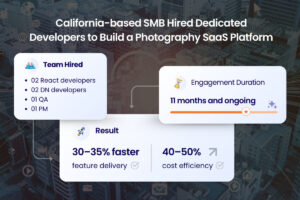
California-based SMB Hired Dedicated Developers to Build a Photography SaaS Platform
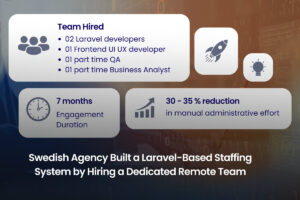
Swedish Agency Built a Laravel-Based Staffing System by Hiring a Dedicated Remote Team