Table of Contents

SaaS leaders in New York are currently standing at a crossroads, balancing the urgent necessity to integrate generative AI with the reality of tightened venture capital and fluctuating interest rates. In the heart of Manhattan and the Brooklyn tech corridor, the pressure to maintain a competitive edge through automation and predictive modeling has never been higher, yet the traditional route of scaling local engineering teams is becoming increasingly cost-prohibitive for many growth-stage companies. The decision to expand is no longer just about finding talent; it is about finding a sustainable way to innovate without exhausting the operational runway.
Successfully navigating this landscape requires a shift from reactive recruitment to a structured AI hiring strategy that prioritizes agility and specialized expertise over geographic proximity. This guide examines how sophisticated decision-makers are leveraging offshore expertise to hire AI developers New York firms can depend on, ensuring project continuity and technological innovation even when budgets remain under intense scrutiny. By moving toward a more flexible delivery model, CTOs and VPs of Engineering can build the intelligent features their customers demand while maintaining the fiscal discipline required by their boards.
The New York SaaS Dilemma: Innovation vs. Burn Rate
The New York tech ecosystem has always been characterized by its fast pace and high overhead. However, the current economic climate has introduced a layer of complexity that forces leaders to rethink their talent acquisition models. When the mandate is to hire AI developers, the competition for local talent in the tri-state area often leads to bidding wars that are unsustainable for companies focused on profitability. This friction between the need for speed and the need for cost-efficiency is the primary challenge facing SaaS leaders today.
The Escalating Cost of Local AI Talent
Hiring a senior AI engineer in Manhattan often involves a total compensation package that exceeds the budgets of most mid-market SaaS firms. Beyond the base salary, the costs of office space, benefits, and the inherent volatility of the local job market create a high-risk environment for scaling. For many, the choice to hire ai developers New York based is becoming a luxury rather than a necessity. Leaders are beginning to realize that the geographic location of the developer is far less important than their ability to deliver production-ready code and integrate with existing workflows.
Why Traditional Recruitment Models Are Stalling
The traditional recruitment cycle in New York can take months, which is a lifetime in the rapidly evolving AI sector. By the time a candidate is sourced, interviewed, and onboarded, the underlying technology or market requirements may have already shifted. This lag time represents a significant opportunity cost. To stay ahead, companies are looking for ways to plan AI hiring strategy initiatives that bypass the slow traditional pipeline, favoring models that provide vetted talent in a matter of days rather than months.
Planning AI Hiring While Budgets Are Tight? Start with the Right Strategy
Before committing to local hires or freezing innovation, talk with senior AI advisors who help New York SaaS teams design cost-resilient AI hiring strategies—without increasing burn or slowing delivery.
Building a Resilient AI Hiring Strategy for 2024 and Beyond
A resilient strategy begins with a clear understanding of the specific problems AI needs to solve within your product suite. It is not enough to simply add AI to a roadmap; you must determine whether you need researchers, practitioners, or implementers. For most SaaS companies, the focus should be on the practical application of large language models and machine learning to enhance user experience or automate internal processes. This requires a specific type of engineering talent that understands both the math and the software engineering principles required for scale.
Shifting from General Full-Stack to Specialized AI Roles
While full-stack developers are the backbone of any SaaS product, the nuances of AI require a deeper level of specialization. When you hire AI agent developers, you are looking for individuals who understand prompt engineering, vector databases, and the orchestration of autonomous workflows. These roles are distinct from traditional backend engineering because they involve non-deterministic outputs and complex data pipelines. A modern ai hiring strategy must account for these distinctions to avoid the mistake of over-tasking generalist developers with highly specialized AI challenges.
The Rise of Agentic AI Engineering
The shift toward autonomous agents is one of the most significant trends in software today. These systems do not just respond to queries: they perform actions and make decisions based on defined goals. Hiring for this specific capability requires a focus on developers who have experience with frameworks like LangChain or AutoGPT. By focusing on these niche skills, New York leaders can ensure their teams are building forward-looking features rather than playing catch-up with yesterday’s technology.
Evaluating Skill Depth Over Academic Pedigree
In the AI space, hands-on experience often outweighs academic credentials. When you review AI developer profiles, look for evidence of contributed code, successful deployments of RAG (Retrieval-Augmented Generation) systems, and an understanding of the trade-offs between different model architectures. This practical focus is essential for maintaining delivery speed in a budget-conscious environment.
Navigating Budget Uncertainty while Scaling
Budget uncertainty does not mean that growth must stop; it means that growth must be smarter. Many New York founders are turning to staff augmentation and dedicated pods to manage their engineering costs. This approach allows them to access dedicated AI developers in New York without the long-term liabilities of full-time local hires. The flexibility of a month-to-month engagement model provides a safety net, allowing companies to scale up or down based on their current funding status or project milestones.
The Local vs. Remote Cost Equation
The financial argument for remote teams is compelling. By leveraging talent from India through an established partner like WeblineGlobal, companies can often reduce their development costs by 40 to 60 percent. This capital can then be reallocated to marketing, sales, or further R&D. When you hire AI developers through an offshore model, you are not just saving on salary; you are eliminating the costs associated with payroll taxes, office infrastructure, and retention programs that are notoriously expensive in the New York market.
Risk Mitigation through Dedicated AI Developers New York Standards
The primary concern for many CXOs when hiring remotely is the risk of delivery failure. However, by choosing a partner that utilizes a structured delivery model like RelyShore℠, these risks are significantly mitigated. This model ensures that while the developers are based in India, the quality, communication, and accountability meet the high standards expected by a New York tech firm. It provides the scale of an offshore team with the reliability of a local partner, which is a critical component of any successful AI hiring strategy.
Build AI Capabilities Without Expanding Your New York Burn Rate
We help SaaS teams hire remote AI developers experienced in LLMs, agentic workflows, and production-grade systems—delivering New York-quality execution with a flexible, month-to-month engagement model.
Operationalizing AI Development with Off-site Pods
The most successful SaaS companies do not just hire individual contractors; they integrate dedicated pods into their existing engineering departments. A pod is a self-contained unit that typically includes a lead developer, specialized AI engineers, and QA experts. This structure ensures that the team is not just writing code but is also responsible for the quality and integration of their work. This is the most effective way to hire AI developers when the goal is long-term product evolution rather than a one-off feature launch.
Integrating Remote Teams into New York Workflows
Communication is the bridge that makes remote hiring work. For a New York SaaS company, this means establishing clear documentation standards and leveraging asynchronous communication tools. When you plan AI hiring strategy frameworks, consider how the time zone difference can be used as an advantage. A “follow-the-sun” model allows for continuous development cycles, where the remote team works while the New York team sleeps, leading to faster deployment times and more rapid iteration on AI models.
Intellectual Property and Data Security
For any SaaS leader, protecting intellectual property is a top priority. When hiring dedicated AI developers New York firms must ensure that robust NDAs and security protocols are in place. Working with an established partner like WeblineGlobal provides the assurance that all IP remains with the client. From secure access controls to rigorous data handling policies, the infrastructure must be designed to protect the proprietary algorithms and datasets that give a SaaS company its competitive edge.
Decision-Making Criteria: Choosing the Right AI Partner
The market for AI talent is flooded with providers making bold claims. To cut through the noise, decision-makers must focus on a few key criteria that directly impact the success of their hiring initiatives. The goal is to find a partner that does not just provide resumes but provides the right engineering culture and technical depth to solve complex problems.
Speed of Shortlisting and Quality of Vetting
In a competitive market, you cannot afford to wait weeks to see candidates. A reliable partner should be able to provide a shortlist of vetted candidates within about 48 hours. When you review AI developer profiles, ask about the vetting process. It should include technical assessments, communication evaluations, and a review of past projects that align with your specific AI goals. This level of scrutiny is what differentiates a high-quality talent partner from a generic staffing agency.
Flexibility and Scalability of the Engagement
Budget uncertainty requires flexibility. Avoid vendors that insist on long-term, rigid contracts. Instead, look for a partner that offers month-to-month flexibility. This allows you to hire AI developers as your project needs evolve. If a specific phase of your AI roadmap requires more resources, you should be able to scale up quickly. Conversely, if you need to pause or pivot, your hiring model should support that without financial penalties.
Strategic Steps to Implement Your AI Roadmap
Implementing an AI roadmap in a New York SaaS company requires a disciplined approach. Start by identifying the low-hanging fruit: areas where AI can provide immediate value with minimal risk. This might be customer support automation, data categorization, or simple predictive analytics. Once these initial projects prove successful, you can then move toward more complex integrations like agentic workflows or proprietary model fine-tuning.
Evaluating the ROI of AI Initiatives
Every hiring decision should be backed by a clear ROI justification. When you hire AI agent developers, calculate the potential savings in operational costs or the projected increase in customer retention. AI should not be a cost center: it should be a growth driver. By using a cost-efficient remote model, the threshold for achieving a positive ROI is much lower, making it easier to justify the investment to stakeholders and investors even during periods of economic uncertainty.
Maintaining Product Continuity
The biggest risk during budget uncertainty is the loss of momentum. If you stop innovating, your competitors will not. By incorporating dedicated AI developers New York standards into your team, you ensure that your product continues to evolve. This continuity is essential for maintaining market share and ensuring that your SaaS platform remains relevant in an increasingly AI-driven world. The ability to maintain a steady cadence of releases, even when local hiring is frozen, is a powerful competitive advantage.
Finalizing Your AI Talent Acquisition Path
The path forward for New York SaaS leaders involves a blend of local strategic leadership and global engineering execution. By adopting a more sophisticated AI hiring strategy, companies can navigate budget uncertainty without sacrificing their technological ambitions. The key is to find the right balance between cost, speed, and quality, ensuring that every developer added to the team contributes directly to the bottom line.
As you look to hire AI developers, remember that the goal is to build a sustainable engine for innovation. Whether you are looking for a single specialist or a full-scale engineering pod, the focus should remain on technical excellence and cultural alignment. With the right partners and a clear vision, your company can not only survive but thrive in the age of AI, regardless of the broader economic climate. Take the next step: contact us and witness how a remote-first engineering model can transform your delivery capabilities and help you reach your product milestones faster and more affordably.
Social Hashtags
#HireAIDevelopersNewYork #NewYorkSaaS #AIHiringStrategy #GenerativeAI #AgenticAI #CTOStrategy #SaaSLeadership #RemoteAI #AIEngineering #StartupScaling #TechLeadership #BudgetOptimization
Review AI Developers Who Are Ready to Ship—Not Just Experiment
Get access to real AI developer profiles with hands-on experience in generative AI, RAG pipelines, and agent-based systems. Interview first, validate skills, and scale only when it makes financial sense.
Frequently Asked Questions
Quality is ensured through a multi-stage vetting process that includes deep technical interviews, coding challenges specific to AI and ML, and a thorough review of past project delivery. Working with an established partner like WeblineGlobal adds a layer of accountability, as developers are managed under proven delivery models like RelyShore℠.
While local hiring can take 3 to 6 months, a remote hiring model can provide a shortlist of pre-vetted candidates within 48 hours. Once a candidate is selected, they can typically be integrated into your team and start contributing within a week, significantly accelerating your development timelines.
Most remote teams dedicated to US clients offer a window of overlap for synchronous meetings and collaboration. Furthermore, many companies use the time difference as an advantage, creating a 24-hour development cycle where work is handed off at the end of the New York business day and completed by the next morning.
Yes, many SaaS leaders prefer the pod model because it provides a complete team with diverse skills, including backend engineering, AI specialization, and quality assurance. This approach allows for better ownership of project outcomes and reduces the management overhead for the local New York team.
When working with a reputable partner, all intellectual property rights are clearly assigned to the client through comprehensive legal contracts and NDAs. Reputable firms use secure infrastructure and strict data access controls to ensure that your proprietary code and data remain protected at all times.


Success Stories That Inspire
See how our team takes complex business challenges and turns them into powerful, scalable digital solutions. From custom software and web applications to automation, integrations, and cloud-ready systems, each project reflects our commitment to innovation, performance, and long-term value.
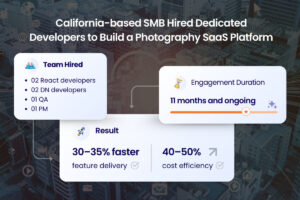
California-based SMB Hired Dedicated Developers to Build a Photography SaaS Platform
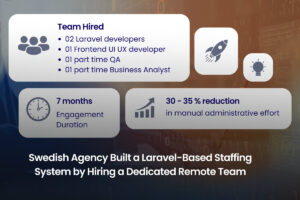
Swedish Agency Built a Laravel-Based Staffing System by Hiring a Dedicated Remote Team