Table of Contents

The race to integrate artificial intelligence into enterprise workflows and consumer products has placed Toronto based technology leaders in a difficult position. On one hand, the pressure from boards and stakeholders to deploy generative models, predictive analytics, and automated agents is relentless. On the other hand, the traditional route of expanding permanent headcount in one of North America’s most expensive talent markets presents significant long term financial risks and operational rigidity.
For a CTO or VP of enterprises in the GTA, the challenge is not just finding the talent, it is finding a way to scale that talent without the baggage of fixed overhead. The shift toward more agile, flexible AI teams has become the preferred strategy for leaders who need to prove ROI before committing to a massive local expansion. This approach allows organizations to move at the speed of the market while keeping their balance sheets lean and their development cycles aggressive.
Understanding the Current AI Talent Landscape in Toronto
Toronto has firmly established itself as a global hub for machine learning and deep learning, thanks in part to the legacy of local research institutions and a vibrant startup ecosystem. However, this prestige comes with a heavy price tag. When you look to hire AI developers Toronto, you are competing against multinational tech giants who can offer compensation packages that often exceed the budgets of even well funded scale ups. This creates a supply side constraint that can stall critical projects for months.
The Trap of Permanent Recruitment for R and D Projects
Artificial intelligence initiatives often begin as research and development ventures. These projects are characterized by high uncertainty and iterative pivots. Hiring a full time local team for a project that might change scope within six months is a risky move for any leader. If the project scope shifts or the initial hypothesis fails, you are left with high cost specialists whose niche skills may not translate to other areas of your tech stack. This is why many are choosing to plan flexible AI hiring strategies that prioritize adaptability over permanent seats.
High Competition and the Cost of Local Acquisition
The time to hire for specialized roles in the local market is currently averaging three to five months. For a Toronto leader, that is a fiscal quarter lost to recruitment rather than development. Furthermore, the total cost of employment, including benefits, office space, and retention bonuses in the GTA can be sixty percent higher than utilizing remote, dedicated engineering pods. This cost disparity is forcing a re evaluation of what it means to have a local team presence.
How to Hire AI Developers Toronto Without the Overhead
Strategic leaders are now looking toward offshore models that offer the same technical rigor as local hires but with a month to month flexibility. By working with established partners like WeblineGlobal, companies can access pre-vetted talent in India that works as a direct extension of their Toronto based core team. This allows you to hire AI developers who understand complex mathematical modeling and neural network architecture without the long term commitment of a local salary benchmark.
Build Your AI Team Without Expanding Headcount
Need AI specialists but want to avoid long recruitment cycles and high Toronto salaries? Access pre-vetted AI engineers who integrate seamlessly with your team and start delivering within days.
The Strategic Shift to Flexible AI Teams
The concept of flexible ai teams is gaining traction because it addresses the core volatility of AI development. Unlike traditional software engineering, AI projects require bursts of highly specialized activity followed by periods of monitoring and refinement. A fixed headcount model does not handle these fluctuations well, leading to either burnout during peak periods or underutilization during the maintenance phases.
Designing a Scalable AI Engineering Pod
Instead of hiring individual contributors one by one, forward thinking VPs of Engineering are opting for dedicated pods. A pod typically consists of a mix of data engineers, machine learning specialists, and QA testers who have worked together previously. This reduces the friction of onboarding and ensures that the team can hit the ground running. When you review AI engagement models, the pod structure often stands out as the most efficient way to deliver complex features like natural language processing or predictive recommendation engines.
Avoiding Technical Debt Through Specialized Hiring
A common mistake in AI hiring is tasking generalist full stack developers with complex data science work. While they may be able to implement a basic API call to an LLM, they often lack the deep understanding of data pipeline optimization or model quantization. To avoid future technical debt, it is essential to hire AI developers who specialize in the specific domain your project requires. Whether it is computer vision for healthcare or sentiment analysis for fintech, specialization is the key to quality.
Identifying Niche Expertise Requirements
Before you start the interview process, you must define whether you need research focused scientists or engineering focused implementers. Most Toronto businesses need the latter, individuals who can take a model and make it work at scale within a production environment. This distinction is critical when you attempt to hire AI developers Toronto who can actually move the needle on your product roadmap.
Evaluating Delivery Risk and Vendor Credibility
When moving away from local hiring, the primary concern for most CTOs is delivery risk. How do you ensure that a team halfway across the world maintains the same standards of quality and security as your local team? This is where the RelyShore model becomes vital. By combining offshore scale with clear communication protocols and IP protection, firms can mitigate the risks associated with remote collaboration.
Security and Intellectual Property Protection
AI models are often built on proprietary data, which is the lifeblood of a modern enterprise. When you plan flexible AI hiring, you must ensure that your partner has rigorous access controls and NDA frameworks in place. Contact WeblineGlobal, that emphasize these protections, ensuring that your data and your models remain your exclusive property, regardless of where the developers are physically located. This level of professional oversight is what separates a dedicated partner from a generic freelance platform.
Technical Assessment and Communication Standards
Communication is the most frequent point of failure in remote teams. For Toronto leaders, finding developers who can not only write clean code but also articulate complex technical trade offs in US English is non negotiable. The vetting process should include deep technical interviews and behavioral assessments to ensure the developers can integrate into your existing Slack channels, Jira boards, and stand up meetings without missing a beat.
Hiring for the Future: Autonomous Agents and Process Automation
As the market evolves, the focus is shifting from simple predictive models to autonomous agents that can perform multi step tasks. To stay ahead, many leaders are looking to hire AI agent developers who can build systems that interact with external tools and APIs. This requires a different mindset than traditional AI development, focusing more on workflow logic and system integration. Having the ability to scale this specific expertise up or down based on project milestones is a major competitive advantage.
Scale Your AI Projects Faster with Dedicated Teams
Skip months of hiring delays. Work with experienced AI developers skilled in machine learning, LLMs, and AI agents who can accelerate your product roadmap while keeping costs under control.
Comparing the ROI: Local vs. Flexible Remote Models
The financial justification for choosing to hire ai developers Toronto via a remote model is compelling. When you factor in the total cost of ownership, the savings typically range between forty and sixty percent. However, the ROI is not just about the lower hourly rate. It is about the speed to market and the ability to pivot without the legal and financial complications of downsizing a local department.
Speed to Market as a Financial Metric
In the tech sector, being first to market with an AI feature can define your market share for years. If local recruitment takes four months and an offshore partner can provide a shortlist of vetted profiles within forty eight hours, the choice becomes clear. The ability to review AI engagement models and start development within a week allows Toronto startups and enterprises to compete with much larger organizations that are bogged down by internal hiring bureaucracies.
Handling Seasonal and Project Based Fluctuations
Many AI projects are cyclical. You might need ten developers for a heavy training and deployment phase, but only two for ongoing maintenance and monitoring. A flexible AI team model allows you to scale your team size up or down with minimal notice. This elasticity is nearly impossible to achieve with a local permanent headcount, where layoffs can damage your employer brand and company culture.
Maintaining Culture in a Distributed Environment
One concern often raised by founders is the impact on company culture. By treating remote developers as a dedicated pod rather than a series of disparate freelancers, you can foster a sense of belonging and shared mission. Regular video syncs and inclusive project management practices ensure that your remote team feels just as invested in the product success as your core team in Toronto.
Key Skills to Vet When You Hire AI Developers Toronto
To ensure your AI hiring without headcount Toronto strategy is successful, you must have a rigorous evaluation framework. The technical landscape changes monthly, so you need developers who are not just experts in current libraries like PyTorch or TensorFlow, but who also possess the foundational knowledge to adapt to new architectures as they emerge.
Data Engineering and Pipeline Management
AI is only as good as the data that feeds it. A common pitfall is hiring a brilliant data scientist who has no experience in building robust data pipelines. You need to hire AI developers who understand the plumbing of data science, including ETL processes, data cleaning, and real time streaming. Without these skills, your AI models will likely fail when they hit the complexities of real world production data.
Experience with LLMs and Prompt Engineering
With the explosion of generative AI, the ability to work with Large Language Models has become a top priority. However, this goes beyond just calling an OpenAI API. Leaders should look for developers who understand fine tuning, RAG (Retrieval-Augmented Generation), and how to optimize context windows for performance and cost. These are the nuances that differentiate a proof of concept from a production ready feature.
Building for Automation with AI Agents
If your goal is to automate internal business processes, you should specifically look to hire AI agent developers. These specialists focus on the orchestration layer, ensuring that the AI can interact with your CRM, your ERP, and other legacy systems. This is a highly practical application of AI that offers immediate ROI by reducing manual labor and improving data accuracy across the organization.
Common Mistakes in AI Hiring and How to Avoid Them
Even with a flexible model, hiring mistakes can be costly. One of the biggest errors is failing to define the project success metrics before the team starts. Without clear KPIs, it is impossible to evaluate whether your AI investment is actually delivering value. Another mistake is neglecting the integration between the AI team and the rest of the product organization. AI should not be built in a silo.
Overestimating the Need for Local Oversight
Many leaders believe they need their AI developers in the same time zone or the same office to maintain control. In reality, modern project management tools and a disciplined approach to documentation make geographic distance irrelevant. By choosing to plan flexible AI hiring with a partner like WeblineGlobal that has a proven track record, you gain access to a global talent pool that is often more experienced and more specialized than what is available locally in the GTA.
Neglecting Post Deployment Support
AI models require constant monitoring for drift and performance degradation. When you review AI engagement models, ensure that you have a plan for long term maintenance. A flexible model is perfect for this, as you can retain a small portion of the team to manage the model after the initial heavy lifting of development is complete.
Strategic Decision Making for Toronto Tech Leaders
The decision to hire AI developers Toronto via a flexible remote model is about more than just cost savings. It is about building a resilient, adaptable organization that can thrive in a period of rapid technological change. By leveraging the expertise of partners like WeblineGlobal, you can access the skills you need today without compromising your financial stability tomorrow.
Whether you are looking to build a complex machine learning platform or simply want to automate a few key business processes, contact us for the flexible approach that provides a path forward that balances innovation with fiscal responsibility. Start by evaluating your immediate needs and then look for a partner who can provide the technical depth and operational flexibility to help you reach your goals.
Social Hashtags
#HireAIDevelopers #AITalent #TorontoTech #AIHiring #MachineLearningJobs #RemoteDevelopers #AIEngineering #GenerativeAI #AIStartups #TechLeadership #OffshoreDevelopment #AITransformation #AITeams #AIInnovation #TechHiring
Hire Remote AI Developers and Start Building This Week
Reduce hiring costs by up to 60% while accessing world-class AI talent. Get a dedicated AI development pod ready to work with your Toronto team in days, not months.
Frequently Asked Questions
With a pre-vetted partner, you can usually review shortlists within forty eight hours and have a team integrated into your workflow within one to two weeks, which is significantly faster than the months required for local hiring.
Most professional remote teams offer a significant overlap with North American business hours to ensure smooth communication and collaboration during daily stand ups and sprint planning sessions.
Flexibility is a core benefit, with many engagement models operating on a month to month basis. This allows you to scale the team size as project requirements evolve without long term contractual penalties.
Reputable firms utilize strict legal frameworks, including NDAs and IP assignment agreements that are enforceable under international law. Additionally, technical measures like secure VPNs and restricted data access ensure your source code and data remain protected.
Yes, the most successful models encourage client involvement in the final interview stages. This ensures that the developers not only have the technical skills but also fit the communication style and culture of your organization.


Success Stories That Inspire
See how our team takes complex business challenges and turns them into powerful, scalable digital solutions. From custom software and web applications to automation, integrations, and cloud-ready systems, each project reflects our commitment to innovation, performance, and long-term value.
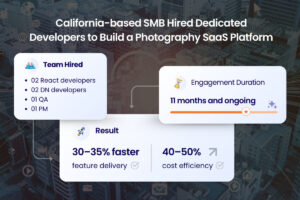
California-based SMB Hired Dedicated Developers to Build a Photography SaaS Platform
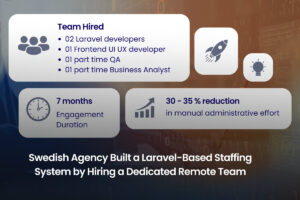
Swedish Agency Built a Laravel-Based Staffing System by Hiring a Dedicated Remote Team