Table of Contents

North Carolina has transformed into a premier hub for software innovation, with the Research Triangle Park and Charlotte’s financial district driving a surge in high-growth SaaS ventures. For founders and CTOs in this region, the transition from a localized startup to a globally scaled platform presents a unique set of infrastructure hurdles. The primary challenge is no longer just about finding a coder who can write a script; it is about identifying strategic partners who understand how to build for millions of concurrent users while keeping operational costs manageable.
As competition for local talent intensifies, many NC firms are re-evaluating their talent acquisition pipelines. The decision to hire backend developers in North Carolina is often balanced against the need for rapid speed to market and the flexibility offered by global delivery models. Navigating this landscape requires a deep understanding of how backend architecture impacts business valuation, investor confidence, and long-term technical debt. This advisory guide provides a framework for North Carolina tech leaders to optimize their backend hiring strategies for maximum scalability.
Understanding the Talent Landscape for SaaS Backend Scalability
The tech ecosystem in cities like Raleigh, Durham, and Charlotte is thriving, but this growth has created a high demand environment where specialized backend talent is at a premium. When companies look to hire backend developers North Carolina, they often find themselves competing with legacy financial institutions and global tech giants who can offer inflated compensation packages. For a mid stage SaaS firm, this competition can lead to hiring delays that stall product roadmaps and defer critical updates needed for saas backend scalability.
The Pressure of Local Competition in the Research Triangle
The concentration of talent in the Research Triangle creates a paradoxical challenge. While the pool of engineers is large, the number of developers with specific experience in high throughput, low latency SaaS environments is relatively small. Leaders must decide if they want to wait months for a local hire or if they should look toward distributed backend teams to fill the gap. Delaying a hire for three to six months can result in missed market opportunities that far outweigh the perceived benefits of an in-person team. To mitigate this risk, many firms choose to hire backend developers through specialized partners who provide pre-vetted talent capable of immediate integration.
Balancing Seniority and Cost in North Carolina
SaaS scalability is rarely achieved by junior developers. It requires architects who understand database sharding, microservices, and asynchronous processing. In North Carolina, the salary expectations for such senior roles have risen sharply. CTOs are forced to weigh the cost of one local senior architect against the possibility of hiring a whole pod of experienced remote developers who can operate under a US based lead. This cost-to-output ratio is becoming the primary driver for hybrid team structures in the Southeast.
Assessing the Opportunity Cost of Slow Hiring
Every week a critical backend role remains vacant, your existing team is likely accumulating technical debt. They may be patching systems rather than building for the future. By the time a local candidate is onboarded and trained, the architectural requirements may have already shifted. This is why many NC leaders now prioritize hiring speed and vendor reliability over physical location, especially when they need to plan backend scalability for an upcoming funding round or product launch.
Planning to Scale Your SaaS Backend in North Carolina?
Don’t let hiring delays stall your product roadmap. Speak with a SaaS backend scalability expert and get a strategic hiring roadmap tailored to your growth stage, funding plans, and infrastructure goals.
Strategic Evaluation Criteria for Backend Roles
Hiring for a SaaS backend is fundamentally different from hiring for a corporate website or a simple internal tool. The stakes are higher because the backend is the engine of the business. When you look to hire backend developers North Carolina, your evaluation criteria must extend beyond basic language proficiency in Java, Python, or Node.js. You need to look for engineers who think in terms of system failure points and recovery protocols. A developer who cannot explain how they would handle a sudden 10x spike in traffic is likely not the right fit for a scaling SaaS company.
Prioritizing Experience in Distributed Systems
Modern SaaS applications rarely run on a single server. They rely on complex architectures involving containers, serverless functions, and distributed databases. Candidates should be evaluated on their ability to manage distributed backend teams and their familiarity with tools like Kubernetes or AWS Lambda. If your candidate lacks experience in distributed computing, your saas backend scalability will eventually hit a ceiling that requires a complete and expensive rewrite. It is often more effective to hire full stack engineers who have a deep backend bias, as they understand how API performance impacts the end user experience.
Evaluating Communication and Delivery Risk
One of the biggest risks in remote or distributed hiring is the breakdown of communication. When working with engineers in different time zones or cities, the quality of documentation and the clarity of Jira tickets become the lifeblood of the project. During the interview process, ask candidates to walk you through how they document a complex API change. If their answer is vague, they will likely become a bottleneck in a distributed environment. This is where a partner like WeblineGlobal provides value, by ensuring that all developers are not only technically proficient but also trained in professional US business communication standards.
Testing for Security and Compliance Awareness
For SaaS companies in North Carolina, especially those in the fintech or healthcare space, security is not an afterthought. Backend developers must be well versed in data encryption, OAuth protocols, and SOC2 compliance. A single security vulnerability can bankrupt a growing SaaS firm. When you review saas growth needs, ensure that security vetting is a core part of your developer onboarding process. This reduces the long term delivery risk and protects your intellectual property from day one.
The Shift Toward Distributed Backend Teams
The traditional model of having every engineer in a physical office in Charlotte or Raleigh is fading. The most resilient SaaS companies are those that have built distributed backend teams. This approach provides a hedge against local labor market volatility and allows for a “follow the sun” development cycle. By leveraging developers in different regions, North Carolina firms can maintain 24/7 coverage for their critical infrastructure, which is essential for global saas backend scalability.
Implementing the RelyShore℠ Delivery Model
At WeblineGlobal, we utilize the RelyShore℠ model to bridge the gap between local oversight and global scale. This allows NC firms to hire backend developers North Carolina style, meaning they get the quality and accountability they expect from a local partner, but with the cost efficiencies and talent depth of our India-based engineering hubs. This model focuses on transparency and IP protection, ensuring that the client retains full project control while we handle the complexities of recruitment and infrastructure. This approach allows you to hire backend developers who are pre-screened for the specific rigors of SaaS growth.
Consistency in Code and Culture
The challenge with distributed teams is often cultural alignment. However, when managed correctly, a distributed team becomes a competitive advantage. It forces a company to adopt better documentation practices and more disciplined sprint planning. These habits are exactly what is needed for saas backend scalability. Instead of relying on informal hallway conversations, decisions are logged and debated in shared digital spaces, creating a permanent record of the architectural evolution of the product. This level of discipline makes it easier to hire full stack engineers later on, as the codebase is organized and accessible.
Managing Time Zones and Real-Time Collaboration
While some founders fear the time difference, it can be managed through overlapping hours and structured handoffs. A well run distributed team ensures that while the North Carolina leadership is sleeping, the backend is being optimized, tested, and prepared for the next day’s deployment. This accelerated development cycle is a key reason why firms choose to plan backend scalability using a global talent pool. It allows for a pace of innovation that local-only teams often struggle to match.
Need Backend Experts Ready to Deploy in Days, Not Months?
Access pre-vetted SaaS backend engineers experienced in distributed systems, microservices, and high-traffic platforms. Get shortlisted candidates within 48 hours and accelerate your scaling plans.
Maximizing ROI When You Hire Backend Developers North Carolina
The ultimate goal of any hiring strategy is to maximize the return on investment. For a SaaS company, ROI is measured in terms of feature velocity, system uptime, and the ability to scale without linear increases in headcount. When you hire backend developers North Carolina, you are investing in the foundation of your business. If that foundation is shaky, every dollar spent on marketing or sales is wasted because the product will fail under the weight of new customers. Investing in high quality saas backend scalability is the most effective way to ensure long term profitability.
Reducing Total Cost of Ownership (TCO)
The total cost of an engineer is not just their salary. It includes benefits, office space, hardware, and the management overhead. Distributed teams significantly reduce these costs, often by 40 to 60 percent. This capital can then be reinvested into product development or market expansion. By working with a dedicated partner, you can review saas growth needs and scale your team up or down based on your current burn rate and project requirements. This flexibility is a massive advantage for startups that need to be lean but ready to grow at a moment’s notice.
Mitigating Technical Debt and delivery risks
Technical debt is the silent killer of SaaS companies. It happens when developers take shortcuts to meet a deadline. Over time, these shortcuts make the system impossible to scale. High quality distributed backend teams are trained to follow best practices that prevent the accumulation of this debt. When you hire backend developers from a reputable source, you are buying into a culture of code quality that pays dividends for years. This is especially important for NC firms looking to be acquired, as savvy investors will conduct deep technical due diligence on the backend architecture.
Shortlisting and Interviewing for Cultural Fit
Even in a remote setting, cultural fit matters. You want engineers who are proactive, curious, and aligned with your company’s mission. At WeblineGlobal, we facilitate direct interviews between our clients and the developers. This ensures that when you hire backend developers North Carolina companies can trust, you have personally verified their technical chops and their personality. We provide shortlists within 48 hours, allowing you to plan backend scalability without the typical HR delays that plague the industry.
Future Proofing Your SaaS Infrastructure
Building a SaaS platform is a marathon, not a sprint. The decisions you make today about your backend team will dictate your ability to compete three years from now. As the North Carolina tech scene continues to evolve, the most successful firms will be those that embrace a global perspective on talent. By combining local leadership with the power of distributed backend teams, you create a robust, scalable, and cost effective engineering organization.
Whether you are building the next big fintech platform in Charlotte or a biotech SaaS in Durham, the principles of saas backend scalability remain the same. You need a team that is agile, skilled, and deeply committed to the quality of their code. When you are ready to hire backend developers or hire full stack engineers, focus on partners who have a proven track record of delivering at scale. This strategic approach will ensure your infrastructure remains a strength rather than a bottleneck as you grow.
Common Mistakes in Backend Scaling
One of the most frequent errors is over-engineering too early. Many teams try to implement complex microservices architectures when a well structured monolith would suffice for their current load. A seasoned backend lead will know when to make that transition. Another mistake is neglecting observability. You cannot scale what you cannot measure. Ensure your team is building in logging and monitoring from the start. Finally, do not wait until your system is crashing to hire backend developers North Carolina specialists. Proactive hiring is always more cost effective than emergency hiring.
Ultimately, your backend is the silent partner in your company’s success. It doesn’t get the glory of a beautiful UI, but it is what keeps the lights on and the users happy. By focusing on quality, scalability, and strategic talent sourcing, you position your North Carolina firm for global success. If you are looking to review saas growth needs or start building your dedicated pod of developers, contact us now to get the best solutions.
Social Hashtags
#SaaS #SaaSScalability #BackendDevelopment #TechHiring #HireDevelopers #SoftwareArchitecture #NorthCarolinaTech #RaleighTech #NCTech #CharlotteTech #StartupGrowth #CTOLeadership #TechFounders #DistributedTeams #TechRecruitment #ScalableInfrastructure
Ready to Build a Scalable, Investor-Ready SaaS Backend?
Let’s design your backend hiring strategy around performance, security, and cost efficiency. Whether you need one architect or a full dedicated pod, we’ll help you scale without technical debt.
Frequently Asked Questions
Hiring a local senior backend developer in North Carolina typically takes 8 to 12 weeks due to high competition. In contrast, through our distributed model, we can provide a vetted shortlist of candidates within 48 hours, allowing you to start the project almost immediately.
We implement strict security protocols, including NDAs, secure access controls, and IP protection. Our developers are trained in US compliance standards such as SOC2 and HIPAA, ensuring that your SaaS data remains secure regardless of where the code is being written.
We offer full flexibility. You can hire a single backend developer to augment your existing team or a full pod consisting of backend, frontend, and QA engineers. This allows you to scale your engineering capacity in alignment with your current project requirements and budget.
Frontend scaling is often about delivering static assets more efficiently. Backend scaling involves managing state, ensuring database consistency, and handling complex logic across distributed systems. It requires a deeper level of architectural knowledge to ensure that, as user numbers grow, the system remains stable and responsive.
Every developer undergoes a rigorous multi-stage vetting process that includes technical tests, communication assessments, and previous project reviews. We focus on hiring developers with experience in high scale SaaS environments, ensuring they are ready to contribute to your goals from day one.



Success Stories That Inspire
See how our team takes complex business challenges and turns them into powerful, scalable digital solutions. From custom software and web applications to automation, integrations, and cloud-ready systems, each project reflects our commitment to innovation, performance, and long-term value.
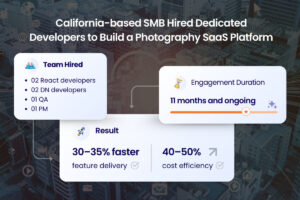
California-based SMB Hired Dedicated Developers to Build a Photography SaaS Platform
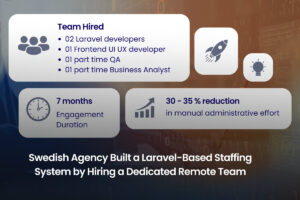
Swedish Agency Built a Laravel-Based Staffing System by Hiring a Dedicated Remote Team