Table of Contents

The technology corridor stretching from Phoenix to Scottsdale and down to Tucson has transformed into a premier hub for innovation. As Silicon Desert continues to attract major enterprise players and high-growth startups, the demand for senior engineering talent has reached a fever pitch. For CTOs and VPs of enterprises in the region, the challenge is no longer just finding talent, but finding talent that can seamlessly integrate into existing cultures without disrupting the momentum of internal processes.
Managing this growth requires a departure from traditional local-only recruitment strategies. Arizona leaders are increasingly looking toward global talent pools to maintain agility and manage costs. However, the true differentiator between a failed outsourcing attempt and a high-performing extension is alignment. When you hire dedicated developers Arizona businesses must ensure that these remote experts operate as a natural extension of their onsite team, sharing the same goals, tools, and technical standards.
The Evolving Landscape of Talent Acquisition in the Silicon Desert
Arizona has become a magnet for tech talent, but the local supply often struggles to keep pace with the rapid expansion of the SaaS, fintech, and healthcare sectors. This gap creates a significant bottleneck for companies trying to hit aggressive product milestones. Local hiring often involves lengthy recruitment cycles, high sign-on bonuses, and the risk of poaching, which can destabilize a growing engineering department.
The move toward the hybrid pod model
Many leaders are shifting away from hiring individual freelancers in favor of dedicated pods. These pods provide a structured team environment where developers, testers, and leads work in unison. By choosing to hire full-stack engineers who are accustomed to working in a dedicated capacity, Arizona firms can bypass the fragmented communication issues often associated with traditional staff augmentation.
Economic advantages of remote integration
Cost efficiency remains a primary driver for many Arizona-based founders. By leveraging a model that combines US-based project assurance with the scale of India-based engineering, companies can reduce their burn rate by 40 to 60 percent. This capital can then be reinvested into marketing, R&D, or local leadership roles, creating a more balanced and sustainable business model.
Eliminating the overhead of local expansion
Hiring locally in Phoenix or Tempe involves more than just salary. You have to consider office space, benefits, hardware, and the administrative burden of HR compliance. Remote teams eliminate these logistical hurdles, allowing technical leaders to focus purely on delivery and architecture.
Struggling to scale your engineering team in Arizona? Discover how aligned remote developers can accelerate delivery without increasing overhead.
Defining Internal Processes for Remote Success
The success of a remote partnership is predicated on how well you review the onboarding strategy. Without a clear blueprint of how code is written, reviewed, and deployed, even the most skilled developers will struggle to provide value. Arizona companies that excel in this area prioritize documentation and process transparency from day one.
Standardizing the communication stack
To align remote teams, Arizona leaders must mandate the use of centralized communication tools. Whether it is Slack, Microsoft Teams, or Jira, every interaction must be searchable and transparent. This prevents “information silos” where remote developers are left out of critical decision-making loops that happen on the office floor.
Establishing a synchronous overlap
While the time difference between Arizona (MST/MST-no DST) and India is significant, it can be turned into a “follow-the-sun” advantage. Successful teams establish a 2 to 3-hour daily overlap. This window is used for stand-ups, pair programming, and unblocking technical hurdles, ensuring that the remote team is never working in a vacuum.
Daily stand-up optimization
Keeping meetings punchy and focused on blockers rather than status updates ensures that the overlap period is used for high-value collaboration. This is especially important when you hire dedicated developers Arizona for fast-paced agile environments.
Engineering Standards and Quality Assurance
Technical alignment is just as important as cultural alignment. When you hire IT consultants or senior developers, they must adopt your specific coding standards, branching strategies, and testing protocols. This consistency ensures that the codebase remains maintainable as it scales.
Implementing automated code reviews
Internal processes should include automated linting and testing suites that run on every pull request. This provides an objective baseline for quality, ensuring that remote contributions meet the same rigorous standards as those produced in-house. It reduces the friction during manual code reviews and speeds up the deployment cycle.
The role of the technical lead in alignment
A dedicated tech lead on the vendor side acts as the bridge between your Arizona-based architects and the remote developers. This lead is responsible for enforcing your internal processes and ensuring that the team understands the “why” behind specific architectural choices. This layer of accountability is a core component of the RelyShore model used by WeblineGlobal.
Documentation as a source of truth
Every architectural decision should be documented in a shared wiki or Confluence page. When remote developers have access to a robust knowledge base, they can solve problems independently without waiting for an Arizona-based colleague to wake up.
See how pre-vetted remote developers can seamlessly integrate with your internal processes and start contributing in days, not months.
Overcoming Cultural and Operational Friction
Cultural alignment is often the most overlooked aspect of remote hiring. Arizona teams are known for their collaborative, direct, and pragmatic approach to problem-solving. Bridging the gap with a team in India requires intentional effort to align remote developers with the local work ethic and social norms.
Building a unified team identity
Remote developers should not be treated as “vendors” but as team members. Including them in company all-hands meetings, celebrating their milestones, and encouraging informal interactions helps build the trust necessary for high-stakes engineering work. When developers feel a sense of ownership, their output quality naturally increases.
Navigating the feedback loop
Open and honest feedback is essential. Internal processes must include regular one-on-one sessions between the remote developers and the Arizona project managers. These sessions are an opportunity to address concerns early, before they manifest as delivery risks or technical debt.
Scalability and Long-Term Delivery Risk Management
The primary reason to hire dedicated developers Arizona is the ability to scale up or down based on project demands. However, scalability without a process-first approach leads to chaos. Arizona leaders must ensure that their vendor has the capacity to provide pre-vetted talent quickly, often within 48 hours, to meet shifting priorities.
Mitigating intellectual property risks
Operating across international borders requires strict adherence to security protocols. Companies like WeblineGlobal prioritize IP protection through robust NDAs, secure access controls, and transparent pricing. Arizona firms should evaluate vendors based on their track record of security and compliance, especially in regulated industries like fintech or healthcare.
Month-to-month flexibility for Arizona startups
Startups in the Phoenix area often face fluctuating funding rounds and market pivots. Having the flexibility of a month-to-month hiring model allows these companies to manage their runway more effectively while still having access to top-tier engineering talent when they need it most.
Evaluating vendor stability
When selecting a partner, look for longevity. A vendor that has been operating since 1999 and has delivered thousands of projects provides a level of security that a new agency cannot. This stability is crucial for long-term alignment with your internal processes.
Measuring the ROI of Process Alignment
The ultimate goal of choosing to hire dedicated developers Arizona is to see a measurable impact on your product roadmap. By aligning remote teams Arizona with your specific internal workflows, you reduce the “onboarding tax” and see a faster return on investment. Success is measured not just by code volume, but by the speed of feature releases and the reduction in production bugs.
WeblineGlobal has helped hundreds of clients, including global brands like LG and Siemens, achieve this level of integration. Contact us to combine the scale of India-based talent with the reliability of a US-backed delivery model, and we ensure that your remote team operates with the precision and dedication of a local hire. When your processes are aligned, the distance becomes irrelevant, and your engineering capacity becomes your greatest competitive advantage.
Strategic Decision-Making for Your Next Engineering Hire
Choosing to hire dedicated developers Arizona is a strategic move that requires a focus on more than just technical skill. It is about finding a partner who understands the nuances of the Silicon Desert tech scene and can provide the process alignment necessary for long-term success. By prioritizing communication, standardizing engineering practices, and leveraging the economic benefits of remote pods, you can build a high-performing engineering organization that is ready to scale. If you are ready to evaluate how a remote team can fit into your current workflow, the next step is to speak with an advisor who understands your local challenges and global opportunities.
Social Hashtags
#HireDedicatedDevelopers #ArizonaTech #RemoteDevelopment #TechOutsourcing #SoftwareDevelopment #GlobalTalent #ITStaffAugmentation #TechLeadership #StartupScaling #AgileTeams
Ready to hire dedicated developers in Arizona? Get a tailored engagement model with fast onboarding, full process alignment, and zero hiring friction.
Frequently Asked Questions
Successful teams establish a consistent daily overlap of 2 to 3 hours. This window is used for critical communication, while the remaining hours allow the remote team to work uninterrupted, providing a continuous development cycle that speeds up project timelines.
Through a structured vetting process, you can typically receive a shortlist of pre-vetted developer profiles within 48 hours. This allows you to scale your team much faster than traditional local recruitment, which can take weeks or months.
Alignment is achieved through integrated tools and processes. By including remote developers in your Jira workflows, Slack channels, and automated code review pipelines, they adopt your standards from day one. A dedicated technical lead also provides an extra layer of oversight.
Yes. One of the primary benefits of the dedicated team model is flexibility. Many vendors offer month-to-month engagements, allowing Arizona companies to adjust their team size based on current product needs and budget constraints without the complexities of local layoffs.
Professional agencies use comprehensive legal frameworks, including NDAs, IP transfer agreements, and secure access protocols. Working with a vendor that has a US presence provides an additional layer of legal assurance and project accountability for Arizona-based businesses.




Success Stories That Inspire
See how our team takes complex business challenges and turns them into powerful, scalable digital solutions. From custom software and web applications to automation, integrations, and cloud-ready systems, each project reflects our commitment to innovation, performance, and long-term value.
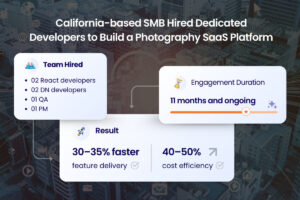
California-based SMB Hired Dedicated Developers to Build a Photography SaaS Platform
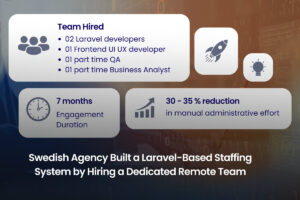
Swedish Agency Built a Laravel-Based Staffing System by Hiring a Dedicated Remote Team