Table of Contents

In the high-stakes ecosystem of the Pacific Northwest, scaling a technology company presents a unique set of challenges that often outpace the capacity of internal teams. For Seattle-based founders and engineering leaders, the transition from a scrappy startup to a high-growth enterprise is marked by a sudden and sharp increase in infrastructure demands. As user bases expand and feature releases accelerate, the foundational systems that once served a handful of users begin to show cracks, necessitating a more sophisticated approach to automation and reliability.
The decision to hire DevOps engineers Seattle businesses rely on is rarely just about adding headcount. It is about architectural survival and the ability to maintain developer velocity without compromising system uptime. When devops complexity Seattle startups face becomes a bottleneck, the leadership team must decide between competing for local talent against the likes of Amazon and Microsoft or seeking a more flexible, scalable hiring model that balances cost with high-level technical expertise.
Understanding the Growth Tipping Point in Infrastructure
Every growing company hits a wall where manual deployments and reactive troubleshooting no longer suffice. In Seattle, where the talent market is incredibly tight, this tipping point often arrives just as a company secures its next round of funding. The pressure to deliver new features increases, but the infrastructure team is still mired in legacy scripts and manual environment provisioning. This creates a friction point that can stall growth entirely if not addressed through strategic hiring.
The Architecture of Growth Phases
During early growth phases, most engineering teams treat DevOps as a shared responsibility. Developers manage their own deployments, and the CTO often handles the cloud console. However, as the product scales, this “everyone does everything” model leads to inconsistent environments and security vulnerabilities. Identifying this transition early is critical to avoiding a total system overhaul later. When you reach this stage, it becomes necessary to hire cloud & devops engineers who can standardize the pipeline and introduce professional-grade automation.
Identifying Infrastructure Debt
Infrastructure debt is the silent killer of scaling startups. It manifests as slow build times, flaky deployment scripts, and a general fear of pushing code to production. If your senior developers are spending more than twenty percent of their time on infrastructure maintenance instead of product features, your growth is being subsidized by technical debt. This is a clear indicator that your current team needs specialized support to manage DevOps complexity before it leads to burnout.
Assessing Operational Bottlenecks
Look for signs such as deployment windows that require all-hands-on-deck, frequent rollbacks, or lack of visibility into cloud spending. These are not just technical issues, they are business risks that impact your bottom line and time-to-market. Addressing these requires a shift from generalist developers to dedicated infrastructure specialists who understand the nuances of modern cloud-native ecosystems.
Scaling fast but struggling with infrastructure stability?
Seattle startups often hit a tipping point where deployments slow down, infrastructure debt grows, and developer productivity drops.
Talk to DevOps experts who help growth-stage companies automate pipelines, stabilize infrastructure, and scale cloud environments faster.
The Seattle Talent Landscape: Local vs. Global Models
Seattle remains one of the world’s most expensive markets to hire devops engineers Seattle based. With major tech giants headquartered in the region, a local hire often comes with a total compensation package that can exceed three hundred thousand dollars per year. For many growth-stage companies, this cost is difficult to justify, especially when multiple engineers are needed to cover 24/7 operations and diverse skill sets like Kubernetes, Terraform, and CI/CD optimization.
Evaluating the Cost of Local Talent Acquisition
Beyond the salary, the time-to-hire in the Pacific Northwest can stretch into months. Every month a critical DevOps position remains vacant is a month where your roadmap is at risk. Leaders must evaluate the opportunity cost of waiting for a local hire versus building a remote-first pod that can start delivering within days. Often, the hybrid approach, where you keep core leadership local and hire IT consultants or remote pods for execution, provides the best ROI.
The Managed Team Advantage
Strategic growth requires speed. By leveraging dedicated pods in India, companies can achieve forty to sixty percent cost savings while gaining access to a massive pool of vetted talent. These teams operate as an extension of your local Seattle office, providing the heavy lifting in automation and monitoring while your local leads focus on high-level strategy and security posture. This model allows you to review scaling approach methodologies without the long-term commitment of massive local overhead.
Cultural and Technical Alignment
The success of a remote model hinges on technical and communication alignment. It is not enough to find someone who knows how to script; you need partners who understand the business context of your growth. Using a model like RelyShore ensures that while the execution happens offshore, the delivery and accountability remain grounded in US-based standards and expectations.
Strategic Evaluation Criteria for DevOps Hires
When you decide to hire DevOps engineers Seattle teams need to succeed, the interview process must pivot away from generic coding challenges toward operational problem-solving. A senior DevOps engineer is a force multiplier. They don’t just fix servers; they build the systems that build the product. Decision-makers should focus on candidates who demonstrate a “platform-as-a-product” mindset, treating internal developer tools with the same rigor as the external customer-facing app.
Assessing Automation Proficiency
True DevOps is about the elimination of manual work. Ask candidates to describe a time they automated themselves out of a task. Their answer should include not just the tool they used, whether it was Ansible, Terraform, or a custom script, but the business impact of that automation. Did it reduce deployment time by fifty percent? Did it eliminate a category of recurring production errors? This focus on measurable outcomes is what separates a technician from a growth-oriented engineer.
Experience with Modern Toolchains
While tools change, the principles remain. However, in the context of growth phases, familiarity with scalable technologies like Kubernetes, serverless architectures, and multi-region cloud deployments is non-negotiable. You need engineers who have seen systems fail at scale and know how to build in the necessary redundancy and observability from the start. This expertise is exactly what you get when you hire cloud & devops engineers who have worked on enterprise-grade projects.
Hiring locally in Seattle can take months and cost hundreds of thousands annually.
Access pre-vetted DevOps engineers and cloud specialists who can integrate with your team in days and help manage scaling complexity.
Review qualified DevOps developer profiles tailored to your tech stack, infrastructure, and growth phase.
Navigating DevOps Complexity During Rapid Expansion
As you scale, the sheer volume of data, traffic, and code changes increases the surface area for failure. DevOps complexity Seattle companies experience is often tied to the transition from a monolithic architecture to microservices. This transition requires a fundamental shift in how monitoring, logging, and security are handled. It is no longer possible for a single person to keep the system in their head.
The Role of Observability in Growth
You cannot manage what you cannot measure. During growth, your DevOps team must prioritize observability. This means moving beyond simple “up or down” monitoring to deep distributed tracing and predictive alerting. When you manage devops complexity through advanced observability, you empower your developers to move faster because they have the data needed to debug issues in real-time rather than guessing at the cause of a bottleneck.
Security as a First-Class Citizen
Growth often leads to security oversight. A common mistake is treating security as a final check before release. Modern DevOps, or DevSecOps, integrates security into the CI/CD pipeline. This includes automated vulnerability scanning, secrets management, and policy-as-code. Hiring engineers who prioritize security ensures that as you grow, you aren’t also growing your liability. This proactive approach is a hallmark of the engineers provided through WeblineGlobal vetting processes.
Scaling the Human Element
As the technical complexity grows, so does the need for clear communication. A DevOps engineer must be able to explain complex infrastructure choices to non-technical stakeholders. They need to justify why a certain cloud spend is necessary or why a deployment must be delayed for a critical security patch. This level of professional maturity is vital for any team looking to review scaling approach options in a high-pressure environment.
Maximizing ROI with Dedicated DevOps Pods
The traditional hiring model is often too slow for the pace of modern tech. By the time you find, interview, and onboard a local engineer, your requirements may have already shifted. Dedicated DevOps pods offer a flexible alternative. These are pre-vetted, cohesive units of engineers who can plug into your existing workflow and start delivering value immediately. This month-to-month flexibility is crucial for companies navigating the unpredictable waters of growth phases.
The RelyShore Model Advantage
WeblineGlobal utilizes the RelyShore model to bridge the gap between India-based scale and US-based reliability. This ensures that Seattle teams get the best of both worlds: the cost efficiency of offshore development with the rigorous quality standards and intellectual property protections expected by American firms. When you hire DevOps engineers Seattle companies can trust, you are investing in a partnership that scales with you, providing shortlists within forty eight hours to keep your momentum high.
Mitigating Delivery Risks
Delivery risk is often the primary concern for CTOs considering remote talent. Will they understand our stack? Will they be available when a server goes down? By using a structured vendor with a twenty-five-year track record, these risks are neutralized. Robust access controls, NDAs, and transparent pricing guidelines provide the peace of mind needed to focus on product innovation while the remote pod handles the heavy lifting of infrastructure management.
Setting the Stage for Long-Term Scalability
Successful growth is not an accident; it is the result of deliberate infrastructure choices made early on. Seattle technology leaders who recognize the need for specialized DevOps support can avoid the pitfalls that sink many promising startups. Whether you are looking to hire cloud & devops engineers for a specific migration or need a dedicated team to manage your entire cloud ecosystem, the focus must remain on quality, speed, and cost-effectiveness.
As you plan your next phase of expansion, consider how your infrastructure team will evolve. Will you stick with the traditional, expensive local-only model, or will you embrace a modern, global approach that provides the flexibility and expertise needed to compete on a global stage? The choice you make today will determine your ability to scale tomorrow. To ensure your systems are ready for the next million users, it is time to manage DevOps complexity with a partner who understands the unique demands of the Seattle tech landscape. Contact us now.
Social Hashtags
#DevOps #DevOpsEngineers #SeattleTech #CloudEngineering #Kubernetes #StartupScaling #TechLeadership #CloudInfrastructure #TechStartups #PlatformEngineering #CICD #EngineeringLeadership #CloudDevOps #DevOpsHiring #TechGrowth
Ready to eliminate infrastructure bottlenecks and scale confidently?
Our dedicated DevOps pods help Seattle companies automate CI/CD, optimize Kubernetes environments, and manage cloud infrastructure during high-growth phases.
Get started with engineers who can deliver results from day one.
Frequently Asked Questions
Local hiring in Seattle can take three to six months due to high competition. WeblineGlobal can provide shortlists of pre-vetted candidates within forty eight hours, allowing you to start projects in a fraction of the time.
Hiring through a remote-first model in India typically results in a forty to sixty percent reduction in total compensation costs compared to local Pacific Northwest salaries, without sacrificing technical depth or delivery quality.
We utilize overlapping hours and 24/7 monitoring schedules to ensure that your infrastructure is always supported. Our RelyShore model emphasizes consistent communication and proactive updates, so your Seattle team is never left in the dark.
Yes. Clients retain full project control and ownership of all intellectual property. We implement strict NDAs, secure access controls, and transparent reporting to ensure your data and code remain protected at all times.
We offer month-to-month hiring flexibility, allowing you to hire a single dedicated developer or a full pod of engineers, depending on the specific needs of your growth phase and the complexity of your infrastructure.



Success Stories That Inspire
See how our team takes complex business challenges and turns them into powerful, scalable digital solutions. From custom software and web applications to automation, integrations, and cloud-ready systems, each project reflects our commitment to innovation, performance, and long-term value.
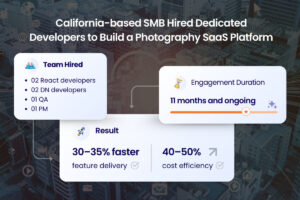
California-based SMB Hired Dedicated Developers to Build a Photography SaaS Platform
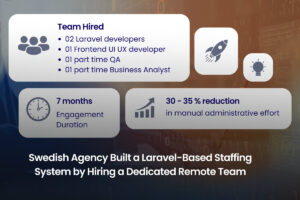
Swedish Agency Built a Laravel-Based Staffing System by Hiring a Dedicated Remote Team