Table of Contents

New York City remains one of the most competitive tech ecosystems in the world, yet for many founders and VPs of Engineering, the city’s greatest asset is also its most significant hurdle. The cost of local talent has reached a point where expanding a roadmap often leads to a disproportionate increase in fixed operational costs. For a startup looking to maintain a lean profile while accelerating product cycles, the traditional model of adding full-time, on-site employees is increasingly difficult to justify to a board focused on capital efficiency and runway preservation.
The challenge is not just the salary. When you hire full stack developers New York tech leaders must account for the secondary costs of localized hiring, including high-tier benefits, office space in prime neighborhoods, and the hidden tax of recruiter fees and lengthy onboarding. This article explores a more pragmatic approach to scaling, where startups decouple their engineering output from their internal headcount growth by leveraging strategic staff augmentation and dedicated remote pods. By adopting this model, leadership can focus on high-level architecture and product-market fit while high-performing remote teams handle the heavy lifting of development.
The New York Hiring Paradox: Why Payroll Growth Stalls Innovation
Every engineering leader in New York understands the pressure of a hiring surge. When a new round of funding hits or a major client signs, the immediate reaction is to open dozens of local reqs. However, the time-to-hire in the city often stretches beyond 90 days for senior roles. This delay creates a vacuum where existing teams are overworked, technical debt accumulates, and the product roadmap slips. When you finally hire full stack engineers locally, the burn rate increases significantly, often without an immediate 1:1 return on productivity due to the steep learning curve of a complex NYC-based codebase.
The True Cost of Local Headcount
A senior developer in New York often commands a base salary that exceeds 180,000 dollars. Once you factor in payroll taxes, health insurance, 401k matching, and the physical footprint required to house them, the total cost of ownership can easily exceed 250,000 dollars per year. For a startup, this is a heavy fixed cost that reduces agility. Many leaders are now realizing that they can expand without payroll growth by shifting their mindset from “owning” talent to “accessing” talent. This transition allows for a more elastic engineering organization that can scale up for a major release and scale back once the product moves into a maintenance phase.
The Impact of Recruitment Friction
The competition for talent in Silicon Alley is fierce. You are not just competing with other startups; you are competing with global financial institutions and tech giants that offer equity packages and perks that are hard to match. This friction means that your internal HR team spends months chasing candidates who may drop out at the final stage for a higher offer. By looking beyond the five boroughs to hire full stack engineers through a vetted partner, you bypass the recruitment war and move directly into the delivery phase.
Scale Engineering Without Hiring Locally
Struggling with high NYC developer costs and slow hiring cycles? Discover how startups are scaling faster with remote full stack teams—without increasing payroll or burn rate.
Strategic Augmentation to Hire Full Stack Developers New York Startups Need
To remain competitive, startups must find a way to maintain the same velocity as their larger competitors without the same bankroll. This is where the hybrid model becomes essential. The core strategy involves keeping a small, high-level team of architects and product owners in-house in New York while using an offshore dedicated team to handle full stack development. This ensures that the strategic direction remains local, but the execution is carried out by a cost-effective, scalable force.
Why Full Stack Versatility Matters in Early Growth
In the early and mid-growth stages, a startup’s needs change weekly. One week the focus might be on refining the React frontend to improve user conversion, and the next, it might be on optimizing the Node.js backend to handle a spike in traffic. When you hire full stack engineers, you gain a team that can pivot between these layers without the friction of handoffs between different departments. This versatility is the primary reason why New York startups prioritize full stack expertise when building their initial remote pods.
Balancing Frontend Speed with Backend Stability
While the frontend is what the users see, the backend is where the value resides. Most startups find that they need to hire backend developers who understand distributed systems and database optimization to support their full stack goals. A well-structured remote pod will include developers who can navigate the entire ecosystem, ensuring that the API layer and the UI remain in perfect sync. This holistic approach reduces the number of bugs that occur at the integration point between the client and the server.
Assessing Technical Proficiency Across the Stack
When evaluating candidates to hire full stack developers New York startups should look for a mastery of modern frameworks like React, Angular, or Vue on the frontend, combined with robust backend skills in Python, Java, or .NET. It is not enough to have a surface-level understanding; the developers must be able to contribute to architectural discussions and understand the performance implications of their code at every level.
Overcoming the Logistics of Remote Engineering Pods
The biggest concern for a CTO in Manhattan is often “How do I manage a team that I cannot see?” This is a valid fear, especially if previous experiences with generic outsourcing have failed. However, the modern staff augmentation model is built on transparency and integration. The remote team should function as an extension of your New York office, participating in daily stand-ups, using the same Slack channels, and committing code to the same repositories. To successfully review flexible teams, one must look at their communication protocols as much as their technical skills.
Managing Time Zones and Synchronous Communication
While India is several time zones away, a professional partner like WeblineGlobal ensures that there is a significant overlap in working hours. This overlap allows for real-time collaboration during the New York morning, where blockers are cleared and requirements are clarified. The rest of the day, the remote team works independently, providing a “follow the sun” development cycle that can effectively double your output. This model allows you to expand without payroll growth by utilizing a global workforce that never sleeps.
The RelyShore℠ Model: Security and Accountability
One of the ways WeblineGlobal differentiates its service is through the RelyShore℠ model. This framework is designed to provide US-based assurance with the scale and cost-efficiency of India-based talent. For a New York startup, this means you get the IP protection, NDA compliance, and quality standards you expect from a domestic firm, but at a price point that allows you to hire three developers for the cost of one local hire. This level of accountability is what makes the decision to review flexible teams a strategic win rather than a risky gamble.
Hire Full Stack Developers New York Startups Trust
Get pre-vetted full stack developers aligned with your tech stack and timezone. Skip the hiring delays and start building with a scalable remote pod in days—not months.
Financial Justification: ROI of Remote Staff Augmentation
For a CFO or a Founder, the decision to hire full stack developers New York talent versus remote talent often comes down to the spreadsheet. If you can achieve the same or better output while reducing costs by 40 to 60 percent, that saved capital can be redirected into marketing, sales, or further R&D. This is the core of how startups scale without bloating their payroll. By maintaining a lower fixed headcount, the company is more resilient to market fluctuations and can extend its runway significantly.
Comparing Total Cost of Ownership
When you hire backend developers or full stack engineers locally, you are paying for the New York cost of living. When you hire through an offshore partner, you are paying for technical expertise without the geographic premium. This does not mean the quality is lower; it simply means the cost of doing business is localized. A startup that chooses to expand without payroll growth can often build a team of five high-performing engineers for less than the cost of two local hires, effectively doubling their development velocity while keeping their burn rate in check.
Scaling Up and Down with Market Demand
The ability to scale a team quickly is a massive competitive advantage. If your startup lands a major enterprise contract, you might need to add four developers within two weeks. Recruiting locally in New York makes this impossible. However, with a dedicated partner, you can review flexible teams and have vetted profiles on your desk within 48 hours. Conversely, if a project concludes, you can scale back the team without the legal and emotional complexities of local layoffs.
Identifying and Mitigating Delivery Risks
No hiring strategy is without risk. When startups hire full stack developers New York based or otherwise, they must be aware of potential pitfalls such as communication gaps, misaligned expectations, and technical inconsistencies. The key to mitigating these risks is a rigorous vetting process and a clear governance structure. You are not just hiring a coder; you are hiring a problem solver who must understand your business logic and your user’s needs.
Technical Vetting and Communication Standards
Before any developer joins a project, they should undergo a multi-stage evaluation. This includes a deep dive into their coding history, a live technical interview, and an assessment of their English communication skills. Because the remote team will be an extension of your New York staff, their ability to articulate complex technical concepts is just as important as their ability to write clean code. We recommend that startups hire full stack engineers who have experience working with US-based clients, as they will be more familiar with the pace and expectations of the NYC tech scene.
IP Protection and Infrastructure Security
For a New York startup, their code is their most valuable asset. Any partner you choose must have robust security protocols in place. This includes secure ODC (Offshore Development Center) environments, restricted access controls, and strict adherence to international IP laws. When you review flexible teams, ensure that the vendor has a long track record of delivering projects for global brands, as this is a strong indicator of their commitment to security and professional ethics.
Making the Decision: How to Transition Your Engineering Strategy
Moving from a 100 percent local team to a hybrid model is a strategic shift that requires buy-in from the top down. It is not about replacing your local team, but about empowering them. By offloading the repeatable, high-volume development tasks to a remote pod, your local architects can focus on innovation and high-level strategy. This creates a more rewarding environment for your New York staff, as they are no longer bogged down by every single bug fix or minor feature request.
To begin this transition, start small. Select a specific product module or a new feature set and hire backend developers or a small full stack pod to take ownership of it. As the relationship matures and the remote team proves its value, you can gradually expand its scope. Contact us for this incremental approach, and it’ll help you expand without payroll growth while minimizing operational risk and building a foundation for long-term and scalable success.
Social Hashtags
#StartupGrowth #NYCStartups #TechHiring #FullStackDevelopers #RemoteTeams #StaffAugmentation #OffshoreDevelopment #ScaleSmart #EngineeringLeadership #TechStartups #SaaSDevelopment #CostOptimization #ProductDevelopment #HireDevelopers #GlobalTalent
Ready to Scale Without Increasing Payroll?
Let’s design your dedicated remote team and reduce your development costs by up to 60%. Talk to our experts and start scaling your product faster—without hiring locally.
Frequently Asked Questions
On average, startups can save between 40 and 60 percent on their total engineering costs. This includes the savings on base salary, benefits, payroll taxes, and office overhead. By choosing to expand without payroll growth, companies can extend their runway and invest more into growth initiatives.
Quality is maintained through a combination of rigorous vetting, automated testing, and regular peer reviews. We recommend integrating the remote team into your existing CI/CD pipelines and code review processes. When you hire full stack engineers through WeblineGlobal, you are getting professionals who are accustomed to high-standard development environments.
Yes. In fact, we encourage it. You should have full control over the team composition. You can interview candidates, review their portfolios, and even assign a small coding task to ensure they are the right fit for your specific tech stack and company culture.
While a local hire in New York can take 3 to 4 months, a remote developer or a full pod can often be shortlisted and ready for interview within 48 to 72 hours. This speed allows you to respond to market opportunities in real-time without the drag of a traditional recruitment cycle.
The client retains 100 percent ownership of all intellectual property, source code, and assets produced during the engagement. This is backed by comprehensive NDAs and legal contracts that ensure your startup’s innovations are fully protected.



Success Stories That Inspire
See how our team takes complex business challenges and turns them into powerful, scalable digital solutions. From custom software and web applications to automation, integrations, and cloud-ready systems, each project reflects our commitment to innovation, performance, and long-term value.
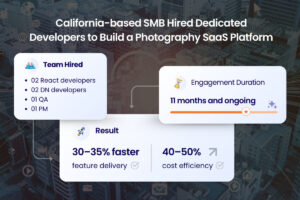
California-based SMB Hired Dedicated Developers to Build a Photography SaaS Platform
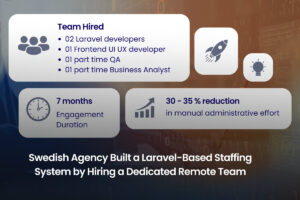
Swedish Agency Built a Laravel-Based Staffing System by Hiring a Dedicated Remote Team