Table of Contents

Reaching Series B is a milestone that changes the DNA of a startup. In the San Francisco ecosystem, this stage signals the end of the “move fast and break things” era and the beginning of the “scale fast and sustain” era. For CTOs and VPs of Engineering, the pressure shifts from proving product-market fit to delivering a robust, enterprise-grade roadmap while managing an increasingly scrutinized burn rate. The local talent market, however, often presents a paradox where the cost of talent rises faster than the availability of the specific expertise required to scale.
The traditional approach of hiring solely within the 415 or 650 area codes starts to show its limitations during this phase. As product complexity grows, the need for dedicated product engineers San Francisco becomes acute, yet the competition from FAANG and late-stage unicorns makes local recruitment a slow, expensive battle. Forward-thinking leaders are now shifting their strategy toward hybrid models that combine local core leadership with high-performing offshore pods to maintain velocity without draining their fresh capital on overhead alone.
The Series B Scaling Wall: Why Local Hiring Slows Down
In the early stages, a handful of generalist engineers can manage the entire stack. But once Series B funding hits, the roadmap usually expands into multiple product lines, integrations, and performance optimizations. This is where many San Francisco teams hit a wall. Attempting to hire full stack engineers locally often results in three-month recruitment cycles and salary expectations that can destabilize a budget. The scarcity of high-level talent means that even with millions in the bank, your speed to market is governed by how fast you can find a seat for a new hire in a physical or local remote setting.
The Economics of the Bay Area Talent War
San Francisco remains the global hub for innovation, but it is also the most expensive place to build a team. When you calculate the total cost of ownership for a local senior developer, including benefits, office space, equity, and payroll taxes, the numbers often exceed $300,000 per year. For a Series B company looking to add 20 engineers, that is a $6 million annual commitment just for headcount. By deciding to adjust hiring post funding, leaders can reallocate that capital toward marketing, sales, or specialized R&D while maintaining a larger engineering footprint.
Equity Dilution and Retention Challenges
Retention is the silent killer of Series B startups. In San Francisco, engineers are constantly approached by recruiters with better offers. Losing a key full-stack developer in the middle of a sprint can set a product back by months. When companies hire full stack developers San Francisco through an offshore model, they often find higher loyalty and lower turnover, as these developers are integrated into the team as long-term partners rather than mercenary contractors. This stability is crucial for maintaining the institutional knowledge required to scale a complex codebase.
Opportunity Cost of Slow Hiring
Every month a position remains open is a month the product roadmap remains stagnant. In the competitive SaaS landscape, a 90-day delay in feature release can be the difference between market leadership and obsolescence. Speed is the primary currency of the post-Series B world, and the traditional local-only hiring model is often too slow to keep up with the demands of the board and the market.
Scaling After Series B? Don’t Let Hiring Slow You Down
Just raised Series B and feeling the pressure to scale fast without burning capital?
Discover how San Francisco startups build high-performing engineering pods—without the Bay Area hiring bottleneck.
Rethinking the Full Stack Requirement for Series B
The definition of a full-stack developer changes as a company matures. At the seed stage, it means someone who can do everything. At Series B, it means someone who understands the architectural implications of their code across the entire delivery pipeline. Decision-makers must look for dedicated product engineers San Francisco who can think like product owners. These engineers do not just close tickets; they understand how a change in the backend affects the user experience on the frontend and the data integrity in the database.
From Generalists to Product-Focused Engineers
Post-funding growth requires a shift from “hacking it together” to “engineering for scale.” This requires a deep understanding of CI/CD, automated testing, and cloud-native architectures. When you hire enterprise developers, you are looking for people who have seen what happens when a system handles 10x its current traffic. They bring a level of discipline to the development process that prevents technical debt from accumulating to a point of paralysis. This transition is why the hiring criteria must evolve from simple coding proficiency to systems thinking.
The Balance of Frontend and Backend Velocity
A common mistake in Series B hiring is over-indexing on one part of the stack. A team might have a brilliant backend but a sluggish, unoptimized frontend that frustrates users. This is why the demand to hire full stack developers San Francisco remains so high; these individuals act as the glue between specialized functions. They ensure that the API design and the UI implementation are in perfect sync, reducing the friction that often occurs when separate teams handle different layers of the application.
Cross-Functional Communication in Remote Pods
Effective full-stack development is as much about communication as it is about code. In a remote or hybrid environment, developers must be able to articulate technical trade-offs to non-technical stakeholders. This is a core part of the vetting process at WeblineGlobal, where we ensure that engineers are not just technically proficient but are also equipped to participate in the product discovery and planning phases alongside US-based leadership.
Hybrid Pods: The Strategic Advantage of Offshore Engineering
The most successful Series B companies in the Bay Area are moving toward a “pod” structure. Instead of hiring individual contributors one by one, they plan execution teams that are pre-configured with a mix of senior and mid-level developers, often supported by a local product manager or CTO. This hybrid approach provides the best of both worlds: local strategic oversight and offshore execution at scale. It allows the core team in San Francisco to focus on high-level architecture and market strategy while the dedicated pod handles the heavy lifting of feature development and maintenance.
US Management with India-Based Execution
One of the biggest concerns for SF-based leaders is the “black box” effect of outsourcing. This is why the RelyShore model is so effective. By having a US-based presence that understands the local business culture and a deep talent pool in India, companies can ensure that expectations are met without the typical friction of offshore engagement. When you hire full stack developers San Francisco through this model, you get the cost advantages of India with the accountability and communication standards expected by a US executive team.
The RelyShore Delivery Model and Reliability
Reliability is non-negotiable at Series B. The RelyShore model focuses on transparency, IP protection, and consistent delivery. It moves away from the old “body shopping” approach toward a value-driven partnership. This means that the developers are not just an extension of your team; they are your team. They use your Slack, attend your standups, and are deeply invested in your product’s success. This level of integration is what allows a company to scale its engineering capacity by 3x or 4x without a corresponding increase in management overhead.
Managing Time Zone Overlap and Syncing
While the time difference between San Francisco and India is significant, it can be turned into a “follow the sun” advantage. Critical bugs can be addressed overnight, and features can be developed while the US team sleeps. Successful CTOs use this to create a 24-hour development cycle, where the morning sync becomes the handoff point. This requires dedicated product engineers San Francisco who are experienced in working within this specific workflow, ensuring that no time is lost in translation or transition.
Build Your Product Team Faster—Without Bay Area Costs
Hiring full stack developers in San Francisco is slow and expensive post-Series B.
See how hybrid offshore pods help startups scale engineering capacity by 3–4x while maintaining product quality, velocity, and IP security.
Evaluating Vendors for Post-Series B Growth
Not all staffing agencies or software houses are equipped to support a Series B startup. Many are used to small, one-off projects rather than the long-term, iterative development required for a growing product. When you look to hire full stack engineers, the vendor’s track record with similar-sized companies is a critical data point. You need a partner that can scale with you, providing two developers today and twenty six months from now as your requirements evolve.
Vetting for Communication and Cultural Alignment
The technical interview is only half the battle. For a San Francisco product team, cultural fit and “product sense” are equally important. Can the developer challenge a requirement if they see a more efficient way to build it? Do they understand the “why” behind the user story? At WeblineGlobal, we emphasize vetting for these soft skills because we know that a developer who doesn’t understand the product context will eventually become a bottleneck. The goal is to find dedicated product engineers San Francisco who can integrate seamlessly into the high-velocity, feedback-rich culture of a Bay Area startup.
Security, Compliance, and IP Protection
As you scale toward Series C and beyond, security and compliance (like SOC2 or HIPAA) become paramount. Your hiring strategy must account for this. When you hire enterprise developers through a partner, you must ensure they have robust security protocols in place, from secure hardware to restricted access environments. Protecting your intellectual property is not just about a contract; it is about the operational practices of the vendor you choose to partner with. This is a core differentiator for established firms that have been in the industry for decades.
Transparent Pricing and Month-to-Month Flexibility
Series B companies need to remain agile. Fixed-price contracts often lead to scope creep and disputes. Instead, a transparent, month-to-month model allows you to scale the team up or down based on your current funding and roadmap priorities. This flexibility is essential for managing the financial volatility that can sometimes follow a major funding round, allowing you to adjust hiring post funding as market conditions change.
Cost Efficiency and ROI Post-Funding
The primary reason San Francisco teams look offshore is cost, but the primary reason they stay is quality. If the quality is not there, the cost savings are quickly erased by the need to refactor poor code or manage late deliveries. However, when done correctly, hiring in India can reduce engineering costs by 40 to 60 percent. This capital efficiency allows a Series B company to extend its runway significantly, giving it more time to reach the milestones required for a successful Series C or an exit.
Burn Rate Optimization for Sustainable Growth
Investors at the Series B stage are looking for a path to profitability or at least a highly efficient use of capital. A high burn rate driven by excessive local salaries can be a red flag during future due diligence. By choosing to hire full stack developers San Francisco through an offshore pod, you demonstrate to your board that you are being strategic with their capital. You are prioritizing the delivery of the roadmap over the prestige of a massive local headquarters.
Accelerating the Product Roadmap
With a larger, more cost-effective team, you can run multiple workstreams in parallel. You can have one team focused on core product features, another on technical debt and infrastructure, and a third on new market integrations. This parallelization is often impossible with a small, expensive local team. By being able to plan execution teams effectively, you can deliver more value to your customers in a shorter amount of time, which is the ultimate driver of ROI in a venture-backed company.
Long-term Value vs. Short-term Savings
The goal is not to find the cheapest developers in the world, but the best value. This means finding engineers who write clean, maintainable code and who can contribute to the long-term health of the application. The cost of a “cheap” hire who creates technical debt is much higher than the cost of a senior, vetted developer from a reputable partner like WeblineGlobal. Quality must always be the leading indicator, with cost as the supporting factor.
Building Your Post-Series B Engineering Roadmap
Scaling an engineering team in San Francisco after a Series B round requires a departure from the status quo. It requires a willingness to look beyond the immediate geographical area and embrace a global talent strategy. Contact us to have dedicated product engineers San Francisco who can be integrated into your existing workflows, you gain the agility and capacity needed to compete at the highest level. The shift is not just about saving money; it is about building a more resilient, scalable, and productive engineering organization.
As you look to the future, consider how your team composition will evolve. The most successful founders are those who realize they cannot do it all locally and instead build a bridge between the innovation center of the Bay Area and the massive engineering talent pool available globally. This strategy ensures that when the market moves, your team is ready to move with it, backed by a delivery model that prioritizes reliability and performance above all else.
Social Hashtags
#SeriesB #StartupScaling #SanFranciscoStartups #HireDevelopers #FullStackDevelopers #ProductEngineering #CTOLife #EngineeringLeadership #OffshoreDevelopment #TechHiring #SaaSScaling #BurnRateOptimization
Get Vetted Developer Profiles—Ready to Start in Weeks, Not Months
Looking to hire full stack developers San Francisco startups trust—without long hiring cycles or equity dilution?
Get access to pre-vetted, product-focused engineers experienced in scaling Series B SaaS platforms.
Frequently Asked Questions
With a pre-vetted talent pool, you can typically see shortlists within 48 hours and have developers integrated into your team within two weeks. This is significantly faster than the 2-3 months often required for local San Francisco hires.
Quality is ensured through a rigorous multi-stage vetting process that includes technical assessments, communication evaluations, and cultural fit interviews. Partnering with a firm that has a long track record of delivering for US-based enterprise clients adds an extra layer of assurance.
Yes, provided they are integrated into your internal processes. By using the same tools (Slack, Jira, GitHub) and participating in daily standups, dedicated product engineers San Francisco can operate as a seamless extension of your local team, maintaining the same velocity and focus.
The main risks involve communication gaps and misalignment of expectations. These are mitigated by choosing a partner with a US presence and a proven delivery model like RelyShore, which emphasizes transparency and proactive management.
Not at all. You retain full control over the project, the architecture, and the roadmap. The offshore team acts as your execution arm, following your direction while providing the scale and technical expertise needed to hit your targets.



Success Stories That Inspire
See how our team takes complex business challenges and turns them into powerful, scalable digital solutions. From custom software and web applications to automation, integrations, and cloud-ready systems, each project reflects our commitment to innovation, performance, and long-term value.
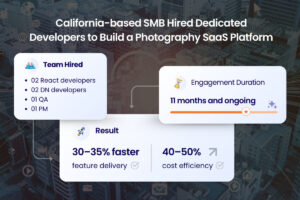
California-based SMB Hired Dedicated Developers to Build a Photography SaaS Platform
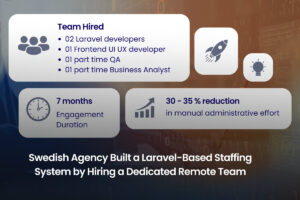
Swedish Agency Built a Laravel-Based Staffing System by Hiring a Dedicated Remote Team