Table of Contents

Toronto has rapidly evolved into a primary North American tech hub, attracting some of the brightest minds in engineering and product development. However, this growth has created a high pressure environment where founders and CTOs feel compelled to scale their local headcount as a signal of success. The result is often a bloated payroll and a team structure that is too rigid for the volatile early stages of a product lifecycle. When companies rush to hire it consultants Toronto before their roadmap is fully validated, they frequently find themselves trapped in a cycle of high burn and technical inertia.
The lessons learned from these experiences are often expensive but invaluable. Leadership teams eventually realize that the goal is not just to have desks filled in an office near King Street, but to maintain a flexible, high performance delivery engine. This article examines the strategic missteps common in the Toronto ecosystem and provides a blueprint for how decision makers can pivot toward more sustainable hiring models, including the use of remote pods and global talent to balance cost and speed.
The Financial Gravity of Premature Local Scaling
Toronto is no longer a low cost alternative to Silicon Valley. Salaries for senior engineers and specialized architects have spiked, often rivaling those in major US tech centers. For an early stage company, committing to a dozen local six figure salaries before achieving product market fit is a significant risk. If the product direction needs to change, the company is often stuck with specialists who do not fit the new requirements, leading to difficult layoffs or unproductive pivoting.
The Overhead Beyond Salaries
When you hire it consultants Toronto or bring on full time local staff, the cost extends far beyond the base pay. Canadian payroll taxes, health benefits, office space in the downtown core, and the administrative burden of HR management add a substantial layer of “hidden” burn. For a startup or a mid sized firm looking to innovate, these fixed costs reduce the capital available for actual experimentation and customer acquisition. Many leaders find that by the time they realize they need a different skill set, their budget is already depleted by these overhead obligations.
Equity Dilution and Talent Retention
In a competitive market like Toronto, attracting top tier local talent usually requires significant equity grants. If you hire too early, you are giving away large portions of your cap table to individuals who might not be the right fit for the company two years down the line. This becomes a major hurdle during future funding rounds or when you eventually need to reset team structure to align with new business goals. High churn in the Toronto market also means that just as a developer becomes fully onboarded, they may be lured away by a larger enterprise, leaving you with a technical gap and a loss of historical knowledge.
Hired Too Early? Fix Your Engineering Strategy Before Burn Takes Over
Many Toronto startups scale local teams too fast—and pay for it later.
Talk to our experts to evaluate whether your current hiring model is helping or hurting your growth.
Common Hiring Mistakes Early Stage Teams Make
One of the most frequent hiring mistakes early-stage companies make is prioritizing “prestige” hires over “utility” hires. Bringing on a high-level architect from a major Canadian bank might look good on a pitch deck, but that individual may not be prepared to handle the hands-on, messy work of building a minimum viable product. This mismatch between seniority and the required daily output leads to stalled progress and frustration on both sides.
Hiring Specialists Too Soon
In the beginning, you need generalists who can navigate across the stack. Hiring a dedicated DevOps engineer or a specialized Data Scientist before your core application is stable is a luxury most early-stage firms cannot afford. These specialists often end up underutilized or, worse, they over-engineer solutions for problems the company does not yet have. A more strategic approach is to hire full stack engineers who can wear multiple hats, ensuring that every dollar spent on payroll directly contributes to shipping features.
The Trap of Local Availability
Decision makers often limit their search to who is available in the GTA, even if the specific expertise required is scarce. This local bias leads to “settling” for candidates who meet some but not all of the criteria. Over time, these compromises accumulate, resulting in a codebase that is difficult to maintain and a team that lacks the specialized knowledge to solve complex scaling issues. Expanding the search to include remote, pre-vetted experts allows you to find the exact match for your technical needs without the geographical constraints.
Management Debt and Internal Friction
Every new local hire requires management. For a CTO or a VP of Engineering, spending forty percent of their week on 1:1s, performance reviews, and culture building for a local team means forty percent less time spent on product strategy. This management debt is one of the most overlooked aspects of early hiring. By the time the leadership realizes they have too many direct reports, the technical roadmap has already begun to slip. This is why many Toronto leaders now look to hire IT consultants who can manage specific workstreams autonomously.
The Strategic Value of the Team Reset
When a company realizes its current team composition is no longer serving its growth, it must perform a team reset. This is not necessarily about firing people, but about restructuring how work gets done. It involves identifying the core “brain” of the company—the local leaders who hold the product vision—and surrounding them with flexible, high-output remote pods that can scale up or down based on the current project phase.
Transitioning to a Hybrid Delivery Model
A successful team reset often involves shifting from a 100 percent local team to a hybrid model. In this scenario, the Toronto-based leaders focus on strategy, stakeholder management, and high level architecture, while the heavy lifting of development is handled by dedicated remote teams. This reduces the administrative burden on the local leadership and allows the company to reallocate budget toward more developers rather than more office space. WeblineGlobal has helped numerous firms navigate this transition, providing the technical scale needed to meet aggressive deadlines without the local hiring headaches.
Maintaining Quality and Culture During a Pivot
The fear many leaders have when they learn from early hiring mistakes is that moving work remote will dilute their company culture. However, modern engineering practices such as CI/CD, robust documentation, and clear Jira workflows actually thrive in a remote or hybrid environment because they force better communication. A team reset is an opportunity to implement these professional standards, ensuring that the engineering organization is built on processes rather than just the physical presence of people in a room.
Addressing the Skills Gap
Sometimes a reset is necessary because the original team simply does not have the skills to take the product to the next level. If you started with a team of WordPress developers but now need to build a complex SaaS platform with React and Node.js, trying to “retrain” everyone locally is slow and expensive. It is often more effective to hire IT consultants who already possess the required expertise. This allows your local team to stay focused on their strengths while the new experts handle the architectural shift.
Build Faster Without Adding More Local Overhead
If your burn rate is climbing faster than delivery, it may be time to rethink local-only hiring.
Learn how Toronto teams scale efficiently using hybrid delivery models and remote engineering pods.
Why Decision Makers are Choosing Remote Engineering Pods
The realization that hiring it consultants Toronto for every role is unsustainable has led many CTOs to the “pod” model. Instead of hiring individuals one by one, companies engage a pre-formed team of developers, QA, and a lead who have already worked together. This eliminates the “storming and norming” phase of team building and allows for immediate productivity.
Cost Efficiency and ROI Justification
Budgeting is a primary concern for any VP of Engineering. By integrating remote talent from regions like India, Toronto firms can often reduce their development costs by 40 to 60 percent. This is not just about saving money; it is about what that money can buy. For the price of one senior local developer, a company can often hire a three-person pod of highly skilled engineers. This increased capacity allows for parallel development of features, faster bug fixing, and a more aggressive go-to-market strategy.
Scaling Without the Delivery Risk
Hiring is always a gamble, but hiring locally in a tight market increases the risk. If a key local hire leaves after three months, the project is jeopardized. Remote pods provided by established vendors like WeblineGlobal mitigate this risk through built-in redundancy. If one developer needs to be replaced, the vendor handles the transition, ensuring that the project momentum is never lost. This level of delivery assurance is critical for Toronto teams that are under pressure from investors to hit specific milestones.
Evaluating Your Hiring Strategy
Before you make your next hire, it is essential to ask whether you are hiring for the right reasons. Is the role critical for local presence, or are you simply following a traditional hiring script? Many of the most successful tech companies in Ontario are those that have embraced a global mindset, leveraging the best talent regardless of geography to build their core products.
Key Questions for CTOs and Founders
When evaluating a potential vendor or considering a new hire, ask yourself: Can this role be performed effectively by someone in a different time zone if the communication protocols are strong? What is the true cost of this hire over eighteen months, including benefits and equity? Do we have the internal capacity to manage another direct report, or should we hire IT consultants who can operate with minimal oversight? Answering these questions honestly often leads to a more balanced and resilient team structure.
The Role of Technical Vetting
Whether you choose to hire locally or remotely, vetting is where most mistakes happen. For Toronto teams, the temptation is to trust a resume or a local recommendation. However, rigorous technical testing and communication assessments are non-negotiable. When you partner with a provider like WeblineGlobal, you gain access to a pool of developers who have already passed these hurdles, allowing you to focus on the final interviews and cultural alignment rather than initial screening.
Leveraging the RelyShore Model
For firms that want the cost benefits of offshore talent with the accountability of a local partner, the RelyShore model offers a middle ground. This approach provides a US or Canada-based point of contact who manages the India-based engineering team. It bridges the gap in time zones and communication styles, giving Toronto decision makers the peace of mind they need while realizing significant cost savings. This model is particularly effective for companies going through a reset team structure phase.
Moving Toward a Smarter Engineering Future
The lessons from Toronto’s early hiring mistakes are clear: speed and flexibility trump head count. By moving away from the “local only” mindset, companies can protect their runway and ensure they have the right skills at the right time. Whether you need to hire full-stack engineers for a new product launch or require specialized consultants to fix an architectural bottleneck, the global talent pool is your greatest asset.
Strategic hiring is about more than just filling seats. It is about building a scalable engine that can adapt to the market. For leaders in Toronto, contact us, and we help you build bespoke IT solutions with standard quality at affordable rates. You can embrace a hybrid and global approach to engineering. When you prioritize delivery over geography, the path to scaling becomes much clearer and significantly less risky.
Social Hashtags
#TorontoTech #HireITConsultants #StartupHiring #TechLeadership #CTOLife #EngineeringStrategy #StartupScaling #RemoteTeams #HybridWork #BurnRateManagement #ProductDevelopment #TechStartupsCanada #GlobalTalent
Get Pre-Vetted Developer Profiles—Ready to Start, Not Learn
Looking to hire IT consultants Toronto teams rely on—without long hiring cycles or equity dilution?
Access experienced, pre-vetted engineers who integrate seamlessly with your existing team.
Frequently Asked Questions
Signs include a high burn rate with low feature output, senior leaders spending most of their time on HR issues rather than product, and specialized engineers sitting idle because the prerequisite work is not finished. If your team is waiting for "clearer requirements" before they can code, you may have over-hired for your current stage.
Quality is maintained through rigorous vetting, standardized coding practices, and strong local leadership. By working with a reputable partner like WeblineGlobal, you ensure that the developers have been tested for both technical proficiency and communication skills. Using a RelyShore model also provides a local layer of accountability.
A team reset should be handled transparently but decisively. Identify the core roles that must remain local and then look for areas where remote pods can take over specific workstreams. This often involves moving from individual contributors to a "pod" based system that integrates with your existing leadership.
In almost all cases, remote developers from India are significantly more cost-effective, often reducing expenses by 40 to 60 percent. This includes the savings on salaries, benefits, office space, and administrative overhead. The real value, however, is the ability to hire a larger, more capable team for the same budget as a small local one.
While local hiring in Toronto can take 3 to 6 months, a pre-vetted remote developer can often be shortlisted within 48 hours and onboarded within two weeks. This speed is a critical advantage for teams that need to react quickly to market changes or investor demands.




Success Stories That Inspire
See how our team takes complex business challenges and turns them into powerful, scalable digital solutions. From custom software and web applications to automation, integrations, and cloud-ready systems, each project reflects our commitment to innovation, performance, and long-term value.

California-based SMB Hired Dedicated Developers to Build a Photography SaaS Platform
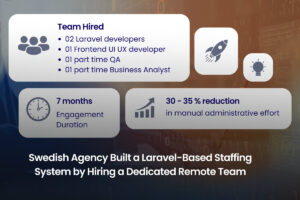
Swedish Agency Built a Laravel-Based Staffing System by Hiring a Dedicated Remote Team