Table of Contents

Introduction: The Stability Imperative for New York Enterprise Platforms
For CTOs and VPs of Engineering operating within New York’s competitive financial, media, and tech sectors, platform stability is non-negotiable. Mission-critical systems processing high-volume transactions, managing complex regulatory compliance, or handling vast real-time data streams cannot afford downtime or unpredictable performance bottlenecks. This demand for resilience and scalability is why Java, despite the rise of newer languages, remains the bedrock for institutional technology across the city.
The core challenge for New York enterprises is not whether to use Java, but how to staff these platforms quickly, cost-effectively, and with the necessary seniority. Local talent acquisition is fiercely competitive and prohibitively expensive, leading most forward-thinking leaders to pivot toward strategic remote staffing models. The strategic decision then shifts from “Do we need Java?” to “Where do we find high-caliber dedicated Java developers New York enterprises can trust, and how do we integrate them seamlessly into our delivery pipeline?” This guide provides a framework for evaluating those critical decisions.
The Strategic Need: Why Java Remains the Cornerstone for Enterprise Development in NYC
When reviewing technology stacks for long-term strategic investment, senior leaders look beyond current trends and focus on security, maintainability, and ecosystem maturity. Java provides these guarantees, making the decision to hire Java developers New York enterprises easier from a technical risk perspective.
Stability, Maturity, and Longevity of the JVM Ecosystem
Java’s “write once, run anywhere” philosophy, coupled with the inherent stability of the Java Virtual Machine (JVM), significantly reduces operational risk. For systems that must run reliably for decades, the maturity of the Java ecosystem means deep documentation, decades of security patches, and a massive pool of developers capable of maintaining legacy codebases while simultaneously building modern microservices architectures. When recruiting, you are not just hiring a coder; you are hiring someone fluent in a massive, resilient technical landscape.
Performance and Concurrency Handling for High-Volume Systems
New York-based systems, especially in FinTech, demand exceptional throughput and low latency. The JVM’s advanced garbage collection, just-in-time (JIT) compilation, and robust threading models enable superior concurrency handling compared to many scripting languages. Successful enterprise developers New York under the offshore model must be able to fine-tune these features to extract peak performance. When assessing candidates, therefore, it’s vital to check their expertise not just in writing basic Java code, but in optimizing memory profiles and diagnosing high-load performance issues.
Evaluating the Commitment to Long-Term Delivery
Java projects often have lifecycles measured in years, not months. This necessitates hiring professionals who understand long-term maintainability. When WeblineGlobal supports clients looking to support core platforms, we prioritize engineers who understand design patterns like Dependency Injection and SOLID principles, ensuring the platform remains modular and adaptable as business requirements inevitably shift.
If you are ready to evaluate senior candidates to support core platforms, then contact us as we provide vetted profiles quickly. Our focus is on identifying engineers who possess both the technical depth and the long-term commitment required by top New York organizations.
Evaluating Scalability: Beyond Syntactic Checks When You Hire Java Developers
Hiring developers who can handle greenfield projects is one challenge; hiring enterprise developers New York who can scale a mission-critical platform while it’s under heavy load is another. The true measure of a senior Java engineer is their knowledge of the surrounding architectural landscape, not just the language syntax.
Framework Proficiency: Mastering the Spring Ecosystem
The Spring framework (particularly Spring Boot and Spring Cloud) is the lingua franca for modern enterprise Java development. A candidate who claims expertise must demonstrate practical experience with Spring Data, Spring Security, and building RESTful services using Spring MVC. Crucially, they should understand how to configure and deploy these services efficiently in containerized environments (Docker/Kubernetes). If a potential hire can only use Spring at a surface level, they will quickly become a delivery bottleneck on any complex project.
Cloud-Native and Microservices Experience
Modern Java platforms are rarely monolithic. They utilize microservices deployed across AWS, Azure, or GCP. When you hire Java developers, ensure they possess hands-on experience designing distributed systems, managing inter-service communication (e.g., using Kafka or RabbitMQ), and implementing robust circuit breaker patterns. Ask specific, scenario-based questions about latency mitigation and data consistency in distributed transaction environments—these are the critical areas where true senior expertise shines through.
Assessing Data Access and ORM Expertise (JPA/Hibernate)
Many performance issues in large-scale Java applications trace back to inefficient data access. Successful dedicated Java developers New York teams must demonstrate expertise in Object-Relational Mapping (ORM) tools like Hibernate or JPA. Can they optimize complex queries? Can they correctly manage caching layers (like Redis or Memcached)? Evaluating these specific areas during the interview process is far more valuable than simply testing core language competency.
Stabilize Your Enterprise Java Platform Without Local Hiring Delays
New York enterprises rely on Java for mission-critical systems—but local hiring slows delivery and inflates costs. Talk to our experts to explore proven remote staffing models built for long-term platform stability.
The Cost vs. Competency Dilemma: Sourcing Dedicated Java Developers New York Talent
The high cost of living and intense competition in the New York metropolitan area mean local salaries for senior Java developers often push project budgets past sustainable limits. This economic reality is the primary driver compelling enterprises to seek highly skilled, cost-effective remote alternatives globally.
Navigating the Local Talent Crunch
Even if the budget were unlimited, the sheer velocity of hiring required to staff a scale-up or migration project is often impossible to meet locally. The demand for specialized skills (like Java engineers with Kafka or Kubernetes experience) far outstrips supply. This means relying solely on local recruitment guarantees prolonged time-to-market and increased delivery risk.
Offshore Cost Efficiency with Quality Assurance
The strategic alternative is not simply finding cheap labor, but leveraging global talent pools where the cost of living allows for superior value. By selecting partners like WeblineGlobal, which specializes in connecting US-based leadership with senior remote talent in high-skill regions, New York enterprises can realize 40–60 percent cost savings while maintaining high technical bars. The key is ensuring that the remote team structure (whether staff augmentation or dedicated pods) comes with robust assurance mechanisms—security protocols, communication standards, and accountability reporting.
We help businesses hire enterprise developers who meet demanding US technical standards but operate within a dramatically different cost structure. This balance is essential for long-term, scalable growth without constant budget constraints.
To understand the cost advantages and quality assurance models for recruiting high-caliber dedicated Java developers New York organizations need to review Java experience with our team. WeblineGlobal focuses on matching senior talent that fits your specific enterprise needs and budget.
Mitigating Delivery Risk: Hiring Models for Mission-Critical Java Platforms
A poorly structured remote team introduces significant risk: miscommunication, inconsistent velocity, and potential security lapses. When hiring, you must evaluate the vendor’s model as carefully as you evaluate the engineers themselves.
Defining Team Autonomy vs. Integration (Staff Augmentation vs. Dedicated Pods)
When you seek to hire Java developers remotely, you have two primary models. Staff augmentation (placing developers directly under your existing management) is ideal for filling specific short-term gaps. However, for building core platforms, the dedicated team or “pod” model (where the vendor supplies a self-managed unit including engineers, QA, and a local lead) often reduces internal management overhead and ensures more consistent delivery velocity. CTOs must decide which model offers the optimal balance of control and efficiency for their specific project risk tolerance.
Security, Compliance, and IP Protection
For New York enterprises, particularly those in regulated industries, data security and IP protection are paramount. Any remote engagement must be governed by strict NDAs, clear IP ownership clauses, and verifiable security protocols. In the case of WeblineGlobal, our RelyShore℠ model includes mandatory infrastructure access controls and physical security measures, ensuring that remote teams handle sensitive enterprise code with the same rigor as an in-house team.
Communication Standards and Time Zone Management
While remote developers may be in a different time zone, the vendor must guarantee sufficient overlap hours with your New York teams for critical stand-ups, technical deep-dives, and rapid issue resolution. Furthermore, assessing candidates’ English fluency and their cultural familiarity with US business norms is crucial for preventing the subtle communication breakdowns that often derail complex Java projects.
Hire Senior Java Developers New York Enterprises Trust
Access pre-vetted Java engineers with deep experience in JVM performance, Spring, microservices, and enterprise security—ready to integrate seamlessly with your New York teams.
Talk to an Enterprise Hiring Specialist
Building the Right Java Engineering Pod: Essential Skill Sets and Composition
A successful Java team is rarely comprised of identical full-stack engineers. It requires a strategic blend of specialists capable of handling everything from legacy integration to cutting-edge cloud deployment.
Beyond Core Java: Specific Enterprise Requirements
While core Java skills are foundational, enterprise developers New York need specialization. For financial systems, this might include low-latency messaging expertise (e.g., FIX protocol or complex event processing). For large media platforms, it might involve mastery of content delivery networks (CDNs) and video streaming pipelines built using Java backends. Ensure your hiring criteria clearly differentiate between standard Java programmers and senior, domain-specific Java architects.
The Role of QA, DevOps, and Full-Stack Integration
Hiring developers without integrated QA and DevOps support is a false economy that dramatically increases risk. A high-performing Java pod should include:
- Dedicated QA Engineers: Proficient in JUnit, Mockito, and automation testing frameworks (Selenium, Cypress) for Java applications.
- DevOps Specialists: Experts in CI/CD pipelines (Jenkins, GitLab CI), infrastructure-as-code (Terraform), and monitoring tools relevant to JVM performance (Prometheus, Grafana).
- Front-End Integration Skills: While the core platform is Java, the developers must efficiently integrate with front-end technologies (React/Angular/Vue), often requiring API gateway design expertise.
When you need to strategically hire enterprise developers that can scale your platform rapidly, schedule a consultation to discuss your specific team needs. WeblineGlobal focuses on building these integrated, cross-functional pods to ensure delivery efficiency.
Recruiting Leadership: The Importance of Senior Architects
When seeking to hire Java developers for a significant project, investing in a Principal or Architect-level role is crucial. This individual provides the technical governance, guides junior developers, and makes the high-stakes decisions regarding library choices, system boundaries, and performance optimization. Their experience in mitigating complex technical debt saves months of rework down the line.
Final Decision Framework: Securing Your Enterprise Java Future
For New York enterprises, the decision to outsource or expand the engineering team with remote talent is a strategic one, balancing urgency, cost pressure, and quality demands. Java’s role as a stable, scalable foundation necessitates a disciplined approach to talent acquisition.
Focus your vendor evaluation on demonstrable proof points: specific project experience in your industry, the technical vetting process used to qualify dedicated Java developers New York standard talent, and the contractual assurances around security and IP. Avoid vendors who promise only low costs; prioritize those who demonstrate maturity in delivery processes, guaranteeing seamless integration with your existing internal teams and infrastructure. Selecting the right global partner will enable you to maintain high velocity and technical excellence without succumbing to the prohibitive costs of the local market.
Social Hashtags
#HireJavaDevelopers #JavaDevelopment #NewYorkTech #EnterpriseSoftware #JVM #SpringFramework #FinTechEngineering #HireDevelopers #DedicatedDevelopers #RemoteEngineering #CTOStrategy #EnterpriseIT #ScalablePlatforms
Get Pre-Vetted Java Developers for Your Core Platform—Fast
Skip the New York talent bottleneck. Review curated profiles of senior Java developers experienced in building and scaling enterprise platforms for finance, media, and regulated industries.
Frequently Asked Questions
Hiring remote talent often drastically accelerates time-to-market. Instead of spending months recruiting and negotiating salaries locally, quality remote partners can typically provide pre-vetted senior Java profiles ready for final client interviews within 48 hours. This reduction in lead time ensures projects can start weeks or months earlier.
Senior enterprise developers New York teams possess deep knowledge of JVM tuning, advanced Spring frameworks (Security, Cloud), database optimization (JPA/Hibernate), concurrency management, and cloud-native architecture experience (microservices, Kubernetes deployments). Their value lies in architecture oversight and performance mitigation, not just coding ability.
IP protection is achieved through robust contractual measures (NDAs, assignment of IP rights), physical security protocols (secure offices, access control), and technical controls (secure VPNs, restricted source code access). Vetting vendors for established security frameworks like those offered by the WeblineGlobal RelyShore℠ model is mandatory.
Staff augmentation is best for temporary skill gaps or overflow work. If you are building or migrating a core platform, a dedicated team (pod) is typically superior. The pod provides end-to-end responsibility, faster knowledge transfer, integrated QA, and reduces the managerial burden on your internal executive team.
The most common pitfalls are prioritizing low cost over technical seniority, failing to integrate remote developers into the local time zone rhythm, and neglecting proper technical vetting that tests architectural decision-making rather than simple coding exercises. Focus on proven, experienced senior talent, even if slightly higher priced than entry-level remote options.




Success Stories That Inspire
See how our team takes complex business challenges and turns them into powerful, scalable digital solutions. From custom software and web applications to automation, integrations, and cloud-ready systems, each project reflects our commitment to innovation, performance, and long-term value.
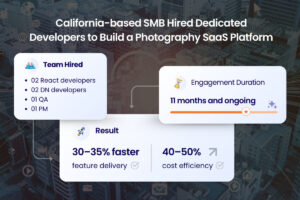
California-based SMB Hired Dedicated Developers to Build a Photography SaaS Platform
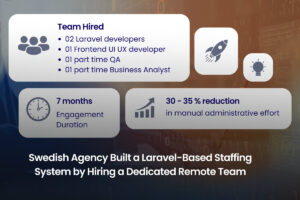
Swedish Agency Built a Laravel-Based Staffing System by Hiring a Dedicated Remote Team