Table of Contents

Chicago remains a powerhouse for B2B innovation, particularly in FinTech, logistics, and enterprise SaaS. For companies operating in this high-growth environment, mobile application delivery is no longer optional; it is fundamental to capturing market share and retaining customers. However, the decision to scale often collides violently with the practical realities of the local talent market.
Founders and engineering VPs quickly realize that relying solely on local, in-house hiring for growth imposes severe limits on speed, budget, and access to specialized skills. The imperative is clear: you need to scale your mobile capacity rapidly, cost-effectively, and with predictable quality. For organizations looking to expand their roadmaps or manage multiple simultaneous mobile projects, understanding when and how to hire mobile app development team models becomes the critical differentiator between stalled growth and strategic acceleration.
The High-Stakes Reality of Scaling Mobile Teams in Chicago
The Chicago tech landscape is characterized by high demand and constrained supply, creating a challenging environment for building sustainable, full-stack mobile development capabilities internally. This isn’t just about finding developers; it is about assembling high-performing, specialized teams capable of delivering complex, enterprise-grade applications.
The Impact of Local Talent Scarcity and Retention
When you try to scale aggressively in the Chicago area, you run into two primary headwinds: availability and cost. The pool of truly senior mobile developers specializing in modern frameworks (React Native, Flutter, Swift/Kotlin for complex enterprise applications) is finite. You often find yourself in bidding wars, driving up salaries and extending the hiring cycle from weeks to months.
The secondary effect is retention. If you manage to staff an excellent in-house team, the market’s aggressive poaching strategies mean that key personnel are constantly vulnerable to higher offers. This instability translates directly into delivery risk, project delays, and crippling technical debt when institutional knowledge walks out the door. Smart leaders recognize that relying on this volatile local market is not a scalable strategy for high-volume development work. To meet aggressive deadlines, many look externally to hire mobile app developers who can integrate quickly.
Cost Overruns: When Scaling In-House Becomes Unsustainable
Scaling a full-stack mobile team locally—including roles like dedicated iOS specialists, Android engineers, backend integrators, QA, and a Product Owner—requires substantial recurring investment. Beyond salary, Chicago companies must account for benefits, real estate overhead, and the 30 percent or more premium associated with recruiting fees and HR burdens.
For high-growth companies focused on maximizing runway and maintaining financial discipline, these costs quickly make aggressive scaling mathematically impossible. If your product roadmap demands doubling your mobile engineering capacity within six months, attempting to do that purely through local Chicago hiring will almost certainly blow your operational budget before delivery begins. This unsustainable cost structure forces engineering leaders to prioritize core features over valuable growth initiatives, limiting overall business potential.
Evaluating Internal Constraints vs. External Solutions
The true decision point for a CTO isn’t whether the team is good, but whether the team structure supports the company’s growth trajectory. When speed and skill diversity are paramount, internal constraints often become impossible bottlenecks.
Skill Gaps vs. Time-to-Market Demands
Mobile development requires a diverse skill set: native iOS (Swift/Objective-C), native Android (Kotlin/Java), cross-platform proficiency, API integration expertise, and robust QA automation. If your current in-house team is strong in React Native but needs specialized expertise in BLE integration for an IoT product, sourcing that niche skill locally can take six months.
Every week spent searching for a specific developer is time-to-market lost. External dedicated teams, however, are pre-vetted skill repositories. When you need a dedicated team for hire that specializes in specific technologies or regulatory compliance, working with a partner allows you to onboard that expertise in days or weeks, aligning capacity perfectly with immediate project needs.
Risk Mitigation: Dependency on Key Personnel
A common pitfall in smaller in-house teams is the high dependency on one or two senior developers. If these individuals are handling both core feature development and architecture decisions, their sudden departure or even extended leave can halt critical projects. This risk is amplified when they hold unique legacy knowledge.
By choosing to hire dedicated mobile app developers through a reputable third party, the risk is distributed across a mature delivery organization. The partner is responsible for continuity, knowledge transfer, and rapid backfilling, ensuring that your project remains insulated from individual personnel risks. This shift in risk management is often a primary driver for senior leaders evaluating outsourcing options. If you are struggling to map specialized skill requirements to your current hiring pipeline, it is time to request developer profiles tailored to your specific mobile stack needs.
Struggling to scale your mobile roadmap with Chicago’s limited talent pool? Let’s evaluate your current team structure, delivery velocity, and skill gaps—then map the fastest, most cost-efficient way to scale.
Before committing to internal expansion, conduct a comprehensive risk audit of your existing mobile roadmap. Ask yourself: Can we staff this project entirely with local talent without exceeding 15% of the projected quarterly budget? If the answer is no, leveraging external capacity is not merely an option; it is a fiduciary responsibility to the organization.
Why Senior Leaders Choose to Hire Mobile App Development Team Models
The strategic move toward external augmentation is driven by the need to bypass the geographic constraints of Chicago while maintaining control and quality. This involves shifting from a staff augmentation mindset to a dedicated team, or “pod,” model.
Speed and Predictability: Deploying Dedicated Pods
A high-performing mobile app development team is more than just a collection of individuals; it is an integrated unit with established processes, internal communication norms, and shared delivery cadence. Trying to build this cohesion from scratch internally every time a new project spins up is inefficient.
When you choose to hire mobile app development team models from established providers like WeblineGlobal, you are onboarding a cohesive unit that has already worked together successfully. This eliminates the “forming, storming, norming” phase, allowing the team to hit peak productivity faster. Deploying dedicated developers for hire ensures immediate availability of specialized roles—from certified AWS cloud architects necessary for robust mobile backends to specialized UI/UX experts—providing speed and predictability that local hiring cannot match.
The Financial Model: Cost Efficiency Without Compromising Quality
The most tangible benefit of moving beyond Chicago-centric hiring is the dramatic improvement in the cost-to-skill ratio. While local hiring involves paying a geographic premium, accessing developers remotely, particularly from proven offshore hubs, allows organizations to lower engineering costs by 40 to 60 percent.
This efficiency is not achieved by sacrificing quality. Instead, it leverages global economic realities to acquire highly skilled, senior engineering talent at a sustainable rate. For a CTO, this difference means the ability to fund two full-stack mobile development pods for the price of one local team, accelerating the roadmap significantly without jeopardizing overall cash flow or profitability goals.
Ready to evaluate how a dedicated, pre-vetted remote team can accelerate your mobile roadmap? Schedule a Consultation today to discuss your project requirements and receive tailored developer profiles.
Essential Criteria for Vetting Dedicated Mobile App Developers
Once the decision is made to leverage remote capacity, the next challenge for Chicago leaders is vendor selection. Vetting a partner to hire dedicated mobile app developers requires scrutiny that goes far beyond reviewing technical résumés. You need assurance of seamless integration and operational reliability.
Evaluating Technical Depth and Delivery Mindset
A strong developer profile should highlight proven success in complex scenarios, not just familiarity with standard frameworks. Look for experience in integrating mobile apps with enterprise systems, managing secure data transmission, and handling complex state management.
Beyond technical skills, the delivery mindset is crucial. Do their previous projects demonstrate an agile, iterative approach? Do they prioritize clean architecture and maintainable code? These softer skills dictate the long-term cost of ownership for your mobile application. Focus on partners who can demonstrate a consistent track record of working successfully with US-based product owners and engineering leads.
Communication and Process Alignment
The success of remote dedicated developers for hire hinges on clear communication. Time zone alignment, English proficiency, and established meeting cadences are non-negotiable. At WeblineGlobal, our delivery philosophy is built on models like RelyShore℠, which combines the cost benefits of remote talent with the assurance of US-based oversight and process rigor. This hybrid approach minimizes cultural friction and ensures reporting structures align with Chicago headquarters requirements.
If the vendor cannot provide clear examples of communication protocols and IP protection guarantees upfront, they pose an unacceptable operational risk. A crucial step in this vetting process is the ability to interview candidates directly, assessing not only their code quality but their soft skills and problem-solving communication. We encourage all prospective clients to Schedule a Consultation to review our developer evaluation methodology.
Need to add senior mobile developers without months of recruiting delays? Get immediate access to pre-vetted iOS, Android, React Native, and Flutter experts who integrate seamlessly with your team.
Assess the vendor’s infrastructure for security, data privacy, and access controls. Since mobile applications often handle sensitive user data, compliance is paramount. Ensure the vendor adheres to necessary standards and provides robust tools for tracking progress, managing source code (Git), and continuous integration/continuous deployment (CI/CD) pipelines. This infrastructural review guarantees that the team you hire mobile app development team is equipped for enterprise standards.
Transitioning from Local Reliance to Global Scalability
Making the transition is less about replacing your local team and more about strategically augmenting its capacity and skill set. The goal is to create a combined engineering force that scales dynamically based on the product roadmap, not constrained by the Chicago job market’s seasonal availability.
Maintaining Full Control While Augmenting Capacity
A common executive apprehension is the fear of losing control over the development process. When utilizing dedicated teams, you should retain full ownership of the product roadmap, technology stack decisions, and intellectual property. The external team acts as a seamless extension of your existing engineering department, often reporting directly to your CTO or VP of Engineering.
This allows your internal Chicago-based senior architects to focus on core strategic innovation and mentorship, while the dedicated external team handles the heavy lifting of feature implementation, maintenance, and detailed technical execution. This strategic partitioning allows your most expensive internal resources to focus on high-leverage activities, maximizing the ROI of your in-house staff.
Future-Proofing the Mobile Stack
The pace of change in mobile technology is relentless, requiring constant upskilling in areas like edge computing, integrated AI/ML functionality, and advanced security protocols. Trying to maintain this knowledge entirely in-house is prohibitively expensive and often leads to skill stagnation.
By engaging with specialized remote teams, you gain instant access to experts fluent in the latest mobile trends—such as implementing large language model inference on device or integrating decentralized identity solutions—without the protracted internal training cycles. This ability to instantly inject specialized knowledge future-proofs your mobile stack and maintains technological parity with market leaders. If your roadmap demands complex technical skills beyond your current bench strength, we can quickly hire mobile app developers with those required niche capabilities.
Scaling Smartly: Your Next Mobile Development Decision
For Chicago-based companies facing explosive growth, the limitations of the local talent pool present a genuine strategic bottleneck. The path forward involves decoupling engineering capacity from geographic location. By choosing to hire mobile app development team models or dedicated pods, you are making a deliberate decision to prioritize speed, cost-efficiency, and resilience.
The critical step now is assessment. Evaluate your current project velocity against your growth targets. If there is a disconnect, it is time to explore how a dedicated, remote development partner can bridge that gap, providing the senior talent necessary for scalable, high-quality mobile delivery. Don’t let local constraints dictate your global ambitions.
Ready to scale beyond Chicago’s talent constraints? Partner with a dedicated mobile app development team that delivers speed, predictability, and enterprise-grade quality—without local hiring bottlenecks.
Social Hashtags
#MobileAppDevelopment #HireDevelopers #DedicatedDevelopmentTeam #AppDevelopmentServices #TechOutsourcing #ChicagoTech #B2BTech #SaaSDevelopment #CTOStrategy #DigitalTransformation
Frequently Asked Questions
The cost difference is significant. Companies in Chicago typically see savings of 40 to 60 percent on overall engineering labor costs when they hire dedicated developers for hire remotely, primarily due to global wage parity and reduced overhead associated with local staffing.
Unlike local hiring which takes 3–6 months for high-level mobile engineers, a dedicated team can often be shortlisted and onboarded in as little as 2–4 weeks. This speed is achieved because the developers are already vetted and organized into functional units by the service provider.
Yes. A key benefit of dedicated development models is continuity. Once the core development is complete, the team can transition seamlessly into long-term support, maintenance, bug fixing, performance optimization, and managing regular app store submission cycles, ensuring your application remains competitive.
Successful remote partners prioritize clear communication protocols. This usually involves overlapping work hours for critical meetings (e.g., US morning/India evening), guaranteed English fluency, and utilizing project management tools for asynchronous updates. Effective communication is a non-negotiable metric when selecting a partner to hire mobile app developers.



Success Stories That Inspire
See how our team takes complex business challenges and turns them into powerful, scalable digital solutions. From custom software and web applications to automation, integrations, and cloud-ready systems, each project reflects our commitment to innovation, performance, and long-term value.
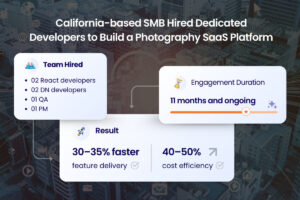
California-based SMB Hired Dedicated Developers to Build a Photography SaaS Platform
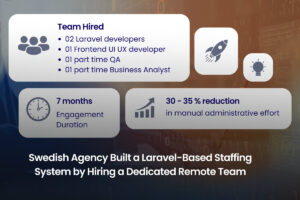
Swedish Agency Built a Laravel-Based Staffing System by Hiring a Dedicated Remote Team