Table of Contents

The Strategic Imperative: Securing Scalable APIs for Texas Growth
Texas has cemented its reputation as a leading tech epicenter, drawing massive investment and driving an aggressive pace of digital transformation. Companies, whether they are scaling FinTech platforms in Dallas or launching complex enterprise SaaS solutions from Austin, face a critical shared challenge: building application programming interfaces (APIs) that can handle rapid, non-linear growth without collapsing under peak load.
For most senior technical decision-makers, the language of modern scalability often translates directly to Node.js. Its event-driven and non-blocking architecture makes it ideal for handling high concurrency, and the microservices architecture makes it crucial for high-traffic applications. However, the theoretical advantages of Node.js quickly run into the practical difficulties of sourcing the right talent in a fiercely competitive market. The strategic question is not merely “Should we use Node.js?” but rather, “How can we efficiently and reliably hire Node developers who can actually deliver the necessary performance and scalability?
Why Node.js Dominates the API Scalability Conversation in Texas Tech
The speed and concurrency requirements of modern platforms often push traditional, thread-blocking backend technologies past their limits. Node.js addresses this core delivery risk by utilizing a single-threaded, asynchronous approach. This design allows a single server process to manage thousands of concurrent connections, making it inherently suited for IO-intensive tasks such as routing high volumes of API requests.
For Texas companies operating in high-stakes, real-time sectors like logistics, oil & gas optimization, or complex financial trading, the ability of Node.js to maintain low latency under stress is a non-negotiable feature. When evaluating technology stacks, CTOs must weigh the immediate development speed against the long-term operational cost of managing a less efficient backend. Choosing Node.js is often a foundational decision for organizations prioritizing velocity and resource efficiency over monolithic stability.
The Event-Driven Advantage: Evaluation Criteria for CXOs
When you seek to hire Node.js developers Texas, you are primarily investing in expertise related to the event loop. The true measure of a developer’s quality in this ecosystem is their ability to write non-blocking code that optimizes this loop, preventing bottlenecks. For decision-makers, this translates into key evaluation points for vendor selection or direct hiring:
- Concurrency Management: Can they demonstrate experience handling millions of concurrent connections without thread starvation?
- Microservices Expertise: Have they successfully deployed Node.js within distributed systems, leveraging tools like Kafka or RabbitMQ for inter-service communication?
- Error Handling: How robust is their approach to dealing with uncaught exceptions and ensuring service resilience?
A capable Node.js team knows that scaling is less about adding more servers and more about writing smarter code. If you need to design scalable APIs rapidly, the developers must understand throttling, caching strategies, and load balancing natively within the Node.js context.
When to Choose Node Over Other Backend Frameworks (Hiring Risk Assessment)
While frameworks like Django (Python) or Spring (Java) offer robust environments, their operational models are fundamentally different. We often recommend Node.js when the product vision involves high throughput, low-latency requirements, and an agile frontend (React, Angular, Vue) where using a unified JavaScript ecosystem simplifies hiring and full-stack knowledge transfer. The speed of iteration—critical for competitive markets in Texas—is significantly accelerated when the team can seamlessly context-switch between frontend and backend environments.
The associated hiring risk, however, is finding engineers who truly master the asynchronous paradigm. Superficial knowledge of JavaScript often masks a lack of deep understanding of how Node’s architecture handles I/O. This is why specialized vetting is paramount when you decide to hire backend developers focusing on Node.js.
Strategic Options to Hire Node.js Developers Texas
The competition for top-tier Node talent in major Texas hubs—Austin, Houston, Dallas—drives salaries sky-high and prolongs hiring cycles. For high-growth companies that require immediate staffing to meet product roadmap deadlines, relying solely on local sourcing can be prohibitively slow and expensive. This necessitates a strategic look at remote and dedicated team models.
The High Cost of Local Competition vs. Remote Augmentation
The primary financial challenge facing VPs of Engineering in Texas is the rising blended cost of talent acquisition and retention. A developer salary, plus overhead, benefits, and the opportunity cost of a six-month hiring search, often makes the local route unsustainable for aggressive scaling goals. This has led many founders to explore staff augmentation and dedicated teams as a superior method to hire Node.js developers Texas.
Evaluating the Need for Dedicated Node Developers Texas
If your project requires sustained effort on complex architectural components, such as building a dedicated API gateway, a simple contractor won’t suffice. You need committed engineers who function as an integrated extension of your core team. Seeking hire Node developers through a dedicated team (or ‘pod’) model offers continuity, shared institutional knowledge, and deep expertise, all while bypassing the Texas talent bidding war.
A dedicated pod model, often delivered through proven global partners like WeblineGlobal, guarantees that your team consists of engineers already vetted for technical competence and strong communication skills. This immediately addresses one of the biggest risks of scaling: skill gap identification.
The Speed-to-Market Requirement
In tech, time-to-market is currency. Delaying a launch by six months because of a hiring bottleneck can cost millions in lost competitive advantage. When the need to hire backend developers is urgent, the only viable solution is a vendor capable of providing high-quality, pre-vetted candidates within days, not months. We find that our Texas-based clients often prioritize the 48-hour shortlist promise over attempting another futile local search.
Vetting Specialized Skills: Async/Await and Microservices Expertise
The process of technical evaluation for Node.js must go beyond basic coding challenges. It needs to test resilience under pressure and architectural judgment. Poorly implemented asynchronous logic is the single fastest way to cripple a Node.js API, regardless of server power.
Essential Questions for Evaluating Developer Experience
When you review node expertise, focus on scenarios that test advanced knowledge:
- How do they handle back-pressure when consuming data from a slower service?
- Describe a situation where they intentionally used Worker Threads and justify the decision.
- How do they implement stateless authentication across a microservices architecture? (e.g., JWT strategies).
These questions reveal whether the developer views Node.js as merely JavaScript on the server or as a specialized runtime environment requiring unique operational knowledge.
Are you struggling to find top-tier Node.js talent that meets your scalability and budgetary requirements in Texas?
Avoid the protracted local hiring cycle. Schedule a consultation with WeblineGlobal today to review profiles of pre-vetted dedicated Node developers available for immediate integration.
De-Risking Delivery: Team Structure for High-Performance Node Backends
Hiring is only half the battle. The organizational structure and process around the developers determine the ultimate success of the project. A team building scalable Node APIs requires specific roles that focus on performance monitoring, DevOps integration, and API contract management.
Staff Augmentation vs. Dedicated Pods
For temporary spikes or filling a single, well-defined role (e.g., a specific integration specialist), staff augmentation works well. However, when the goal is to build, maintain, and evolve a critical, scalable API platform, we strongly advise the dedicated team model. Dedicated teams come with built-in synergy: a Lead Node Architect, senior backend developers Texas, and potentially a dedicated QA focused on integration testing, all working under a unified delivery standard (like the RelyShore℠ model).
This structure minimizes the integration risk often associated with placing individual contractors onto an existing core team, ensuring higher quality code standards from day one.
Key Metrics for Measuring Node.js Team Success
The success of the developers you hire must be measured against business outcomes, not just task completion. For API development, these outcomes are highly measurable:
- P95 Latency: The time taken for 95% of requests to complete. Node.js teams should aim for consistently low latency figures, reflecting well-optimized event loop usage.
- Throughput: Requests per second (RPS) the API can handle.
- Mean Time To Recover (MTTR): How quickly the team resolves performance degradation or outages, indicating a robust monitoring setup.
These metrics provide CTOs with a quantifiable return on investment for their decision to hire Node developers, moving the conversation away from input (hours worked) toward output (system performance and stability).
Cost Efficiency and Long-Term ROI: Comparing Global Talent Pools
For Texas companies aiming for aggressive scaling, extending the search beyond local state lines is an economic necessity. The goal is to maximize talent quality while controlling CapEx.
The Economics of Hiring Remote vs. On-Shore Backend Developers Texas
A global talent strategy typically delivers cost efficiencies between 40 to 60 percent compared to hiring equivalent senior roles locally in Texas metros. More importantly, this reduction in cost does not necessitate a compromise on quality, provided the hiring partner has rigorous vetting protocols. Accessing skilled engineers in high-volume markets like India allows organizations to staff up with dedicated Node developers Texas expertise quickly and affordably.
The ROI calculation shifts: instead of hiring one developer for six figures locally, you can staff a full team of three equally skilled engineers for a comparable budget, dramatically accelerating development velocity and lowering delivery risk.
Vendor Selection: Assurance, IP, and Communication
When seeking a partner to help hire backend developers remotely, particularly those focused on mission-critical Node.js APIs, assurance is key. The partner must prove they prioritize security (IP protection, NDA implementation), stable infrastructure, and professional communication standards.
WeblineGlobal, for instance, utilizes a US presence combined with vast engineering scale in India, providing US-based contractual assurance while delivering the cost advantages of global talent. This hybrid model mitigates common risks associated with purely offshore arrangements, allowing Texas clients full confidence to design scalable APIs and maintain control over their intellectual property.
Making the Final Decision: Secure Your API Future
For technology leaders in Texas, the path to building highly scalable APIs is clear: Node.js is the preferred technology, and strategic sourcing is the necessary methodology. Contact us to hire Node.js developers Texas, as we offer a structured evaluation of talent sourcing speed, economic viability, and the developer’s proven ability to handle asynchronous and high-concurrency environments.
By shifting focus from expensive, slow local recruitment toward rapidly deployable, dedicated remote teams, organizations can secure the high-performance backend expertise needed to meet Texas’s aggressive growth trajectory without draining capital or sacrificing crucial time-to-market. Prioritize vendors who can demonstrate deep technical vetting and a reliable delivery framework, ensuring your investment accelerates your product roadmap and solidifies your platform’s future scalability.
Social Hashtags
#HireNodeJSDevelopers #NodeJSDevelopment #TexasTech #ScalableAPIs #BackendDevelopment #APIArchitecture #TechHiring #DedicatedDevelopers #StaffAugmentation #DigitalTransformation #EnterpriseSoftware #CTOStrategy
Ready to staff your next scalable API project with expert Node.js talent?
Stop waiting for local candidates. We offer month-to-month flexibility and transparent pricing. Request developer profiles tailored to your specific Node.js requirements today.
Frequently Asked Questions
Local salaries for senior Node.js developers in Texas metros (Austin/Dallas) can range significantly higher than the blended rate for equivalent remote teams. Remote augmentation models typically offer a 40–60 percent cost saving, allowing companies to allocate capital to scaling the team size rather than inflating individual salaries.
While local recruitment can take 4–6 months, high-quality staff augmentation partners, like WeblineGlobal, typically provide a shortlist of pre-vetted, expert developers within 48 hours. This drastically cuts the time-to-deployment, crucial for time-sensitive projects.
Look for expertise in asynchronous programming fundamentals, familiarity with advanced NPM packages (like Express or NestJS), experience deploying and managing microservices via containers (Docker/Kubernetes), and strong knowledge of database integration (SQL and NoSQL) optimized for Node's concurrency model. It is essential to review Node expertise beyond basic coding.
Absolutely. While Node.js excels at IO-intensive tasks (making it perfect for scalable APIs and routing), it can handle complex processing when integrated correctly using Worker Threads or by offloading heavy computational tasks to dedicated microservices built in other languages, ensuring the core event loop remains non-blocking and responsive.
The primary risk is poor communication and a lack of architectural oversight. Mitigate this by choosing vendors that provide seamless time zone overlap support and utilize senior engineering leadership to oversee the remote dedicated Node developers Texas team, ensuring consistent code quality and adherence to architecture standards.




Success Stories That Inspire
See how our team takes complex business challenges and turns them into powerful, scalable digital solutions. From custom software and web applications to automation, integrations, and cloud-ready systems, each project reflects our commitment to innovation, performance, and long-term value.

California-based SMB Hired Dedicated Developers to Build a Photography SaaS Platform
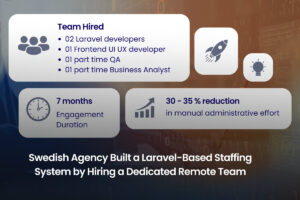
Swedish Agency Built a Laravel-Based Staffing System by Hiring a Dedicated Remote Team