Table of Contents

In 2026, the traditional way of hiring everyone at the company headquarters no longer works. There’s a strange “Silicon Valley Paradox”: investors are putting huge amounts of money into AI startups, but the price of hiring local talent in places like San Francisco, Palo Alto, and Los Angeles has become a big problem. Skilled workers are so hard to find that building only in the Bay Area isn’t just costly, but it could even hurt whether your product succeeds in the market.
If you’re a CTO or Founder of a company in California today, the question isn’t whether you should hire remote developers. It’s about team architecture. How do you structure your software development team in California to survive the local talent crunch without losing your innovative edge?
Building a startup in California now requires a global-first mindset. This isn’t about traditional outsourcing; it’s about being strategic. You decide which roles need to be in that high-rent office in California and which are better served by high-velocity remote pods of software engineers that scale without draining your bank account.
The 2026 Reality Check: California Salaries vs. Remote ROI
Let’s talk numbers. In 2026, the cost of a local California software engineer goes way beyond the base salary. Between bidding wars and the sheer cost of keeping an office in a California tech hub, the total cost for a single mid-level software developer often lands between $230k and $280k per year.
For a Series A or B startup, those figures eat your runway fast. Is it really worth betting your capital on a local hire who might get poached by Big Tech in a year?
The “Burn Rate” Math
By integrating remote developers into your California startup, you aren’t just saving money—you’re buying capacity. A distributed model: hiring remote developers from India typically offers 40–60% cost efficiency.
Think of it this way: for the price of two senior software engineers in San Francisco, you could deploy a full “pod” of four or five remote developers. This lets you run parallel tracks—keeping your core AI engine development local while your remote team scales the frontend, mobile app, and API integrations.
A quick tip for the road: When you’re looking at ROI, don’t get hung up on hourly rates. Look at “speed-to-hire.” Every week a seat stays empty in California is a week of lost market opportunity.
Let’s look at your 2026 roadmap together. We can help you find that sweet spot between local vision and remote execution.
Architecting for Velocity: The “Core + Pod” Hybrid Model
The most successful CA startups in 2026 have ditched the all-or-nothing remote debate. Instead, they use a Core + Pod structure.
- The Core Team: These folks stay local. It’s your CTO, Product Leads, and architects—the people focusing on high-touch R&D and your proprietary IP. They own the “Why.”
- The Remote Pods: These are self-contained, multi-disciplinary units (Backend, Frontend, QA) that handle the “How.” They own specific features or product modules.
Why this works:
- Less Management Drama: Your VP of Engineering manages one “Pod Lead” instead of ten individual contractors.
- No Knowledge Leaks: Since the pod works as a unit, you don’t lose context like you do with fragmented freelancers.
- Pure Scalability: Need to pivot? Adding a new pod is lightyears faster than hunting for five local developers.
Speed-to-Hire: Scaling in 48 Hours vs. 90 Days
In 2026, speed is the only moat that matters. If a competitor offers an AI feature three months before you, your preference for local hiring in California becomes a massive disadvantage.
A typical local hiring cycle in California—between sourcing, technical rounds, and notice periods—now drags on for 75 to 90 days. For a startup, that’s an eternity. With a remote model, you can see shortlists of pre-vetted, ready-to-code talent in as little as 48 hours.
Vetting Without the Stress
The biggest fear with remote hiring is the “bad hire.” But by 2026, we’ve turned vetting into a science. You should expect:
- Culture Fit: Ensuring devs can actually navigate the fast-paced, “fail fast” nature of a US startup.
- Technical Deep-Dives: Moving beyond basic tests to see how they solve real architectural puzzles in Python, React, or n8n.
- Flexibility: Use month-to-month terms to “test-drive” the team before committing long-term.
Ready to add some horsepower to your team? Get a shortlist of pre-vetted developers who actually fit your stack.
Operational Synergy: Solving the Timezone Gap
The classic founder worry: “Am I going to be on Zoom at midnight?”
In 2026, it’s not about matching clocks; it’s about synchronizing outcomes. High-performing pods use overlapping windows and async-first workflows. With an offshore development model like RelyShoreSM, you get a US-based partner who handles the accountability. You get the scale of India-based execution with the peace of mind of local standards.
It means your remote developer team isn’t just checking off tickets; rather, they’re proactively spotting bottlenecks in your CI/CD pipeline while you sleep.
The Decision Matrix: When to Stay Local vs. Remote
Don’t guess—be strategic about where your talent sits.
| If you are doing… | Stay Local (CA) | Go Remote (Pod) |
| High-Touch R&D | Yes (Whiteboarding is easier) | Possible for Senior Leads |
| Feature Scaling | Too slow/expensive | Ideal (High velocity) |
| Legacy Maintenance | Total waste of local talent | Ideal (Cost-effective) |
| Product Discovery | Yes (Stay near the customer) | Support roles only |
| QA & Automation | Nearly impossible to find locally | Ideal (Specialized) |
| AI/ML Implementation | Too much local competition | Ideal (Vetted specialists) |
Hiring traps to avoid:
- Hiring for “Comfort”: Don’t insist on “heads in seats” when half your local team is working from their couch in Oakland anyway.
- Missing the Big Picture: A $200k salary looks fine until you realize you lost $500k in revenue because your launch was four months late.
- Underestimating Global Talent: India isn’t a “back-office” anymore. It’s where the world’s most complex AI and SaaS architectures are being built.
Beyond the Zip Code: Building for Resilience
The most resilient startups in California are geographically bound. They know that while the vision is local, the talent is global. By embracing a remote-inclusive model, you aren’t just cutting costs; you’re building a scalable engine that can handle whatever the 2020s throw at us.
If your 2026 roadmap looks impossible with your current headcount, stop looking for talent in your area code. The devs who will help you hit your next milestone are already vetted and ready to work—they’re just a few time zones away.
Stop waiting for that “perfect” local hire who might never show up. View profiles of developers ready to jump in today.
Social Hashtags
#RemoteDevelopers #TechHiring #CaliforniaStartups #SaaSTalent #AIStartups #GlobalTalent #StartupGrowth #CTO #DevTeams
Frequently Asked Questions
In 2026, the total cost of employment (TCE) for a mid-level software engineer in California tech hubs like San Francisco or Los Angeles typically ranges between $230,000 and $280,000 per year. This includes base salary, benefits, equity, and the high overhead costs of maintaining office space in the Bay Area. In contrast, remote developer pods can reduce these operational costs by 40–60% while maintaining high output.
The local hiring cycle in California currently averages 75 to 90 days due to intense competition from Big Tech and extensive vetting processes. Remote hiring models drastically reduce this speed-to-hire. California startups can often see qualified shortlists within 48 hours and have developers integrated into their workflow in less than two weeks by leveraging pre-vetted remote talent pools.
Yes. Most successful CA startups in 2026 utilize a "Core + Pod" architecture. This involves keeping a local "Core" team (CTO, Product Leads) in California for high-touch R&D and strategy, while offloading feature scaling, QA, and frontend development to remote pods. This ensures that your proprietary IP stays close to home while your execution speed stays high and your burn rate stays low.
Modern remote collaboration focuses on outcome synchronization rather than matching clocks. Engineers’ teams in California can use async-first workflows and overlapping golden hours for synchronous meetings to achieve a 24-hour development cycle. Many startups use a US-based partner to handle accountability, ensuring that remote engineers in India are proactively solving bottlenecks while the local team is offline.
The Silicon Valley paradox of 2026 shows that while VC funding is high, the local talent crunch makes 100% local hiring a liability. Relying solely on local talent leads to slower product launches and extreme burn rates. Founders who have a global-first mindset hire four or five remote developers for the price of two local San Francisco engineers, allowing them to scale their product roadmap twice as fast.



Success Stories That Inspire
See how our team takes complex business challenges and turns them into powerful, scalable digital solutions. From custom software and web applications to automation, integrations, and cloud-ready systems, each project reflects our commitment to innovation, performance, and long-term value.
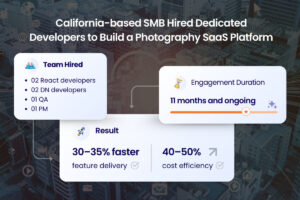
California-based SMB Hired Dedicated Developers to Build a Photography SaaS Platform
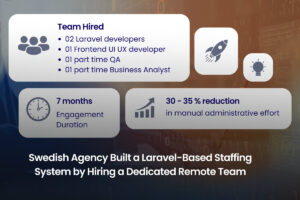
Swedish Agency Built a Laravel-Based Staffing System by Hiring a Dedicated Remote Team