Table of Contents

The tech landscape in the New York Tri-State area has reached a critical inflection point. For a CTO in Manhattan or a Product Leader in Jersey City, the challenge is no longer just finding talent. Rather, it is the unsustainable math of scaling it locally. With senior software developer salaries in the city frequently crossing the $200,000 mark before factoring in NYC payroll taxes and benefits, local-only hiring has become a primary driver of high burn rates.
For NYC companies building sophisticated US products, the goal is to find a balance between the high-touch strategy required in the New York Tri-State area and the engineering horsepower found globally. This short guide explores how to navigate that transition without sacrificing the software product quality your users expect.
Why Hiring Software Developers in New York is No Longer Enough
In hubs like Brooklyn or Long Island City, the competition for software engineering talent is fierce. You aren’t just competing with other startups; you are competing with the massive compensation packages of fintech giants and big tech outposts. This creates a talent paradox: you can surely find the best software developers in New York, but the cost to hire software engineers and retain them can actually slow your product’s time-to-market.
When you factor in the overhead of premium office space in Midtown and the administrative burden of local compliance, the effective cost of a single local hire often equals the cost of a three-person dedicated pod elsewhere. For software product companies at a growth stage, this disparity is the difference between launching a new feature set in three months or twelve.
Looking to scale your US product without rebuilding your NYC team?
When to Hire Local vs. Remote Developers – Strategic Decision
Deciding which roles to keep in the Tri-State area and which to move to an offshore model is a matter of communication density. Roles that require daily, face-to-face stakeholder alignment—such as your Head of Product or Lead Architect—often benefit from being near your Manhattan headquarters.
However, hiring remote software developers for the execution layer is often the more logical choice.
- Infrastructure & DevOps: These roles thrive on specialized knowledge that doesn’t require a physical presence in a New York office.
- Full-Stack Feature Teams: When your product roadmap is clearly defined, a dedicated developer team can execute at a higher velocity than a local team bogged down by the distractions of a central office.
- QA & Testing: Testing US software products for performance and security is a discipline that benefits from the structured, repeatable processes that seasoned offshore teams provide.
Beyond Cost: The ROI of Hiring Dedicated Developers in India
The narrative around offshore development has shifted. While cost-saving remains a factor because it often reduces expenditures by 40% to 60% compared to NYC rates, the real ROI lies in Product Velocity.
For a company based in White Plains or Newark, hiring in India offers a unique follow-the-sun advantage. While your New York team sleeps, your dedicated developers in India are pushing code, running test suites, and resolving bugs. This 10.5-hour time difference, when managed through a model like WeblineGlobal’s RelyShoreSM, transforms your development cycle into a 24-hour engine. You wake up to progress, not just emails.
Need experienced developers who can work seamlessly with your NYC team?
Building “Pods”: A Modern Approach for NYC Companies
Individual staff augmentation is often challenging because it puts the burden of management back on your already-stretched NYC-based engineering leads. A more effective strategy for product companies is the pod model.
A pod is a self-contained unit typically consisting of a dead developer, backend and frontend specialists, and a QA engineer. By hiring a cohesive team rather than a collection of individuals, you ensure:
- Lower Management Overhead: The pod manages its own internal workflows.
- Increased Accountability: The team is responsible for a specific delivery outcome, not just hours logged.
- Consistency: Standardized coding practices across the entire team prevent the “technical debt” that often occurs with fragmented remote hiring.
How to Evaluate Offshore Talent for US Standards
If you are a VP of Engineering in Hoboken, you know that a developer who can pass a LeetCode test might still fail in a high-pressure US product environment. Vetting for US products requires a deeper look at two specific areas:
Communication and Context Does the developer understand the why behind a feature? In the fast-paced NYC business culture, you don’t have time to over-explain every ticket. You need remote developers who can proactively ask questions about user intent and edge cases.
Technical Logic over Syntax During interviews, move away from syntax-heavy questions. Instead, present an architectural problem your company recently faced. Ask the candidate to walk you through how they would scale that solution. This reveals their ability to think like a product owner, not just a coder.
Overcoming the Offshore Development Stigma: Security, IP, and Quality Control
The primary hesitation for NYC companies regarding offshore hiring usually centers on security. How do you protect your intellectual property when your team is thousands of miles away?
High-caliber partners mitigate this through US-based legal assurances and rigorous infrastructure controls. At WeblineGlobal, we emphasize IP protection through:
- Strict NDAs and Enforceable Contracts: Legal frameworks that align with US business standards.
- Controlled Access: Utilizing secure VPNs and hardware-level access controls to ensure your data never leaves your environment.
- Transparency: Regular code reviews and integrated Jira/Slack workflows so your local leads in NY Tri-State area have 100% visibility into every line of code written.
Transitioning from Local Search in NY to Global Scaling
The transition doesn’t have to be all or nothing. Most successful NYC product companies begin with a hybrid approach. They prefer IT staff augmentation by keeping their core brain in the Tri-State area while scaling their software engineering resources through remote developers and pods.
Start by identifying a standalone project or a secondary product line. Use this as a pilot to test communication cadences and delivery quality. As the trust grows and the ROI becomes visible in your burn-rate reports, you can scale the offshore developer teams to handle larger portions of your roadmap.
In a city that never sleeps, your development engine shouldn’t either. Moving beyond the constraints of the local NYC software developers isn’t just about saving money—it is about giving your product the resources it needs to win in a global market.
Need experienced developers who can work seamlessly with your NYC team?
Social Hashtags
#HiringDevelopers #RemoteDevelopers #SoftwareDevelopment #TechHiring #NYCTech #USStartups #OffshoreDevelopment #DedicatedDevelopers #ITStaffAugmentation #TechFounders #ProductLeaders #DigitalTransformation
Frequently Asked Questions
In the New York Tri-State area, a Senior Developer often costs between $180,000 and $240,000 annually. By hiring dedicated developers in India, NYC companies typically reduce their engineering spend by 40% to 60% while maintaining high-velocity delivery for US products.
Actually, it is a strategic advantage. The 10.5-hour difference allows for a "Follow-the-Sun" model. Your NYC-based product team can define requirements during the day, and the offshore team executes overnight, ensuring 24/7 development cycles.
Security is managed through US-aligned legal contracts, NDAs, and technical safeguards. Reputable partners like WeblineGlobal use secure access controls and transparent workflows (Jira/GitHub) so your Manhattan-based leads retain full ownership and visibility.
Yes, provided you hire for "Product Thinking" rather than just coding skills. By utilizing a "Pod" model, you get a cohesive team that understands US product standards and proactively communicates to meet the aggressive deadlines typical of the NYC tech scene.
While local hiring in the Tri-State area can take 3–6 months, you can typically review vetted developer profiles and begin interviews within 48 hours, with teams fully onboarded and integrated into your Slack/Jira workflows in a fraction of the time.



Success Stories That Inspire
See how our team takes complex business challenges and turns them into powerful, scalable digital solutions. From custom software and web applications to automation, integrations, and cloud-ready systems, each project reflects our commitment to innovation, performance, and long-term value.
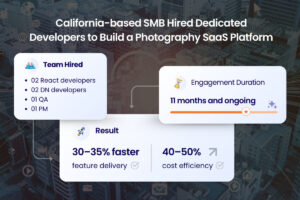
California-based SMB Hired Dedicated Developers to Build a Photography SaaS Platform
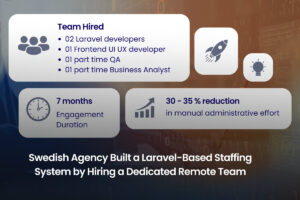
Swedish Agency Built a Laravel-Based Staffing System by Hiring a Dedicated Remote Team