
Table of Contents

Scaling a technology company today requires being fast and having access to talent from all over the world. Chief Executive Officers have a lot of pressure to deliver features quickly, reduce costs, and be more innovative than their competitors in a market that is changing fast. Often it is hard to find good software engineers in the local area who are willing to work for a reasonable salary. This means that business leaders have to look for talent in other countries.
Finding engineers from outside the local area can really change how a company grows, innovates, and captures market share. However, this also brings up concerns about losing control, visibility, and the quality of the code.
If a company enters the talent market without a solid plan, it can lead to chaos, missed deadlines, and wasted money. Founders worry about managed code, communication breakdowns, and cultural differences that can derail the product roadmap. To get the most out of a workforce, a company needs a structured operational framework. This hiring remote developers guide provides leaders with the exact plan they need to scale securely, maintain control, and drive business outcomes across borders.
Need to scale your engineering team without losing visibility or control?
Why CEOs Are Choosing Remote Developers to Scale Faster
The traditional way of hiring people can limit a company’s growth. Finding talent can take months, cost a lot of money, and use up a lot of resources from the human resources department. Companies that only hire locally have to compete with each other for the small pool of available engineers, which drives up salaries. Business leaders can find relief by looking for talent. Today, the best practices for hiring remote developers include accessing offshore talent pools.
When companies hire remote developers, they can get specialized skills right away. New technologies, intelligence, and complex cloud infrastructure require special expertise that is not always available in the local job market.
Adding remote software developers to the existing team can speed up product development significantly. In the technology industry, getting to market quickly is crucial for survival. It is also possible for companies to bypass hiring bottlenecks and deploy features faster and get a head start with the help of remote developer management tools.
Building a remote development team eliminates the need for a physical office, which saves money on real estate. Leaders can use the saved money to invest in product innovation and marketing. Companies can scale up or down quickly based on project demands. Partnering with offshore remote developers allows companies to work following the sun. Development progress continues uninterrupted across time zones.
Cost efficiency is a reason why executives choose to hire distributed talent. Hiring developers reduces operational costs while maintaining high technical standards. Building a remote engineering team can give companies a long-term competitive advantage. Modern companies see talent integration as a key driver of growth rather than just a backup plan.
The Biggest Concerns CEOs Have About Remote Developer Hiring
When companies switch from offices to distributed operational models, it can create concerns for leaders. Founders worry about losing control and visibility. They can no longer just walk over to an engineer’s desk to check on progress. Anxiety about management oversight stops executives from expanding globally. To address these concerns, leaders need to understand the pain points that come with modern executive leadership teams.
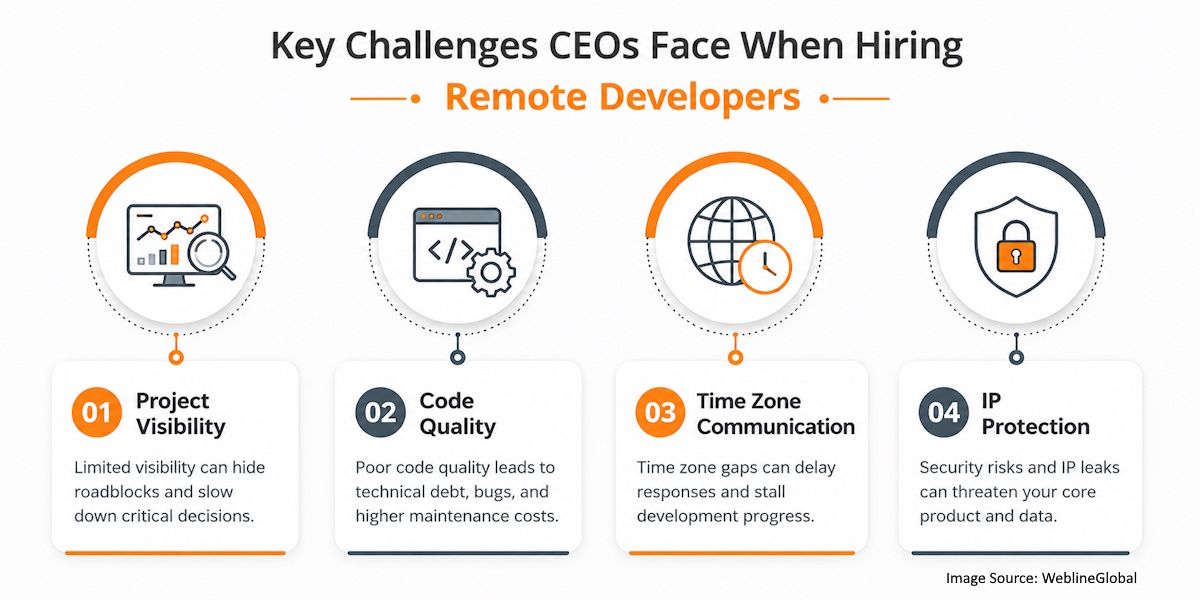
Maintaining Project Visibility
When engineers are away from headquarters, visibility can be a problem. Executives worry about not being able to see progress and potential roadblocks that can threaten project goals. Traditional status meetings may not accurately capture the velocity of engineering work. Leaders need real-time dashboards and clear tracking mechanisms to monitor project health continuously. Without transparency, leaders can feel lost during critical product launches.
Ensuring Code Quality
Code written by contractors can raise concerns for technical founders and CTOs. Poor architecture can create technical debt that slows down future releases and crashes production environments. Executives fear that remote hires will deliver quality unmaintainable codebases that need to be rewritten later. Enforcing testing standards, automated code reviews, and continuous integration can protect product integrity. Quality control must be central to any scaling strategy.
Communication Across Time Zones
When teams are spread across time zones, communication can be a challenge. Questions asked at the end of a workday may sit unanswered for hours while remote teams’ sleep. Misaligned schedules can slow down decision-making and stall active development sprints. Establishing overlapping work hours and asynchronous documentation protocols can bridge these divides. Strong communication habits can keep distributed teams synchronized and moving forward.
Protecting Intellectual Property
A company’s algorithms and core source code are its most valuable assets. Sharing information with external engineers can introduce security risks and compliance challenges. Executives worry about data leakage, code theft, and weak legal enforcement in jurisdictions. Securing property requires strict legal contracts, secure access controls, and vetted partnership agreements that safeguard enterprise assets.
How to Hire Remote Developers Without Losing Control
Retaining executive control over distributed engineering functions demands deliberate operational design. Leaders cannot rely on luck when building external technology units. Implementing strict protocols ensures that outsourced talent aligns perfectly with company objectives and cultural values.
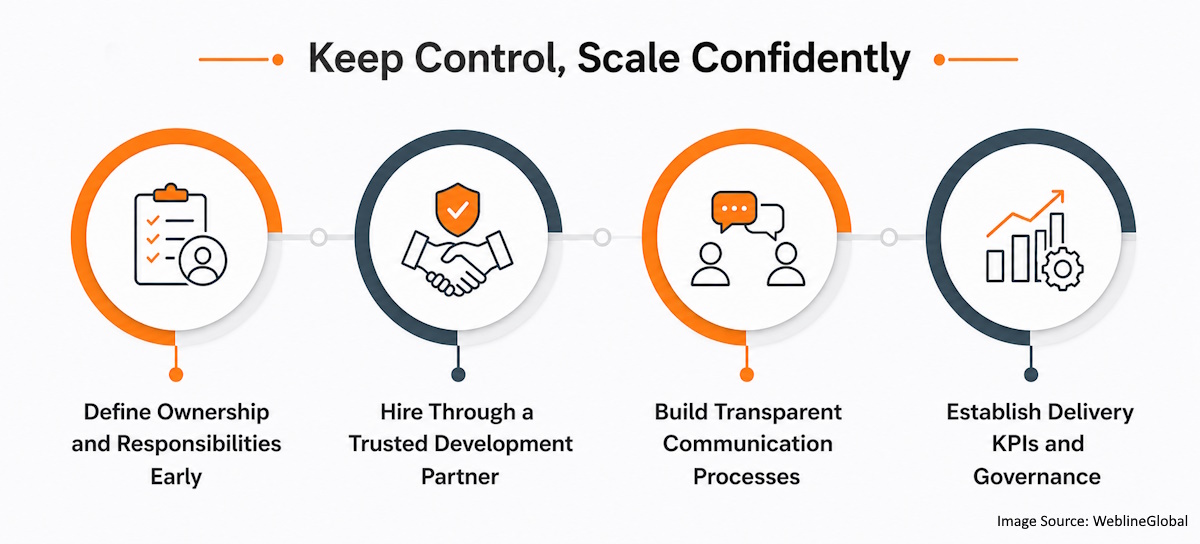
Define Ownership and Responsibilities Early
Confusion can destroy project velocity. Create toxic finger-pointing. Every engineer needs to know what they are responsible for. Ambiguity can lead to dropped tasks and missed deadlines when bugs appear. Clear accountability structures can keep distributed teams focused on deliverables.
Hire Through a Trusted Development Partner
Sourcing individuals through freelance marketplaces can introduce variance in code quality. Vetting candidates can take up executive time that should be spent on strategy. Partnering with established agencies can simplify the process. Trusted partners like WeblineGlobal can supply vetted professionals who integrate smoothly into existing corporate cultures. This approach minimizes hiring risks. Guarantees technical competence from day one.
Build Transparent Communication Processes
Communication must be documented, asynchronous, and easily accessible across the organization. Relying on office chats can fail completely in distributed environments. Teams can use project management tools, shared wikis, and structured daily updates. Transparency can eliminate guesswork. Keep all stakeholders informed about the project’s current progress.
Establish Delivery KPIs and Governance
Metrics can drive performance in distributed organizations. Leaders can track velocity, bug-fix turnaround times, and code review frequency. Governance frameworks can ensure that external engineers adhere to coding standards. Clear Key Performance Indicators can replace presence with results-driven accountability.
Want vetted remote developers who integrate with your existing engineering workflows?
Remote Developers Vs. In-House Developers: What CEOs Should Consider
Comparing internal staff with distributed talent helps leaders allocate financial and human resources effectively. Each operational model offers distinct advantages and challenges. Evaluating these factors guides strategic decision-making at the executive level.
| Strategic Feature | In-House Developers | Remote Developers |
| Hiring Speed | Slow, often takes months | Fast, global talent access |
| Overhead Costs | High office and equipment costs | Low infrastructure overhead |
| Flexibility | Rigid long-term commitments | High scalability up and down |
| Control | Direct physical oversight | Process-driven governance |
| Time Zone Access | Restricted to local hours | Potential 24-hour productivity |
Understanding these operational differences ensures balanced resource allocation across the enterprise. Companies frequently combine both models to build hybrid engineering organizations that maximize local collaboration and global scalability.
The Leadership Framework on How to Manage Remote Development Teams
Successful management of distributed talent requires shifting from micromanagement to outcome-based leadership. Physical presence no longer equals productivity in software engineering. Executives can build trust through systems that measure actual output.
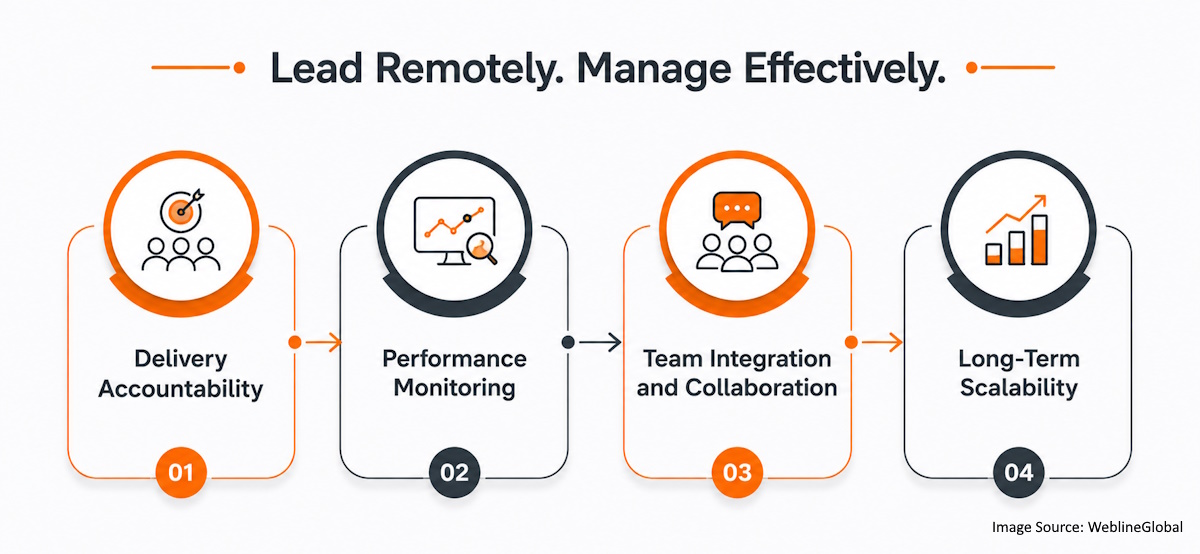
Delivery Accountability
Accountability rests on completed work rather than hours logged at a desk. A dedicated remote development team can commit to sprint goals and deliver functional increments. Managers can track completion rates. Address blockers immediately. Clear ownership can prevent tasks from falling through cracks.
Performance Monitoring
Data analytics can reveal developer productivity without intrusive surveillance. Leaders can monitor pull request frequency, deployment success rates, and code review times. Objective metrics can replace assumptions about remote worker efficiency.
Team Integration and Collaboration
Isolation can damage morale and project cohesion over time. Distributed engineers need to be included in company culture, product vision meetings, and social channels. Integrating talent into the core team can foster deep loyalty and a shared sense of purpose.
Long-Term Scalability
Scalability requires documented processes. Documenting onboarding steps, coding guidelines, and deployment procedures can prepare the organization for growth. Systems designed for ten engineers must support fifty without breaking down.
Why Dedicated Remote Developers Offer Greater Executive Control
Hiring dedicated developers on remote terms solves the fragmentation and missed deadlines often experienced with traditional freelancers. Because these professionals work exclusively on your product, they provide the loyalty, focus, and stability of an in-house team while maintaining the flexibility of outsourced talent.
Key Benefits
- Uncompromised Focus: Developers work exclusively on your product, eliminating the split attention typical of standard freelancers.
- Enhanced Executive Control: Leaders gain deep oversight of resource allocation and priority management without requiring constant micromanagement.
- Seamless Integration: Dedicated teams quickly adopt existing workflows, master proprietary technologies, and align closely with core business goals.
- Predictable Delivery Cycles: Stable staffing structures ensure consistent productivity and reliable product release timelines.
- Streamlined Governance: Utilizing dedicated partnership models simplifies overall project governance, risk compliance, and strategic management compared to ad-hoc contracting.
Final Thoughts
Scaling a technology company globally no longer requires surrendering control. Implementing the remote developer hiring checklist outlined in this guide can secure the product vision, protect property, and drive rapid growth. Modern leadership demands adaptability and rigorous process design.
Companies seeking talent acquisition can turn to WeblineGlobal for remote engineering and IT staff augmentation services. Their expert engineers and structured engagement models can ensure projects stay on track and under control. Connect with WeblineGlobal today to build a performing distributed engineering organization.
Social hashtags
#RemoteDevelopers #RemoteEngineering #RemoteTeams #SoftwareDevelopment #EngineeringLeadership #TechLeadership #GlobalTalent #ITStaffAugmentation #DedicatedDevelopers #OffshoreDevelopment #DeveloperHiring #TechTalent #TeamScaling #DigitalTransformation
Looking to expand engineering capacity while maintaining quality and delivery accountability?
Frequently Asked Questions
Remote developers are software engineers who design, build, and maintain applications outside traditional physical office locations, utilizing global talent pools to deliver technical solutions efficiently.
Chief executives retain operational control by establishing outcome-based key performance indicators, utilizing transparent project management dashboards, enforcing rigorous code reviews, and partnering with dependable agencies.
Remote developers can achieve productivity levels higher than local staff because they operate without typical office distractions, utilize flexible schedules, and focus entirely on well-defined sprint deliverables.
The main risks of working with developers include problems with communication because of different time zones, the possibility of poor-quality code from contractors who have not been thoroughly checked, and the risk of sensitive information being leaked if there are not strong legal protections in place.
To get high-quality code, companies need to make sure that remote developers do automated testing all the time, use continuous integration pipelines, review each other's work frequently, and follow strict rules about how the code should be written, which are enforced by experienced technical leaders.
Dedicated remote developers work for your company full-time and are as loyal and focused as the people who work in your office, but freelancers work for many clients at the same time, which means they cannot give their full attention to any one project and often miss deadlines.
To manage remote teams effectively, companies can use collaboration tools like Slack, version control systems like GitHub, project tracking software like Jira, and documentation tools like Confluence, which help keep everyone on the same page.
Companies can protect their sensitive information by making remote developers sign agreements that say they will not share any confidential information by controlling who has access to what, and by working with partners who are trustworthy and follow all the rules.
Companies should consider hiring remote developers when it takes too long to find the right people locally, when they need someone with specialized skills that are not available locally or when they need to grow quickly and need to be able to do it in a way that is cost-effective.
CEOs can measure how well remote developers are doing by looking at things like how often they deploy new code, how quickly they respond to requests, how well they fix bugs, and whether they meet their deadlines rather than just looking at how many hours they work.
India has a lot of talented developers who speak English, a great education system for engineers, and it can be less expensive to hire developers there. Plus, there are many companies that specialize in providing remote development services and can scale up quickly.
Executives should look for partners that have a pool of talented developers who have already been vetted a track record of delivering projects successfully, open and honest communication, flexible ways of working together, and strong security measures in place to protect sensitive information.


Success Stories That Inspire
See how our team takes complex business challenges and turns them into powerful, scalable digital solutions. From custom software and web applications to automation, integrations, and cloud-ready systems, each project reflects our commitment to innovation, performance, and long-term value.
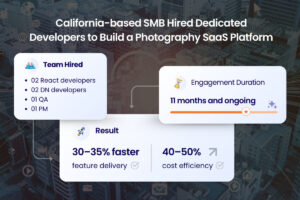
California-based SMB Hired Dedicated Developers to Build a Photography SaaS Platform
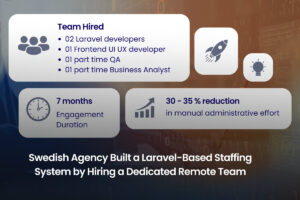
Swedish Agency Built a Laravel-Based Staffing System by Hiring a Dedicated Remote Team