Table of Contents

INTRODUCTION
During a recent project for a large-scale telecommunications provider, our team was tasked with building an enterprise customer support chatbot. The system was designed as a Retrieval-Augmented Generation (RAG) pipeline, built using Python and powered by a highly optimized, lightweight GenAI model to ensure low latency. The goal was to help users navigate a massive, complex knowledge base covering thousands of overlapping products, services, and troubleshooting steps.
While evaluating the early iterations of the platform, we encountered a situation where the chatbot’s accuracy plummeted on seemingly simple queries. A user would ask, “How can I obtain a SIM card?” and the RAG system would pull in text chunks detailing standard physical SIMs, digital eSIM activations, and temporary travel data SIMs. The resulting answer was a confusing, synthesized amalgamation of all three distinct processes.
We realized that before the system could accurately retrieve knowledge, it needed to know exactly what the user actually wanted. Hardcoding decision trees was impossible due to the sheer volume of topics. This challenge inspired the architectural pattern shared in this article: designing a generic, scalable mechanism for an LLM to detect ambiguous user queries and autonomously generate follow-up questions before executing a vector search.
PROBLEM CONTEXT
In a standard RAG architecture, a user query is converted into embeddings and compared against a vector database to retrieve semantically similar chunks of text. This works flawlessly when the user’s intent is highly specific, such as “What are the APN settings for a prepaid travel eSIM in Europe?”
However, enterprise knowledge bases are rarely queried with such precision. Our telecom client’s database contained deep, specialized documentation that shared highly similar semantic vocabulary. When a vague query was submitted, the vector similarity search performed exactly as designed—it retrieved the top nearest neighbors. Because “SIM card” was central to multiple distinct service categories, the retrieved context was completely fragmented.
To provide accurate support, the architecture needed a conversational routing layer. It had to determine whether a query was specific enough to act upon, or if the user needed to narrow their request down from a list of dynamically generated options based on the available data.
WHAT WENT WRONG
Initially, we attempted to handle ambiguity within the main generation prompt. We provided the LLM with the retrieved context and instructed it: “If the provided context covers multiple different types of services, ask the user to clarify.”
This approach surfaced several critical failures. First, it wasted valuable compute and latency on full-scale vector retrievals and deep context processing for queries that were destined to be rejected. Second, the LLM often suffered from “lost in the middle” syndrome; it would attempt to answer the vague question using one part of the context while appending a half-hearted clarification question at the very end.
We also explored building an intent-matching layer using standard NLP and rigid routing rules. But with thousands of overlapping telecom concepts, maintaining this ruleset became a bottleneck. The system required an intelligent, taxonomy-aware gating mechanism. It became evident that we needed to rethink the flow entirely, a common realization when teams look to hire python developers for scalable data systems capable of handling unpredictable user inputs.
HOW WE APPROACHED THE SOLUTION
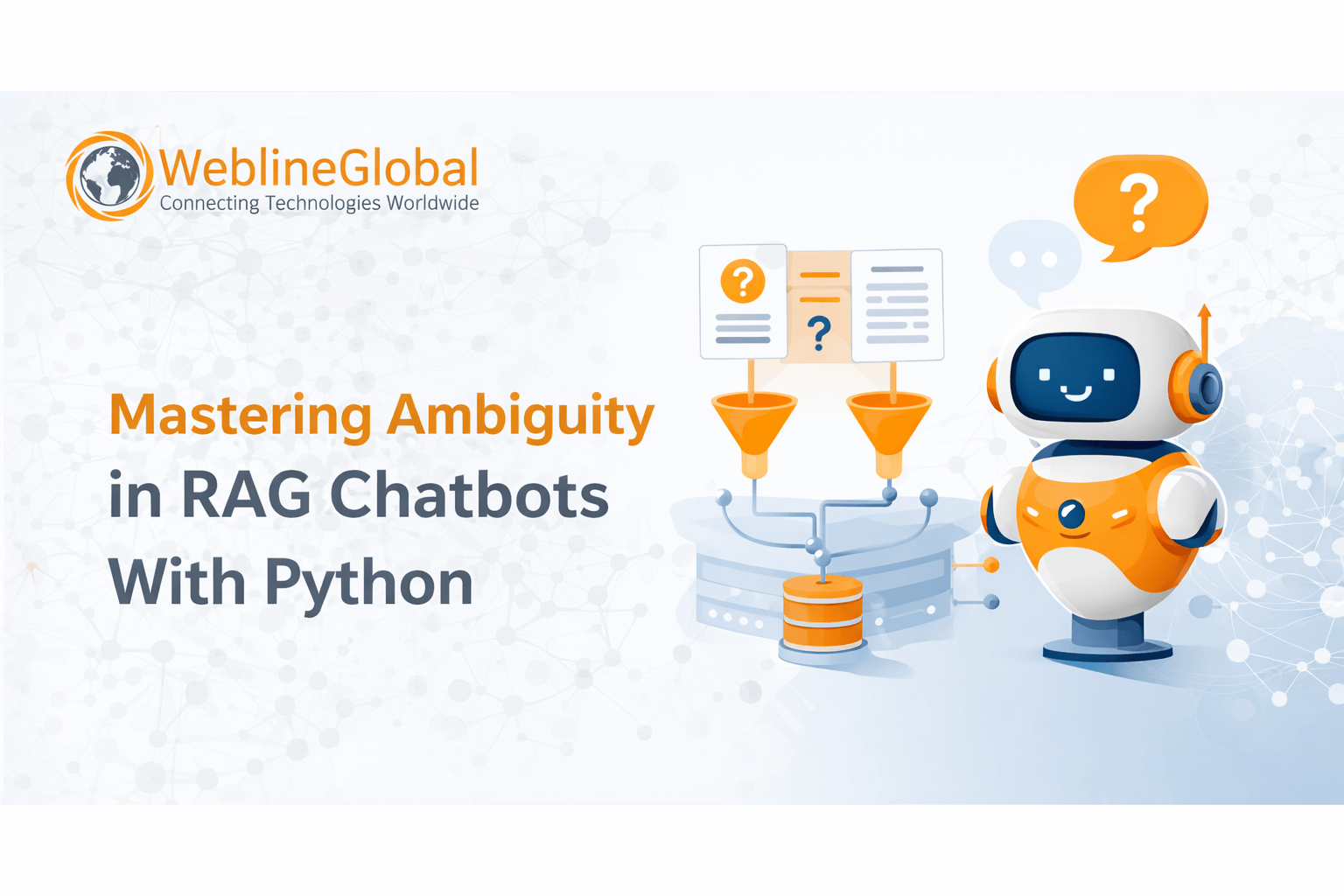
We decided to implement a “Two-Pass Retrieval and Clarification” pipeline. Instead of sending the raw query directly into a heavy vector search, we introduced a lightweight Intent Evaluation Agent at the very edge of the workflow.
The logic operated as follows:
- Pass 1 (Taxonomy Lookup): We maintained a lightweight, high-level index of category metadata (e.g., product names, sub-categories). When a user asked a question, we performed a rapid, low-latency search against this metadata to fetch the top 3 to 5 related category titles.
- Ambiguity Detection: We passed the user’s raw query and these matched category titles to a fast, lightweight LLM. Using Pydantic to enforce a strict JSON schema, we tasked this LLM with a single job: determine if the query maps cleanly to one category, or if it spans multiple conflicting categories.
- Dynamic Follow-up: If multiple categories matched (e.g., Physical SIM, eSIM, Travel SIM), the LLM returned a structured response flagging the ambiguity, along with a dynamically generated clarification question presenting those specific options to the user.
- Pass 2 (Deep Retrieval): If the query was deemed specific, the system proceeded to the standard, deep RAG extraction.
FINAL IMPLEMENTATION
By leveraging Python and Pydantic for structured outputs, we ensured the LLM’s response was programmatically predictable. Using a fast, lightweight GenAI model kept the overhead of this pre-check under 400 milliseconds.
Here is a sanitized, architectural representation of the classification logic:
from pydantic import BaseModel, Field
from typing import List, Optional
# Define the strict schema for the LLM output
class IntentClarification(BaseModel):
    is_ambiguous: bool = Field(
        description="True if the query matches multiple distinct categories."
    )
    clarification_question: Optional[str] = Field(
        description="The follow-up question asking the user to choose between the conflicting categories."
    )
    selected_category: Optional[str] = Field(
        description="The specific category if the query is clear and unambiguous."
    )
def evaluate_user_intent(user_query: str, matched_categories: List[str]) -> IntentClarification:
    prompt = f"""
    You are an intent routing agent.
    User Query: "{user_query}"
    Potential Categories from Knowledge Base: {matched_categories}
    If the user query is broad and could apply to multiple categories, mark is_ambiguous as true
    and generate a polite question asking them to specify which category they mean.
    If the query is specific to just one category, identify it.
    """
    # Example using a generic structured LLM call
    # response = llm_client.generate_structured_output(
    #     prompt=prompt,
    #     schema=IntentClarification,
    #     model="optimized-fast-llm"
    # )
    # return response
    pass
When the user asked “How can I obtain a SIM card?”, the metadata search returned [“Physical SIM”, “eSIM Activation”, “Travel Data SIM”]. The Intent Agent processed this and cleanly output: is_ambiguous = True, along with the question: “To help you with your SIM card, could you let me know if you are looking for a standard Physical SIM, an eSIM, or a Travel Data SIM?”
LESSONS FOR ENGINEERING TEAMS
Implementing dynamic clarification layers is a critical step in maturing a GenAI architecture. Here are the core insights from this deployment:
- Decouple Intent from Generation: Never rely on your final answer-generation prompt to also handle intent routing. Separation of concerns applies to LLM architecture just as it does to traditional software.
- Use Metadata for Context: Do not ask an LLM if a query is ambiguous in a vacuum. Provide it with the conflicting categories from your actual knowledge base so its clarification questions are grounded in real data.
- Enforce Structured Outputs: Relying on plain text for application routing is fragile. Frameworks like Pydantic are non-negotiable for building resilient AI pipelines, a standard practice for engineering leaders who hire ai developers for production deployment.
- Optimize for Latency: The clarification step sits in front of the user. Use the smallest, fastest model capable of basic logical reasoning for this routing layer.
- Avoid Hardcoded Logic: By passing retrieved taxonomy dynamically, the system automatically scales. If the business adds a new product, the metadata index updates, and the LLM instantly includes it in future clarification questions without code changes.
WRAP UP
Building an enterprise RAG system that gracefully handles human ambiguity requires more than just connecting a vector database to an LLM. By introducing a structured, metadata-aware intent clarification agent, we eliminated generic hallucinations and drastically improved the accuracy of the support chatbot. These architectural patterns represent the difference between a proof-of-concept and a production-grade system.
Social Hashtags
#GenerativeAI #RAG #LLM #AIEngineering #AIArchitecture #MachineLearning #ChatbotDevelopment #PythonAI #AIChatbots #EnterpriseAI #VectorSearch #AIInfrastructure #PromptEngineering #AIDevelopment #ArtificialIntelligence
If your organization is navigating complex GenAI integrations and you need to scale your engineering capabilities, it may be time to hire software developer resources who understand modern AI orchestration. To explore dedicated engineering partnerships, contact us.
Frequently Asked Questions
Intent clarification in RAG systems is a mechanism that detects when a user query is ambiguous and asks follow-up questions before retrieving knowledge. This helps the AI chatbot understand the user’s exact intent and improves response accuracy.
RAG systems rely on vector similarity search. When a query is vague, the vector database retrieves multiple related content chunks, which may represent different topics. This can cause the AI model to generate confusing or mixed responses.
A two-pass retrieval pipeline first evaluates the user's intent using metadata or taxonomy categories. If the query is ambiguous, the system asks clarification questions. Once the intent is clear, the system performs deep vector retrieval for more precise results.
Separating intent detection from answer generation improves system reliability and efficiency. It prevents unnecessary vector searches, reduces latency, and ensures the AI retrieves context only after understanding the user's request.
Common technologies include Python for orchestration, vector databases for retrieval, lightweight LLMs for intent detection, and frameworks like Pydantic for enforcing structured outputs and reliable AI workflows.

Success Stories That Inspire
See how our team takes complex business challenges and turns them into powerful, scalable digital solutions. From custom software and web applications to automation, integrations, and cloud-ready systems, each project reflects our commitment to innovation, performance, and long-term value.
California-based SMB Hired Dedicated Developers to Build a Photography SaaS Platform
Swedish Agency Built a Laravel-Based Staffing System by Hiring a Dedicated Remote Team