Table of Contents

INTRODUCTION
While working on a multi-lingual AI engine for a global SaaS platform, we encountered a fascinating anomaly that challenged our assumptions about how language models handle unfamiliar text. Our objective was to implement an automated document analysis and routing system capable of processing data across diverse languages, specifically focusing on English, Japanese, and Hungarian text streams.
To ensure we selected the most robust foundation model for the architecture, we needed to evaluate the efficiency of various tokenizers across these distinct linguistic structures. Poor tokenization directly impacts model latency, context window utilization, and downstream accuracy. As a standard evaluation step, we built a diagnostic pipeline to measure the Out-of-Vocabulary (OOV) rates across several open-source models, including LLaMA, GPT-2, XLM-R, and BERT.
However, during testing, our monitoring tools surfaced an unexpected metric: almost all the modern Large Language Model (LLM) tokenizers reported a flawless 0.00% OOV rate, whereas the legacy BERT tokenizer reported a more realistic ~0.96% OOV rate. A 0.00% OOV rate across thousands of multi-lingual sentences is statistically improbable in traditional NLP architectures.
We realized that applying legacy NLP evaluation metrics to modern byte-level tokenization strategies was generating false positives in our architectural health checks. This challenge inspired the following technical breakdown, designed to help engineering teams avoid the pitfalls of misinterpreting tokenizer behavior when you hire AI developers for production deployment and enterprise model scaling.
PROBLEM CONTEXT: EVALUATING MULTI-LINGUAL NLP ARCHITECTURES
In the context of our multi-lingual SaaS AI pipeline, tokenization efficiency was a critical non-functional requirement. Hungarian relies heavily on agglutination, meaning complex concepts are formed by stringing suffixes together, resulting in highly unique, long words. Japanese, conversely, lacks explicit whitespace boundaries and relies on kanji, hiragana, and katakana character sets. English provided our baseline.
If a tokenizer encounters a word it cannot understand, it traditionally maps it to an unknown token—often represented as [UNK] or <unk>. A high frequency of these unknown tokens degrades the semantic meaning of the input text, causing the model to lose critical context. When organizations hire software developer teams to build customized AI pipelines, establishing a baseline OOV rate is a common first step to determine whether a base model needs domain-specific vocabulary augmentation.
Our architectural goal was to loop through thousands of multi-lingual records, split them into words (or logical boundaries), and calculate the percentage of tokens mapped to the tokenizer’s designated unknown token. If a model exhibited a high OOV rate on our proprietary datasets, it would be flagged as unsuitable for production without extensive fine-tuning.
WHAT WENT WRONG: THE 0.00% OOV ANOMALY
To analyze the efficiency of our candidate tokenizers, we deployed a Python-based diagnostic script to parse our multi-lingual datasets. The logic was straightforward: iterate through each sentence, split the text, tokenize each word, and check for the presence of the tokenizer’s designated unknown token.
Our implementation looked similar to this:
def compute_legacy_oov_rate(tokenizer, sentences):
    total_words = 0
    oov_words = 0

    for sentence in sentences:
        words = sentence.split()
        for word in words:
            total_words += 1
            word_tokens = tokenizer.tokenize(word)

            # Checking for the explicit unknown token
            if tokenizer.unk_token in word_tokens:
                oov_words += 1

    return oov_words / total_words if total_words > 0 else 0.0
When executing this script across 1,000 sentences per language, the results were baffling. The bert-base-uncased tokenizer returned an OOV rate of 0.967%. However, GPT-2, LLaMA, and XLM-R tokenizers all returned exactly 0.00%. Furthermore, when we altered the script to split strings character by character, the OOV rate slightly elevated to 0.15%–0.20%, but the subword evaluation remained firmly at zero.
It was clear that modern LLM tokenizers were handling “unknown” data differently than older architectures. Relying on tokenizer.unk_token was an architectural blind spot.
HOW WE APPROACHED THE SOLUTION: DECONSTRUCTING SUBWORD MECHANICS
To identify the root cause, we needed to look beneath the API layer and examine the underlying mathematical models of the tokenizers themselves. We began by classifying the tokenizers into their core operational methodologies:
- WordPiece (BERT): Uses a deterministic vocabulary. If it cannot construct a subword from its vocabulary to represent a character, it definitively fails and outputs an
[UNK]token. - Byte-Pair Encoding (GPT-2): Operates on Byte-Level BPE (BBPE). Instead of falling back to an unknown text character, it falls back to the raw 256 bytes of UTF-8 encoding.
- SentencePiece / Unigram (XLM-R, LLaMA): Treats the input as a raw stream (including spaces) and often utilizes byte-fallback mechanisms when character mapping fails.
We realized that for BPE and SentencePiece models with byte-fallback enabled, the concept of an “unknown token” is effectively obsolete. Because any string—no matter how obscure the language or symbol—can be broken down into underlying UTF-8 bytes, the tokenizer will never output an <unk> token. Instead, it will shred the unknown word into a highly fragmented sequence of byte-level tokens.
This was why our script reported a 0.00% OOV rate. The models weren’t flawlessly understanding Hungarian and Japanese; they were merely bypassing the [UNK] state by fragmenting the words into individual byte representations. In a production AI pipeline, severe fragmentation is just as damaging as an [UNK] token because it explodes the context window and destroys semantic grouping.
When you hire NLP developers for model optimization, a critical architectural pivot is transitioning from legacy OOV tracking to measuring “Subword Fragmentation Rate” or “Tokens-per-Word” metrics to accurately assess vocabulary alignment.
FINAL IMPLEMENTATION: MEASURING SUBWORD FRAGMENTATION
To accurately evaluate how well these tokenizers handled our English, Japanese, and Hungarian datasets, we deprecated the search for unk_token and implemented a token fragmentation metric. We defined a word as “Pseudo-OOV” if it required an excessive number of subword tokens to be represented, which indicates the tokenizer’s vocabulary lacks alignment with the domain.
Here is the modernized implementation we deployed into our evaluation pipeline:
def compute_fragmentation_metrics(tokenizer, sentences, fragmentation_threshold=4):
    total_words = 0
    heavily_fragmented_words = 0
    total_tokens = 0

    for sentence in sentences:
        # Note: Whitespace splitting is naive for Japanese;
        # a localized morphological analyzer is recommended in production.
        words = sentence.split()

        for word in words:
            total_words += 1
            word_tokens = tokenizer.tokenize(word)
            token_count = len(word_tokens)
            total_tokens += token_count

            # If a word takes too many tokens, it's poorly represented in the vocabulary
            if token_count >= fragmentation_threshold:
                heavily_fragmented_words += 1

    avg_tokens_per_word = total_tokens / total_words if total_words > 0 else 0
    pseudo_oov_rate = heavily_fragmented_words / total_words if total_words > 0 else 0.0

    return {
        "average_tokens_per_word": avg_tokens_per_word,
        "pseudo_oov_rate": pseudo_oov_rate
    }
Validation and Results:
When we executed this updated diagnostic against the datasets, the results provided the true architectural visibility we required. While LLaMA and XLM-R still showed no traditional <unk> tokens, their fragmentation rates on complex Hungarian agglutinations spiked significantly compared to standard English text. XLM-R performed far better than GPT-2 on Japanese datasets due to its broader multi-lingual pre-training vocabulary.
LESSONS FOR ENGINEERING TEAMS
Navigating the nuances of multi-lingual tokenization requires moving beyond legacy assumptions. When evaluating AI models for enterprise integration, keep these architectural realities in mind:
- Byte-Level Models Mask OOV: Tokenizers utilizing Byte-Level BPE (like GPT-2, RoBERTa, and LLaMA) or byte-fallback mechanisms will rarely, if ever, generate an unknown token. Tracking
unk_tokenis a deprecated metric for these architectures. - Fragmentation is the New OOV: High fragmentation destroys model context limits and increases inference latency. Evaluate tokenizers based on Tokens-per-Word metrics rather than missing vocabulary tokens.
- Beware of Naive Splitting: Using
.split()for multi-lingual text evaluation is flawed for languages like Japanese or Chinese. Use language-specific libraries (like MeCab for Japanese) to identify true word boundaries before calculating fragmentation. - Character-Level Fallback Differs: When building specialized pipelines, test how tokenizers handle emojis, specialized technical symbols, or domain-specific identifiers. Byte-fallback will handle them, but representing a single emoji as 4 distinct byte tokens degrades semantic attention.
- Custom Vocabularies Matter: If your fragmentation rate is too high, you must either train a custom tokenizer on top of the base model or choose a model pre-trained on a corpus more aligned with your target languages. It is highly recommended to hire machine learning developers for enterprise scaling who understand how to surgically inject domain tokens into a pre-trained BPE model.
WRAP UP
Evaluating AI architectures requires matching diagnostic tools to the underlying mechanics of the models you are testing. What initially appeared as a flawless 0.00% OOV rate in our multi-lingual SaaS platform was actually an artifact of Byte-Level BPE processing. By shifting our observability strategy from tracking missing tokens to measuring token fragmentation, we successfully identified the most efficient foundation models for our English, Japanese, and Hungarian text streams.
Building resilient, scalable AI platforms requires teams who understand these deep technical nuances. If you are looking to architect custom enterprise AI solutions with teams that possess proven delivery maturity, feel free to contact us.
Social Hashtags
#LLM #Tokenization #ArtificialIntelligence #MachineLearning #NLP #AIEngineering #DeepLearning #DataScience #MultilingualAI #AIArchitecture #GenAI #LLMDevelopment #AIOptimization #TechBlog #AITrends #EnterpriseAI
Frequently Asked Questions
BERT uses a WordPiece tokenizer with a strict, character-based fallback. If a character does not exist in its finite vocabulary, it must output an unknown token. GPT-2 uses Byte-Level BPE, which maps text to its foundational 256 UTF-8 bytes. Since any string can be expressed in bytes, GPT-2 never fails to tokenize text.
Byte-fallback is a feature used by tokenizers (like SentencePiece in XLM-R and LLaMA) where, if a specific character or subword is not found in the vocabulary, the tokenizer breaks the character down into its raw byte representations rather than using a generic unknown token.
High fragmentation means a single semantic word is split into many sub-tokens. This consumes the model's context window much faster, increases inference computing costs, and can dilute the model's ability to grasp the cohesive meaning of the word.
While tracking explicit unknown tokens is largely obsolete for byte-level tokenizers, the concept of OOV remains relevant. It has simply evolved into measuring "Pseudo-OOV"—identifying words that require an excessive number of tokens to represent, indicating they are foreign to the model's core vocabulary.



Success Stories That Inspire
See how our team takes complex business challenges and turns them into powerful, scalable digital solutions. From custom software and web applications to automation, integrations, and cloud-ready systems, each project reflects our commitment to innovation, performance, and long-term value.
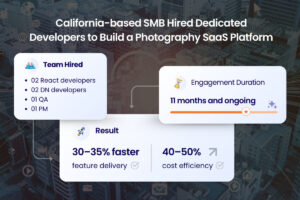
California-based SMB Hired Dedicated Developers to Build a Photography SaaS Platform

Swedish Agency Built a Laravel-Based Staffing System by Hiring a Dedicated Remote Team