Table of Contents

The Strategic Imperative: How Michigan Companies Leverage Python for Data Pipeline Excellence
Michigan’s economy, driven heavily by automotive manufacturing, finance, logistics, and advanced technology, generates immense volumes of complex, time-sensitive data. Transforming this raw output into actionable business intelligence is no longer a competitive advantage, but a foundational requirement for operational survival and growth. The critical infrastructure enabling this transformation is the data pipeline: the engine that ingests, cleans, transforms, and routes data consistently and reliably. In almost every modern implementation, Python is the default language of choice for building these robust systems.
For CTOs and VPs of Engineering in the region, the challenge is not recognizing the need for better data infrastructure, but rather securing the specific, high-caliber talent required to build it quickly and securely. Locating specialized data engineers Michigan who deeply understand scalability, real-time streaming (Kafka/Pulsar), and cloud-native ETL/ELT frameworks (Airflow, Prefect) is difficult and expensive locally. This intense competition for skills forces senior decision-makers to look beyond regional borders for specialized expertise. The resulting strategic decision is often: how do we efficiently hire Python developers Michigan companies need without compromising on quality or control?
Defining the Data Pipeline Challenge for Michigan Enterprises
Modern data pipelines are rarely static batch processes. They must handle massive concurrency, integrate dozens of disparate sources, and maintain high data quality under pressure. For companies dealing with manufacturing sensors, supply chain logistics, or personalized financial products, pipeline failure translates directly into operational downtime and poor decision-making.
Shifting from Legacy Systems to Cloud-Native Streaming
Many legacy systems in Michigan enterprises rely on brittle, tightly coupled data movement scripts or outdated ETL tools. The strategic shift is toward modern, decoupled architectures that utilize cloud infrastructure (AWS S3, Azure Data Lake, GCP BigQuery) and embrace streaming concepts. Developers tasked with this modernization must be fluent not just in basic Python scripting, but in using libraries like Pandas for transformation, Dask for parallel computing, and Pyspark for distributed processing.
When you seek to hire Python developers, ensure their experience profile demonstrates success in migrating existing data warehouses or on-premise systems into scalable cloud environments. This is a transformation project, not just a coding exercise, and requires developers who act as true data architects.
The Economic Impact of Inefficient Data Engineering
The cost of waiting to staff these roles locally or relying on under-qualified internal teams can be immense. Slow pipelines lead to delayed reporting, which impacts inventory management, preventative maintenance scheduling, and customer experience modeling. These are direct revenue losses. Furthermore, poorly written pipelines often require excessive cloud resources (compute/storage) due to lack of optimization, ballooning monthly operational expenditures (OpEx).
When evaluating providers to hire python developers, ask specifically how they guarantee performance optimization and cost efficiency within the target cloud environment. Their developers should view infrastructure efficiency as a core deliverable, not an afterthought. For Michigan businesses focused on manufacturing efficiency, optimization is non-negotiable.
The Essential Skill Profile: What Dedicated Python Developers Must Master
When staffing teams for mission-critical data infrastructure, a generalist Python programmer is insufficient. Senior decision-makers must evaluate candidates based on their mastery of the full data lifecycle, risk mitigation strategies, and architectural foresight.
Core Data Stack Fluency vs. General Scripting
A data pipeline specialist uses Python to orchestrate complex operations. Therefore, proficiency must extend beyond standard object-oriented programming. They need hands-on experience building custom connectors, handling schema evolution, and managing version control for data models. Look for experience with tools like SQLAlchemy, Marshmallow, and specific API integrations relevant to your vertical (e.g., Salesforce, ERP systems, or industrial IoT protocols).
We often find that highly effective data engineers Michigan companies seek possess deep expertise in specific distributed systems. This includes practical experience configuring and monitoring message brokers like RabbitMQ or Kafka, which are essential for processing high-velocity data streams typical in the automotive sector.
Evaluating ETL/ELT Orchestration Expertise
Orchestration frameworks like Apache Airflow or Dagster define the backbone of reliable pipelines. A top-tier Python developer needs to show proof of complex Directed Acyclic Graph (DAG) construction, dependency management, error handling, and sophisticated retries. Their ability to write idempotent ETL processes drastically reduces data risk.
Beyond orchestration, the transition to ELT (Extract, Load, Transform) requires deep familiarity with tools like dbt (Data Build Tool), allowing transformations to occur closer to the data destination. This is a critical skill set to evaluate when you review data-ready python developer profiles, as it signals a modern, scalable approach to data governance.
Architectural and Cloud Proficiency
Data pipelines are inherently infrastructure-heavy. The best Python developers for data work are often mini-DevOps engineers. They understand infrastructure-as-code (Terraform, CloudFormation) and containerization (Docker, Kubernetes).
In the context of scaling data infrastructure, the developer must understand the nuances of the cloud data warehouse architecture, whether it’s Snowflake, Redshift, or Google BigQuery. They need to know how to optimize data partition keys, indexing strategies, and minimize data movement costs across zones.
ADVISORY CHECKPOINT: Building a resilient data foundation requires vetting developers not just on code samples, but on architectural decisions and cloud cost mitigation strategies. If your Michigan firm needs immediate scaling capacity for critical data projects, we provide access to pre-vetted Python developers ready to integrate into your existing structure. Discuss data pipeline requirements with our team today.
The Talent Acquisition Dilemma: Local vs. Dedicated Remote Teams
Decision-makers in Michigan face a common bottleneck: the cost of securing local senior Python talent is prohibitive, and the supply pool is stretched thin by major regional tech hubs. The median salary expectations for senior data engineers can easily consume significant portions of the project budget before any code is written. This reality drives the strategic shift toward high-quality, specialized remote models.
Analyzing the High Cost and Scarcity of Local Michigan Talent
The time-to-hire for specialized data roles often exceeds six months in competitive US markets. For fast-moving Michigan companies, this delay means losing market ground or delaying critical product launches dependent on data insights. When you attempt to hire Python developers Michigan firms often find themselves in bidding wars that push salary expectations far above initial projections, affecting overall ROI justification.
Furthermore, hiring locally often results in a small, potentially homogenous talent pool. Remote hiring, particularly leveraging established vendors with global talent pools, provides immediate access to diverse skill sets perfected across various international markets and delivery models.
The Efficiency of Dedicated Remote Teams
A highly effective solution gaining traction among Fortune 500 companies and scaling startups alike is the utilization of dedicated, offshore Python development teams. These teams operate as extensions of the local engineering leadership, providing specialized expertise and significant cost efficiencies (often 40–60% lower than US compensation rates).
When you onboard dedicated Python developers Michigan needs, you aren’t just getting remote staff; you are securing an immediate, mature team structure. At WeblineGlobal, for instance, we ensure these pods are equipped not just with Python data expertise, but also with necessary seniority in QA, PM, and cloud infrastructure, minimizing integration friction.
Ensuring Quality and Delivery Consistency
A primary concern when evaluating remote data development is maintaining quality and control, especially concerning sensitive data. This is where the vendor’s operating model becomes crucial. We leverage the RelyShore℠ model, which provides local US accountability and project management combined with highly skilled engineering resources in India. This model addresses latency, time zone differences, and crucial security protocols like strict IP protection and NDAs.
Decision-makers should scrutinize the vendor’s hiring and vetting processes for hire data analytics experts. Do they test for architectural foresight, communication clarity, and debugging skills, or just basic coding proficiency? A robust vendor ensures that the remote team integrates seamlessly and operates under the same high standards as local employees.
Key Evaluation Criteria for Outsourcing Data Pipeline Development
Before committing to a vendor, CTOs must validate their capabilities across several dimensions that impact long-term delivery risk and scalability, specifically within data engineering.
Measuring Expertise in Specific Data Ecosystems
A critical vetting step is demanding specific proof of work in your industry vertical. If your Michigan company is in automotive, the developer needs experience handling sensor data, time-series databases (like InfluxDB or TimescaleDB), and massive IoT streams. If you are in finance, compliance (e.g., PCI, SOC 2) and encryption handling are paramount.
Ask vendors for case studies that mirror your operational environment. Generic Python experience is insufficient; you need proof that the dedicated team understands the nuances of streaming millions of records per second while ensuring data integrity. This specialist experience mitigates integration risk significantly. You may hire python developers widely, but only a few possess this specialized domain knowledge.
Governance and Security: Protecting IP and Compliance
Data pipeline projects inherently deal with the most sensitive organizational assets. A reliable remote partnership must offer stringent safeguards. Before you sign a contract, ensure clear protocols are established for:
- Data Access Controls: Role-based restrictions and transparent audit trails.
- IP Ownership: Clear, documented assignment of all code and work product to your company.
- Encryption Standards: Developers must utilize industry-standard encryption both in transit and at rest.
Decision-makers must treat the security assessment for remote teams with the same rigor applied to internal staff. The vendor should provide clarity on their physical security, network separation, and compliance certifications.
Scalability and Team Augmentation Roadmap
Data initiatives often start small but require rapid scaling as new data sources are introduced or real-time requirements increase. Your vendor must offer flexible scaling options.
Does the vendor allow for month-to-month flexibility? Can they quickly add another specialized data engineers Michigan requires within 48 hours, or will it take weeks? The ability to augment your team rapidly—say, adding a specialized QA engineer or a DevOps resource—is essential for maintaining velocity and handling unpredictable data surges. This flexibility is a key differentiator of the dedicated team model over traditional staffing agencies.
ACTION ITEM: If your current staffing strategy limits your ability to scale critical data infrastructure, it’s time to explore proven remote solutions. We can match you with senior, pre-vetted Python specialists who understand large-scale data architecture. Schedule a Consultation to discuss how to secure high-impact remote teams within days.
Making the Informed Decision to Secure Specialized Python Talent
For Michigan companies aiming to build high-performance data pipelines, the decision is ultimately centered on speed, cost, and reliability. Relying solely on the volatile local talent market introduces unavoidable risks of project delays and budget overruns.
By choosing strategically sourced, dedicated teams, you gain immediate access to developers who specialize in the modern data ecosystem (Kafka, Airflow, cloud services) and integrate directly with your engineering workflow. This approach allows you to secure world-class expertise at a sustainable cost, freeing up capital to focus on strategic initiatives rather than endless recruitment cycles. The path to robust, scalable data pipelines begins with securing the right Python talent, regardless of their physical location.
Frequently Asked Questions
Typically, a reliable remote vendor can shortlist senior, pre-vetted dedicated Python developers Michigan companies need within 48 hours. After client interviews and final selection, the developer can often begin integration and knowledge transfer within one to two weeks, significantly faster than traditional local recruitment efforts.
While developers may be based internationally (e.g., India), established global delivery models are designed to mitigate time zone gaps. WeblineGlobal, for example, ensures significant overlap hours with US business operations, allowing for daily collaborative meetings, immediate feedback loops, and real-time support for critical data deployments, minimizing communication latency.
No. While local context is helpful, modern data pipeline development is primarily a technical and architectural challenge. Expertise in cloud services, distributed systems, Python libraries (Pandas, Dask), and orchestration frameworks (Airflow) outweighs geographical familiarity. Local context can be provided by the internal US-based project leader, allowing you to prioritize the global pool for technical depth.
Security starts with vendor contracts and operational protocols. Ensure the vendor signs stringent NDAs and that their developers operate within secure, monitored environments with strict access controls. All intellectual property generated must be contractually assigned to your company from day one. Look for vendors who demonstrate a mature security posture, protecting your sensitive Michigan operational data.


Success Stories That Inspire
See how our team takes complex business challenges and turns them into powerful, scalable digital solutions. From custom software and web applications to automation, integrations, and cloud-ready systems, each project reflects our commitment to innovation, performance, and long-term value.
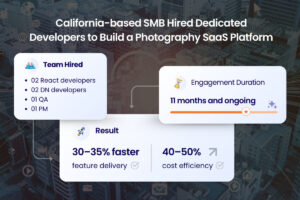
California-based SMB Hired Dedicated Developers to Build a Photography SaaS Platform
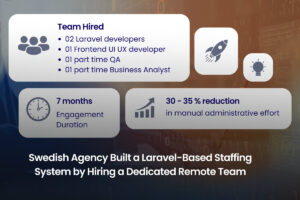
Swedish Agency Built a Laravel-Based Staffing System by Hiring a Dedicated Remote Team