
Table of Contents

How Do We Resolve Azure Foundry Agent Integration Issues in Higher Education?
During a recent project for an enterprise EdTech SaaS platform, we were tasked with building an AI-driven student assistance portal. The goal was to deploy an intelligent agent capable of answering complex compliance and policy questions, such as, “Can I work in the UK during my Ph.D. studies if I have a Student Visa?” The authoritative source for these documents resided in a secure, internal SharePoint repository.
To achieve this, we leveraged Azure AI Foundry to create and configure the agent, successfully attaching the native SharePoint tool to grant the AI access to the required document libraries. However, while transitioning from the development environment to production, we realized a significant discrepancy. Testing the agent within the Azure Foundry Playground worked flawlessly. Yet, when invoking the exact same agent programmatically via REST API using a standard bearer token, the request failed entirely.
This challenge is a prime example of why organizations often choose to hire software developer teams with deep architectural experience. What appeared to be a standard authentication issue masked a deeper structural requirement in how Azure AI Foundry handles external tool payloads. This article breaks down how we identified the root cause of this failure and implemented a resilient solution, so other engineering teams can avoid the same deployment blockers.
Why Does the API Fail Only When the Azure Foundry SharePoint Tool is Attached?
Our architecture relied on a standard service-to-service communication model. We created an App Registration in the Azure portal, utilizing the client credentials flow to generate an OAuth2 token (via login.microsoftonline.com). The application was granted Sites.Selected permissions and we ran the necessary PnP PowerShell commands to grant the Azure AD App explicit access to the specific SharePoint site.
We verified this access independently by successfully querying the SharePoint site via the Microsoft Graph API. Furthermore, we created two separate agents in Azure Foundry to isolate the variable:
- Agent A: No SharePoint Tool attached.
- Agent B: SharePoint Tool attached.
When sending a basic JSON payload to Agent A via REST API, the response was successful. However, sending the exact same payload to Agent B resulted in an immediate failure. The business use case demanded Agent B, as without the SharePoint tool, the AI lacked the critical contextual data required to answer student queries accurately.
What Causes the “invalid_payload” Error in Azure AI Foundry REST APIs?
When invoking Agent B, the REST API returned the following error block:
{
  "error": {
    "code": "invalid_payload",
    "message": "Invalid request payload. [Request ID: xxxxxxxxxxxxxxxxxxxxxxxxxxxxxxxx]",
    "type": "invalid_request_error",
    "details": [],
    "additionalInfo": {
      "request_id": "xxxxxxxxxxxxxxxxxxxxxxxxxxxxxxxx"
    }
  }
}
Initially, one might suspect an authorization failure. However, a 401 (Unauthorized) or 403 (Forbidden) status would indicate permission issues with SharePoint or the Azure token. The invalid_payload error, categorized as an invalid_request_error (HTTP 400 Bad Request), pointed directly to the structure of the JSON body being sent to the Foundry endpoint.
The core issue surfaced here: The Azure Foundry Playground operates within an authenticated user context and automatically injects complex tool configurations, connection references and specific API version headers into the underlying API call. When you build a raw REST request with just the input and agent_reference, the Foundry backend does not know how to contextualize the attached SharePoint tool without explicit connection mappings or the proper API version that supports tool schemas.
Which Solutions Did We Consider to Fix the Azure Agent API Structure?
To diagnose and resolve the payload rejection, we mapped out several potential approaches, evaluating the tradeoffs of each.
Did We Need to Switch to Delegated User Tokens?
We considered whether the SharePoint tool required an On-Behalf-Of (OBO) flow or delegated user permissions rather than a service principal token. While some Microsoft 365 tools demand a user context, we had already granted Sites.Selected to the application itself. Switching to delegated tokens would require a complete overhaul of our backend authentication strategy, which was unnecessary since the Graph API accepted our app-only token.
Should We Bypass the Tool and Use Direct Graph API Calls?
Another option was to remove the SharePoint tool from Azure Foundry entirely and build a custom Retrieval-Augmented Generation (RAG) pipeline. We could query the Graph API manually, extract the document text and feed it into the Foundry agent as a standard prompt. While valid, this approach defeated the purpose of using Azure Foundry’s native tool integrations, adding unnecessary latency and maintenance overhead.
Can We Reverse-Engineer the Playground Payload?
The most practical approach was to inspect the network traffic generated by the Azure Foundry Playground. By analyzing the developer tools in the browser while interacting with the agent, we discovered that the Playground was passing a much richer payload and utilizing a newer, preview api-version query parameter. The standard API documentation for basic agent invocation omitted the required payload extensions for external tool connections.
How Do We Correctly Structure the REST Payload for SharePoint Tools?
The solution required two specific adjustments to our API integration strategy. First, we had to ensure the endpoint URL included the correct preview API version that supported tool configurations. Second, we had to expand our JSON payload to explicitly declare the tool connection context, even if it was pre-configured in the Foundry UI.
When enterprise teams hire ai developers for production deployment, understanding these undocumented payload requirements is what separates successful deployments from prolonged debugging cycles.
Here is the sanitized, corrected approach we implemented:
// 1. Ensure the API version supports tool connections
const endpoint = `https://{your-resource}.openai.azure.com/openai/deployments/{deployment-id}/chat/completions?api-version=2024-02-15-preview`;
// 2. Expand the payload to include tool configurations
const payload = {
  "messages": [
    {
      "role": "user",
      "content": "Can I work in the UK during my PHD studies if I have a Student Visa?"
    }
  ],
  "agent_reference": {
    "name": "Student-Assistant-Agent"
  },
  "tools": [
    {
      "type": "sharepoint",
      "sharepoint": {
        "connection_id": "sharepoint-connection-id-from-foundry",
        "index_name": "policy-documents"
      }
    }
  ]
};
Validation Steps:
- API Version Match: Ensure the
api-versionquery parameter exactly matches the one used by the Foundry Playground. Older stable versions often reject payloads containing new tool arrays. - Connection ID Verification: The
connection_idmust match the enterprise connection established within your Azure Foundry hub. - Token Scopes: Ensure the Bearer token generated from
login.microsoftonline.comincludes the specific audience scope for Azure AI Foundry, not just the Graph API.
What Can Engineering Teams Learn About Azure AI Foundry Configurations?
Transitioning from visual AI builders to raw code always introduces translation gaps. Here are the actionable insights from this deployment:
- Playground vs. Production: Never assume the API payload used in a visual playground matches the minimal required payload in the official documentation. Playgrounds inject state, connections and context automatically.
- Analyze HTTP Errors Carefully: A 400
invalid_payloaderror is fundamentally different from a 401 or 403. Trust your error codes. If it says the payload is invalid, focus on JSON schema, headers and API versions, not Azure RBAC. - API Versioning is Critical: Azure’s AI services evolve rapidly. Features like SharePoint tool integration are often gated behind specific
-previewAPI versions. - Network Inspection is Your Friend: When documentation lags behind feature releases, inspecting the browser network tab during Playground execution is the fastest way to discover expected schema structures.
- Modular Architecture: When you hire python developers for scalable data systems, ensure they design the API wrapper layer to dynamically inject connection configurations based on the environment, keeping the core logic clean.
How Can You Ensure Stable Enterprise AI Integrations?
Integrating Azure AI Foundry with enterprise data sources like SharePoint unlocks massive potential, but it requires strict adherence to evolving API schemas and authentication flows. By understanding the delta between playground environments and raw REST calls, engineering teams can build resilient, secure AI integrations that do not fail unexpectedly in production.
If your organization is navigating complex cloud architectures, authentication flows or AI tool integrations, you need a team that understands the nuances of enterprise deployments. Whether you need to hire dotnet developers for enterprise modernization or require a dedicated engineering squad to scale your AI initiatives, we provide the technical maturity to deliver. contact us to discuss how our pre-vetted remote teams can accelerate your roadmap.
Social Hashtags
#MicrosoftFoundry #AzureAI #SharePoint #AIAgents #GenerativeAI #Azure #RESTAPI #Microsoft365 #EnterpriseAI #AIIntegration #CloudComputing #RAG
Frequently Asked Questions
The Playground operates within the browser's authenticated session and automatically constructs comprehensive JSON payloads, including hidden tool connection IDs and the latest preview API versions. Manual API calls often fail because they lack these dynamically injected parameters.
Yes. As long as the Service Principal (Azure App Registration) is granted Sites.Selected permissions and has been authorized via PnP PowerShell or Graph API for the specific site, the Foundry agent can retrieve documents without needing a delegated user context.
This error (HTTP 400) indicates a schema mismatch. The endpoint received your request and validated your token, but the JSON body provided did not match the expected structure for the specified api-version, often due to missing tool connection definitions.
The most reliable method is to open your browser's Developer Tools (Network tab), execute a successful run in the Azure Foundry Playground and inspect the endpoint URL in the underlying POST request to capture the exact api-version being used.
Absolutely. Once the backend REST payload is correctly structured and secured behind an API gateway, the deployment can easily serve mobile clients. If you plan to extend these capabilities, you can hire app developer to create a mobile app that interfaces seamlessly with your newly stabilized AI endpoints.
Success Stories That Inspire
See how our team takes complex business challenges and turns them into powerful, scalable digital solutions. From custom software and web applications to automation, integrations, and cloud-ready systems, each project reflects our commitment to innovation, performance, and long-term value.
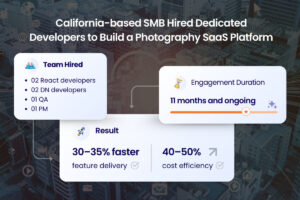
California-based SMB Hired Dedicated Developers to Build a Photography SaaS Platform
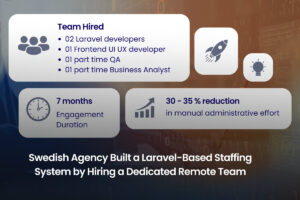
Swedish Agency Built a Laravel-Based Staffing System by Hiring a Dedicated Remote Team