Table of Contents

Launching a mobile application is only the first step in a long journey toward market dominance. For engineering leaders overseeing products that span the vast and diverse geography of the United States, the real challenge begins during the maintenance and scaling phase. Managing release cycles for mobile apps used across US regions requires a sophisticated approach to deployment, testing, and team structure that many organizations struggle to internalize until performance begins to dip or user churn spikes in specific territories.
The complexity of the US market is often underestimated. From varying network conditions in rural versus urban areas to specific state-level data privacy regulations, the demand for a seamless user experience never wavers. As a CTO or VP of Engineering, your goal is to ensure that your release pipeline is robust enough to handle these nuances without slowing down your feature roadmap. Achieving this balance depends heavily on your ability to hire mobile app developers who understand the intersection of high-frequency releases and regional performance stability.
Establishing Predictability in Release Cycles Multi Region Apps
Predictability is the cornerstone of any successful mobile strategy. When your application serves users from New York to California, a “one size fits all” release strategy can lead to unforeseen outages or latency issues that affect only specific demographics. Engineering leaders must move away from ad-hoc deployments toward a structured cadence that accounts for regional peak usage times and maintenance windows.
The Logistical Complexity of US-Wide Deployments
The United States spans multiple time zones, which means a midnight release on the East Coast is occurring during prime evening usage hours on the West Coast. If a release goes sideways, you risk alienating a significant portion of your user base before your team has even had their morning coffee. To mitigate this, you need to stabilize release cycles by implementing automated rollback triggers and regionalized canary deployments.
Staged Rollouts and Canary Testing
Instead of pushing a binary to the entire country at once, experienced teams use staged rollouts. This involves releasing the update to a small percentage of users in specific regions first. If the crash logs and performance metrics remain stable, the rollout expands. When you look to hire mobile app developers USA contextually, you must evaluate their familiarity with tools like Firebase Remote Config or LaunchDarkly to manage these regional feature flags effectively.
Monitoring Regional Latency
Performance isn’t just about crashes; it is about speed. A release might work perfectly in a high-bandwidth environment but fail for users in regions with spotty 5G coverage. Your team must be capable of monitoring latency at a granular level to ensure that code changes haven’t inadvertently bloated the app’s resource requirements.
If you are looking to scale your engineering capacity to handle these complexities, the most efficient path is to schedule a consultation to discuss your specific regional deployment needs.
The Role of Infrastructure in Managing Release Cycles
A mobile app is only as strong as the backend supporting it. For apps targeting the US market, the underlying cloud infrastructure must be optimized for geographic distribution. This is where the synergy between mobile development and DevOps becomes critical. Without a synchronized effort, your release cycles will inevitably hit bottlenecks at the server level.
Integrating Cloud & DevOps into the Mobile Lifecycle
Effective management of release cycles multi region apps requires a CI/CD pipeline that is tightly integrated with regional cloud nodes. This ensures that when a new version of the app is pushed, the backend services it relies on are scaled and ready in the appropriate geographic zones. For many organizations, the best way to achieve this is to hire cloud & devops engineers who can build the automation necessary to support a fast-moving mobile team.
Infrastructure as Code for Regional Parity
Using Infrastructure as Code (IaC) ensures that your staging, UAT, and production environments are identical across all regions. This eliminates the “it worked on my machine” syndrome and reduces the risk of environment-specific bugs during a US-wide rollout. Decision-makers should prioritize vendors who demonstrate mastery over Terraform or AWS CloudFormation in the context of mobile support.
Automated Regression Testing
With every release, there is a risk of breaking existing functionality. Automated regression suites must be run against multiple device configurations and simulated network speeds to mirror the diverse US landscape. This is a non-negotiable requirement for maintaining high ratings in the App Store and Google Play.
To ensure your infrastructure can support your growth, you may want to review the deployment strategy with experts who have managed large-scale US applications.
Strategic Hiring: Finding the Right Talent for US Operations
When you decide to hire mobile app developers USA focused or otherwise, the primary concern is often the trade-off between cost and delivery quality. For US-based companies, hiring locally is increasingly expensive and slow. This is why many VPs of Engineering are turning to offshore dedicated teams that operate as a “pod” to handle specific regional release responsibilities.
Evaluating Candidates for Regional Release Expertise
It is not enough for a developer to know Swift or Kotlin. They must understand the operational side of mobile development. When interviewing, ask about their experience with multi-tenant architectures, regional data residency requirements, and how they handle high-concurrency events such as Black Friday or major US sporting events if your app caters to those peaks.
The RelyShore℠ Advantage for US-Based Firms
At WeblineGlobal, we utilize the RelyShore℠ model to bridge the gap between India-based scale and US-based quality assurance. This model ensures that when you hire mobile app developers USA companies trust, you are getting developers who are vetted for both technical prowess and the communication skills necessary to navigate complex release cycles. This approach provides the month-to-month flexibility that modern startups and enterprises require.
If your current hiring process is taking too long, you can Request Developer Profiles today and see a shortlist of qualified candidates within 48 hours.
Balancing Feature Velocity with Delivery Risk
The pressure to ship new features is constant. However, for apps with a massive geographic footprint, every new feature is a potential point of failure. Managing release cycles multi region apps is a constant exercise in risk mitigation. You must decide which features are critical for the entire US market and which can be rolled out gradually or toggled off if problems arise.
Technical Debt and the Release Bottleneck
Technical debt is the silent killer of release velocity. If your codebase is a mess of legacy patches, your team will spend more time fixing old bugs than shipping new value. A dedicated team focused on “clean code” and architectural integrity is essential. When you hire mobile app developers, ensure they have a proven track record of refactoring and maintaining large-scale codebases without interrupting the release train.
Feature Toggling for Regional Personalization
Feature toggles allow you to decouple deployment from release. You can push the code to the App Store but only “turn on” the feature for users in specific US regions. This is particularly useful for localized marketing campaigns or testing new services in a single city like Chicago or Seattle before a nationwide launch. This level of control is what separates amateur apps from market leaders.
Ready to upgrade your team? Contact us to hire remote developers who can implement these advanced release strategies for your mobile product.
Navigating the Compliance and Regulatory Landscape
Managing mobile apps in the US means navigating a patchwork of regulations. While there is no federal privacy law as comprehensive as GDPR yet, state laws like the CCPA in California or the SHIELD Act in New York impose strict requirements on how mobile data is handled. Your release cycle must include a compliance check phase to ensure that no update violates these regional laws.
Security Audits in the CI/CD Pipeline
Security should never be an afterthought. By integrating automated security scanning into your release cycle, you can identify vulnerabilities before they reach the user. This is especially vital for apps handling financial data or personally identifiable information (PII). When looking to hire cloud & devops engineers, look for those with a “SecOps” mindset who can bake security into the very foundation of your delivery pipeline.
Data Sovereignty and Regional Hosting
While most mobile data for US users stays within US-based servers, the way that data is routed can impact both performance and legal compliance. A well-managed release cycle accounts for these backend changes, ensuring that as you expand your footprint, your data architecture remains compliant with all regional mandates.
If you are concerned about your current security posture, you should schedule developer interviews with specialists who understand the US regulatory environment.
Optimizing Team Composition for Long-Term Scalability
As your app grows, the structure of your team will need to evolve. For many US organizations, the most successful model is a hybrid one. This involves a core group of internal product leaders working closely with a dedicated offshore pod that handles the heavy lifting of coding, testing, and release management. This allows the internal team to focus on strategy while the offshore team ensures the release cycles multi region apps remain consistent and high-quality.
The Economics of Scale in Mobile Development
Hiring a full team locally in the US can easily cost three to four times more than building a dedicated team in India. However, the key is not just lower costs but the ability to scale up or down as your roadmap changes. By choosing to hire mobile app developers through a partner like WeblineGlobal, you gain access to a deep pool of talent that can be deployed quickly to meet aggressive deadlines.
Reducing Time-to-Hire and Delivery Risk
The standard hiring cycle for a senior developer in the US can take months. In the fast-paced mobile market, that is time you don’t have. Our model focuses on providing shortlists within 48 hours, allowing you to stabilize release cycles and keep your project on track without the overhead of traditional recruitment.
Building a Resilient Mobile Future
Managing release cycles for mobile apps across the US regions is a complex but rewarding challenge. By focusing on automated pipelines, regional monitoring, and a strategic approach to talent acquisition, you can build a product that scales effortlessly. The decision to hire mobile app developers USA focused or to leverage a global delivery model like RelyShore℠ will ultimately define your ability to innovate while maintaining the stability your users expect.
Success in the mobile space requires more than just good code; it requires a commitment to operational excellence and the right partners to execute your vision. Whether you are looking to review deployment strategy or build a whole new team, the priority remains the same: delivering a flawless experience to every user, regardless of which region they call home.
Social Hashtags
#MobileAppDevelopment #AppReleaseManagement #CICD #DevOps #SoftwareEngineering #MobileApps #TechLeadership #AppDeployment #CloudComputing #ScalableApps #USMarket #EngineeringLeadership #AppPerformance #StartupTech #DigitalTransformation
Do not let hiring bottlenecks slow your growth. Hire developers now to ensure your US mobile presence remains competitive.
Frequently Asked Questions
Time zones affect when you can safely deploy updates without interrupting peak usage hours. A release at 11:00 PM EST is still 8:00 PM PST, which may be a high-traffic time for certain apps. Using regionalized rollouts or feature flags allows teams to manage this discrepancy effectively.
Hiring remote developers, particularly from India, offers significant cost savings (40–60 percent) and access to a larger talent pool. When managed via a model like RelyShore℠, it provides US-based quality assurance and communication with the cost efficiency of offshore talent.
You must integrate compliance checks into your release cycle. This involves regular audits of data collection practices and ensuring your team is trained on US regional regulations. Hiring developers with experience in US-market applications is critical for this.
Tools like Firebase, LaunchDarkly, and AWS Device Farm are essential for managing regional feature sets, staged rollouts, and testing across the diverse device landscape found in the US market.
With a dedicated partner, you can often receive vetted developer profiles within 48 hours and have a team integrated into your workflow within a few weeks, which is significantly faster than traditional US local hiring processes.



Success Stories That Inspire
See how our team takes complex business challenges and turns them into powerful, scalable digital solutions. From custom software and web applications to automation, integrations, and cloud-ready systems, each project reflects our commitment to innovation, performance, and long-term value.
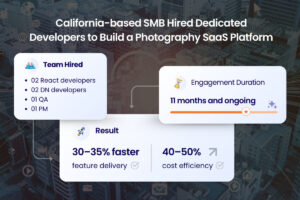
California-based SMB Hired Dedicated Developers to Build a Photography SaaS Platform
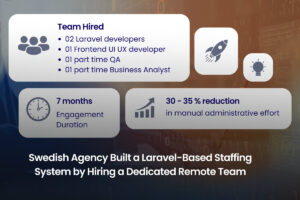
Swedish Agency Built a Laravel-Based Staffing System by Hiring a Dedicated Remote Team