Table of Contents

How to Architect Idea Creation Using n8n for Marketing Workflows?
While working on a comprehensive marketing automation platform for a B2B SaaS client in the retail space, we encountered a situation where automated content generation became a bottleneck. We were building an AI marketing automation workflow in n8n designed to handle everything from caption generation to image prompting and direct publication. The execution and scheduling layers were functioning flawlessly, but the core issue surfaced upstream: idea creation using n8n.
Initially, the system relied on RSS feeds and trending news APIs to feed prompts to a Large Language Model. However, we quickly realized that summarizing existing articles eventually becomes highly repetitive. If the client’s end-user sold artisanal organic consumables, the AI would endlessly generate posts about the latest agricultural news or market trends. It lacked the creative variance a human marketer brings, such as behind-the-scenes stories, myth-busting or historical facts.
This issue matters deeply in production because repetitive content leads to audience fatigue and degrades the ROI of an automated marketing platform. We needed an architecture that forced the AI to explore different conceptual spaces independently, ensuring fresh content without manual intervention. This challenge inspired us to re-architect our n8n pipelines and the lessons learned here can help other engineering teams avoid the trap of linear, reactive AI workflows.
What is the Business Context for an AI Content Ideation Workflow?
The platform we were developing served e-commerce brands looking to scale their social media presence without hiring massive content teams. The core business requirement was to generate a rolling 30-day content calendar that felt organic, engaging and diverse.
In a real-world content strategy, brands rely on content pillars. For example, a brand selling organic honey does not just post news about bees. Their content strategy requires diverse angles:
- Comparisons (e.g., natural sweeteners vs refined sugars)
- Myths vs Facts (e.g., clarifying misconceptions about crystallization)
- Educational content (e.g., how the extraction process works)
- Storytelling and historical uses
- Customer pain points and FAQs
Our architectural challenge was translating this human-led pillar strategy into a deterministic n8n workflow. The system needed to intelligently decide which pillar to use, generate a novel idea within that pillar and verify that it hadn’t published a similar concept recently.
Why Do Basic RSS to AI Workflows Fail in Production?
When the initial workflow was deployed, the architectural oversight was treating ideation as a stateless transformation rather than a stateful generation process. The workflow was essentially a linear Directed Acyclic Graph.
The symptoms appeared within three weeks of production usage. The logs showed the AI repeatedly outputting variations of the same three themes. Because the workflow was stateless, every time the cron trigger fired, the LLM started with a blank slate, heavily biased toward its pre-training data and whatever recent news was injected via the RSS node.
Furthermore, prompt engineering alone could not solve this. We added instructions like generate unique ideas and do not repeat yourself, but without historical context, the LLM could not know what it had generated three days prior. The bottleneck was architectural: the system lacked long-term memory and structured routing.
How to Architect a Non-Repetitive AI Ideation System in n8n?
To solve the repetition and diversity problem, we stepped back to evaluate how we could force conceptual exploration within n8n. We considered several architectural patterns before settling on our final implementation.
Should You Use a Single Reasoning Model for Idea Creation?
Our first diagnostic step was testing if a massive, single-prompt approach could work. We provided a highly advanced model with a prompt containing all possible content pillars and asked it to return a JSON array of 30 diverse ideas. While this worked for a one-off batch, it failed in a continuous automation scenario. The context window became saturated and managing the state of which ideas were already consumed became a database nightmare. We realized that monolithic prompting does not scale well in continuous n8n workflows.
Can Broad Web Scraping Solve the AI Creativity Problem?
We then considered expanding our data ingestion nodes in n8n to scrape community forums and Q&A sites alongside RSS feeds. While this injected different terminology, the core problem remained: the AI was summarizing external thoughts rather than generating brand-specific, structured content pillars. It was still reactive.
Is a Multi-Agent Debate System the Right Approach for n8n?
We experimented with a multi-agent setup where one AI agent generated ideas and another critiqued them for novelty. While intellectually fascinating, orchestrating this within n8n via HTTP requests to external agent frameworks introduced high latency, increased token costs by 400% and made debugging incredibly complex. This is a common inflection point where CTOs hire ai developers for production deployment to build custom logic rather than over-complicating low-code orchestrators.
Why Use a Stateful Content Pillar Architecture in n8n?
We ultimately designed a stateful, slot-based routing architecture directly within n8n. Instead of asking the AI to come up with ideas out of thin air, the n8n workflow assumes control of the strategy. We defined an array of ten distinct content pillars. Upon execution, n8n deterministically selects a pillar based on historical frequency, injects highly specific guardrails for that exact pillar, generates the idea and then uses a vector database to check for semantic duplication before approving it. This decoupled strategy from generation.
How to Implement the Final n8n AI Workflow for Content Ideation?
The final implementation transformed a single linear pipeline into a modular architecture utilizing n8n sub-workflows, PostgreSQL with pgvector and dynamic switch nodes.
First, we created a PostgreSQL database to act as the long-term semantic memory. Every approved idea is converted into an embedding and stored.
The main n8n ideation workflow executes as follows:
- State Retrieval: A Postgres node queries the database to see which content pillars have been underutilized in the last 14 days.
- Pillar Selection: An n8n Code Node calculates a weighted random selection to pick the next pillar (e.g., Myths vs Facts).
- Dynamic Prompt Assembly: Based on the selected pillar, a Switch Node routes the flow to a specific prompt template. The template explicitly forces the LLM to adopt that specific framing.
- Generation and Embedding: An HTTP Request node calls the LLM API. The resulting idea is then passed to an embedding model API to generate a vector array.
- Semantic Deduplication: We query our pgvector database using cosine similarity. If the new idea has a similarity score higher than 0.85 compared to any idea generated in the last 60 days, the workflow rejects it and loops back to regenerate with a higher temperature setting.
Here is a generic representation of the similarity query executed within the n8n Postgres node:
SELECT id, idea_text, 1 - (embedding  '[vector_data]') AS similarity
FROM content_ideas
WHERE tenant_id = 'current_tenant'
  AND published_at > NOW() - INTERVAL '60 days'
ORDER BY similarity DESC
LIMIT 1;
By enforcing deduplication at the vector level rather than the keyword level, we ensured that Honey’s health benefits in the morning and Starting your day with a spoonful of raw honey were recognized as the same concept, forcing the AI to generate a truly new angle next time. If your database grows to millions of embeddings across thousands of tenant accounts, you may need to hire python developers for scalable data systems to decouple the embedding engine from n8n into a dedicated microservice.
What Are the Key Architectural Lessons for n8n Engineering Teams?
Through resolving this ideation bottleneck, we extracted several architectural insights applicable to any enterprise automation project:
- Decouple Strategy from Generation: Do not rely on an LLM to decide what to write about. Use your workflow orchestrator (n8n) to manage the rules, routing and strategy and use the LLM strictly as a text-generation engine.
- Implement Semantic Memory: Relational databases are insufficient for tracking AI repetitions. Implementing vector embeddings allows your system to understand conceptual overlap, not just keyword matching.
- Use Sub-Workflows for Modularity: Instead of building a 50-node monstrosity, separate your deduplication logic, prompt assembly and API calls into n8n Execute Workflow nodes.
- Force Constraints for Creativity: AI models generate their best, most diverse work when highly constrained. Passing a specific pillar (like Historical Facts) yields much better results than asking for a good idea.
- Design for Rejection: Your workflow must gracefully handle failed states. If the generated idea is too similar to past content, the architecture must support a retry loop with altered parameters (like increased temperature or a fallback pillar).
How to Summarize This n8n Idea Generation Architecture?
Architecting idea creation using n8n requires shifting from a simple stateless prompt execution to a stateful, routing-based architecture. By combining structured content pillars, dynamic switch routing and vector-based semantic deduplication, we successfully built an ideation engine that continuously explores new creative spaces without relying on external RSS feeds.
Whether you are building a simple internal tool or looking to hire software developer talent for complex enterprise AI systems, structuring your automation with strict guardrails and long-term memory is the key to scalable quality. If your team is struggling to implement advanced, non-repetitive AI workflows in production, contact us to explore how our dedicated engineering teams can streamline your architecture.
Social Hashtags
#n8n #AI #AIAutomation #WorkflowAutomation #MarketingAutomation #GenerativeAI #AIWorkflow #ContentAutomation #ContentMarketing #AIAgents #LLM #PromptEngineering #PostgreSQL #pgvector #Automation
Frequently Asked Questions
You can integrate pgvector in n8n using the standard PostgreSQL node. You generate the embeddings via an HTTP request to your preferred embedding model (like OpenAI or Cohere), format the resulting vector array as a string and pass it directly into an SQL query inside the Postgres node using the cosine similarity operator.
While n8n is a low-code platform, building a robust semantic deduplication loop requires writing custom SQL queries for the vector search and minimal JavaScript in the Code node for weighted random selection and data formatting. It bridges the gap between low-code ease and custom engineering.
You must implement a loop counter within your n8n workflow state. If the semantic similarity check fails three consecutive times, the workflow should exit the loop, log a warning and either fallback to a broad, guaranteed-unique prompt or alert a human operator.
n8n's Advanced AI nodes (like the AI Agent or Vector Store nodes) are excellent for rapid prototyping. However, for highly controlled enterprise architectures where you need exact oversight over the prompt assembly and similarity threshold logic, using standard HTTP nodes and native database nodes often provides superior control and easier debugging.

Success Stories That Inspire
See how our team takes complex business challenges and turns them into powerful, scalable digital solutions. From custom software and web applications to automation, integrations, and cloud-ready systems, each project reflects our commitment to innovation, performance, and long-term value.
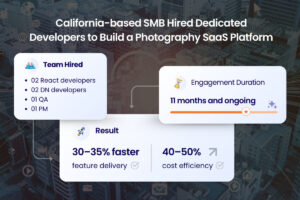
California-based SMB Hired Dedicated Developers to Build a Photography SaaS Platform
NYC Event Company Built Their B2B App 2x Faster by Hiring a Remote React Native Team