
Table of Contents

Today’s organisations are constantly pressured to link heterogeneous software systems, automate repetitive procedures, and break down data silos across departments. With the maturing of low-code and fair code orchestration platforms, n8n is becoming the preferred enterprise choice for constructing complex, secure, and adaptable automation pipelines. But a crucial strategic problem often rests on the desk of engineering leaders and chief technology officers.
Would you prefer to have your current software engineers develop and maintain these workflows, or would you like to collaborate with a dedicated n8n development team?
The answer to that question is to look beyond convenience and consider long-term productivity, opportunity cost, and technical specialisation. Internal engineering teams are typically hired to design fundamental product features that drive direct revenue and competitive difference.
So, your core product roadmap ultimately stops when these same developers spend hours troubleshooting webhook payloads, managing node versions, and debugging asynchronous API failures. Demands for product development and automation create friction and burnout and delay feature releases.
This complete guide analyses the exact dynamics of workload scaling, financial trade-offs, operational speed, and architectural control.
- You’ll learn how to scale your automation infrastructure efficiently
- You’ll do it without ballooning your permanent staff or compromising your core product velocity
- You’ll have clarity on the fundamental differences between internal engineering resources and a dedicated n8n development team.
Is n8n automation taking too much time away from your core engineering roadmap?
When Can Your Internal Engineering Team Handle n8n Automation?
n8n automation initiatives can be well managed by the internal engineering team during the early adoption and exploration phases of a company’s lifetime. A handful of generalist engineers or systems administrators can simply create self-hosted instances, integrate common marketing and CRM applications, and create simple linear workflows as a company starts to realise the possibilities of workflow orchestration.
So, at this stage, integration traffic is minimal, data structures are simple, and the failure rate of basic API connections rarely affects mission-critical sources of revenue.
In addition, internal software engineers have comprehensive knowledge of your key database schemas, internal security policies, and proprietary infrastructure. In the unlikely event that an automation script has to pull data from a legacy internal microservice, an internal developer can build bespoke JavaScript or Python code nodes within n8n with minimal friction. They have tribal knowledge of the company’s codebase, and so are particularly good at ad hoc automation projects that need extensive knowledge of internal software architecture.
However, this internal competence is ideal when automation is a secondary, part-time job vs. a core operational pillar. If your engineering staff spends less than 10 percent of their weekly capacity on maintenance, fixing bugs, and designing workflows, then keeping chores in-house saves money and prevents outside dependencies.
Ultimately, you don’t need to worry about increasing n8n automation when total workflow count stays under a dozen and error monitoring requires only casual observation.
- Low complexity pipelines: Workflows primarily handle standard webhooks and CRUD operations between common software-as-a-service tools.
- Minimal maintenance overhead: Failures occur infrequently and can be resolved reactively without disrupting core business hours.
- Abundant developer bandwidth: Software engineers have dedicated sprint capacity left over after completing primary product milestones.
- Early-stage requirements: The business has not yet reached high transaction volumes or strict compliance frameworks that demand continuous monitoring.
Key Signs Your n8n Automation Needs Have Outgrown Internal Capacity
So, when to build an n8n development team? As organisations increase their digital operations, the complexity of workflows multiplies quickly, turning basic automations into complex, mission-critical webs of data interchange. Keep a tight eye on operational bottlenecks, missed deadlines, and increasing technical debt throughout your automation pipelines to identify the moment your internal staff is drowning in maintenance.
This means that when automation ceases to be a handy productivity tool and begins to take up entire sprint cycles, you’re seeing unmistakable signs that your present staffing model is broken.
Constant re-allocation of core product developers to patch faulty workflow nodes, resolve API rate limit issues, or manually re-run failed data sync operations is a big red signal. If your high-value software engineers are spending their precious hours debugging marketing lead routing mistakes instead of deploying key features, product velocity slows.
Here, it is essential to note that another red flag is the explosion of undocumented, widespread workflows produced by diverse departments, with no centralised architectural governance or version control standards.
If you wonder how to scale n8n automation without expanding headcount, you must know when your organization grows into international markets or corporate segments, security, compliance, and uptime requirements, because this become more stringent. If your in-house staff is not well-versed in safe credential management, custom node creation, and horizontal scaling of queue mode n8n instances, you risk catastrophic data leaks or protracted downtime.
Experts opine that ignoring these warning flags leads to dissatisfied engineers, disgruntled business stakeholders, and brittle automation infrastructure that will crack under the slightest pressure.
- Sustained sprint delays: Product feature releases are routinely postponed because developers are bogged down fixing integration errors and workflow failures.
- Rising error rates: Unmonitored workflows fail silently, leading to corrupted database records, missed customer communications, and lost revenue opportunities.
- Lack of specialized skills: Internal developers struggle with advanced concepts like complex data transformations, custom JavaScript modules, error-handling sub-workflows, and queue scaling.
- Siloed creation: Different business units build conflicting workflows independently, resulting in data duplication, API quota exhaustion, and severe security vulnerabilities.
When to Use a Dedicated n8n Development Team?
You need to think about an n8n development team vs internal engineering team. If workflow automation is one of the primary drivers of operational efficiency and income, then you need to go with a dedicated n8n development team. High-volume data, complex multi-system synchronisation, and real-time client engagement are not the places for the trial-and-error method that is characteristic of part-time internal scripters.
Hiring expertise means we’ll build your orchestration layer from the ground up for optimal robustness, security, and performance. So, ultimately, n8n team augmentation for growing engineering teams is necessary in the following factors:
- High-volume data pipelines: Processing millions of transactions daily requires optimized queue configurations and resource allocation that specialists manage effortlessly.
- Strict compliance needs: Handling healthcare, financial, or personal data demands rigorous security protocols and audit trails built by experienced automation architects.
- Rapid expansion goals: When scaling n8n automation is tied to aggressive company growth targets, dedicated professionals deliver results without draining internal bandwidth.
- Complex multi-system orchestration: Bridging legacy mainframe systems, modern cloud warehouses, and disparate third-party applications requires advanced integration patterns.
We have a specialised team with extensive industry expertise in designing strong, fault-resistant automation architectures that leverage advanced n8n capabilities, including queue mode, Redis scalability, worker node distribution, and custom error-handling patterns. We know how to design idempotent workflows so they don’t create duplicate data when the network retries, and we have robust logging and monitoring practices.
This is a level of technical maturity that few generalist software engineers possess; they think of workflow tools as supplementary utilities, not primary engineering disciplines. Moreover, engaging external consultants enables your organization to fast-track digital transformation activities without the lengthy hiring processes and high costs associated with hiring permanent workers.
Either way, you’re getting an offshore n8n development team for business automation or working remotely with n8n development team specialists who are ready to hit the ground running with pre-built libraries, best practices, and platform knowledge.
For example, a US-based SaaS company used a dedicated n8n automation pod to replace manual workflows and scale its billing and customer lifecycle automation without hiring full-time automation engineers.
Hence, this allows your business to provide difficult enterprise integrations in weeks, not quarters.
Internal Team vs n8n Development Team: Cost, Speed, Control and Scalability
Evaluating the financial and operational trade-offs between utilizing internal engineering resources and partnering with external experts requires a comprehensive analysis of total cost of ownership, deployment speed, architectural control, and long-term scalability. When evaluating the cost of hiring dedicated developers, executives should look beyond hourly rates and consider recruitment expenses, onboarding, training investments, opportunity costs, and productivity losses associated with keeping specialized automation work in-house.
This summary table will help you understand when and how to structure an n8n automation team:
| Evaluation Metric | Internal Engineering Team | Dedicated n8n Development Team |
| Primary Focus | Core product features, intellectual property, and software engineering. | Workflow automation, system integration, and data pipeline orchestration. |
| Time to Deployment | Slow, due to competing priorities and learning curves with low-code platforms. | Fast, driven by specialized expertise, pre-built modules, and single-minded focus. |
| Financial Impact | High fixed overhead, including salaries, benefits, recruitment, and onboarding costs. | Flexible, predictable expenditure with scalable engagement models and zero overhead. |
| Scalability | Rigid; scaling capacity requires lengthy hiring cycles and further distracts management. | Highly agile; easily scales up or down based on current automation pipeline demands. |
| Architectural Control | High direct control, though often plagued by developer reluctance toward low-code tools. | Collaborative control with enterprise-grade best practices and standardized documentation. |
Hiring n8n automation developers for integration tasks requires significant recruitment costs, long periods of vacancy, and ongoing training costs as automation platforms change. In contrast, when you engage with a remote n8n development team, you get immediate access to experienced specialists who are already familiar with complex enterprise integration patterns. Speed to market is much improved because specialists don’t have the overhead of context switching that internal product engineering teams are plagued with.
Another important factor where organisations tend to have worries about external partners is control. But structured engagement models mean your internal leadership retains ultimate architectural governance, while leveraging outside talent for the heavy lifting.
Scalability is a breeze when working with an experienced provider such as WeblineGlobal. You may scale up your automation capability on the fly as business requirements change, without the administrative hassle of permanent headcount changes.
Need experienced n8n developers without expanding your permanent engineering headcount?
How to Integrate n8n Specialists Without Disrupting Your Existing Engineering Team
Bringing in automation expertise from outside your business demands a good integration plan to maintain a healthy working relationship, information sharing, and alignment between your in-house product team and external experts. Following a structured approach to onboarding remote developers can help establish clear responsibilities, communication practices, documentation standards, and knowledge-sharing processes from the beginning.
Hence, when conducted poorly, external contractors can seem like disruptive intruders; when executed well, they can be a force multiplier alleviating pressure on your entire technical department.
- Define clear domain boundaries: Explicitly separate core product code ownership from workflow automation and middleware orchestration responsibilities.
- Establish shared documentation standards: Mandate comprehensive documentation for all workflows, data schemas, webhook endpoints, and credential management policies.
- Integrate communication workflows: Include external specialists in relevant engineering channels, sprint reviews, and architectural design discussions to foster alignment.
- Conduct regular knowledge transfer: Schedule periodic review sessions where external experts train internal staff on advanced platform features and troubleshooting techniques.
Successful integration is based on clear boundaries and well-defined areas of responsibility. The core product repositories, database schemas, and key application logic should be owned by your internal engineering team, while the integration layer, middleware orchestration, and cross-departmental data flows should be fully owned by the dedicated n8n development team. With the help of defined API contracts and documentation standards, teams may operate in tandem without stomping on each other’s digital toes.
Communication channels need to be intentionally transparent. By inviting external developers into your daily stand-ups, sprint planning sessions, and asynchronous collaboration tools, you create a unified team culture rather than a fractured us vs. them mentality. Also, a proper handover and documentation process ensures that the internal developers still have awareness of how the workflows work, so they can deal with minor mistakes but leave complex architectural scaling to the professionals.
How CTOs can Scale n8n Automation Capacity and What CTOs Should Evaluate First
CIOs and technical executives should perform a thorough internal audit and market assessment before committing to an external partner for process automation. When evaluating a potential provider, choosing a reliable technology partner requires looking beyond technical skills to assess credibility, communication, security practices, delivery processes, and long-term strategic alignment.
The first point of critical assessment is your current technical debt and integration inventory. Inventory all existing workflows, identify frequent failure areas, and evaluate whether operations are actually mission-critical vs. experimental. If you know exactly your baseline data volume and API usage habits, you can tell potential partners exactly what you need and be sure that the scope is correct when you make a bid.
The second assessment is security, data privacy, and compliance governance. Since n8n commonly deals with sensitive customer records, financial transactions, and proprietary corporate data, you’ll want to make sure any potential partner follows strict security frameworks, data encryption standards, and compliance regulations such as GDPR, HIPAA, or SOC 2.
Ultimately, you can be sure that your automation infrastructure is immune to unauthorized access and data breaches by examining their corporate deployment experience.
- Integration inventory audit: Catalog all existing workflows, data sources, API rate limits, and known failure bottlenecks across your organization.
- Security and compliance vetting: Verify that external partners possess robust credentials in handling sensitive data and building secure enterprise-grade architectures.
- Long-term strategic alignment: Determine whether your automation needs are temporary project-based bursts or permanent ongoing initiatives requiring long-term staff augmentation.
- Cultural and process fit: Assess how well prospective partners align with your agile development methodologies, communication styles, and quality assurance standards.
Summing Up: Choosing the Right n8n Team Model for Your Automation Roadmap
Understanding the complicated nature of current software orchestration needs a pragmatic and systematic approach to resource allocation. Internal engineering teams are crucial for developing key product features and exclusive intellectual property, but they can burn out, delay roadmaps, and create brittle infrastructure when forced to oversee sprawling, high-volume automation pipelines. The first step in unlocking real operational efficiency and scalable growth is to recognise when your firm has outgrown internal capability.
A Pragmatic Approach to Software Orchestration
Understanding the complexities of modern software orchestration requires a pragmatic and systematic approach to resource allocation. Internal engineering teams play a critical role in developing core product features and proprietary intellectual property. However, expecting them to manage sprawling, high-volume automation pipelines can lead to burnout, roadmap delays, and fragile infrastructure. Recognising when your organisation has outgrown its internal capabilities is the first step toward achieving greater operational efficiency and sustainable growth.
Choose the Right n8n Engagement Model
Partnering with an expert n8n integration team can transform workflow automation from an ongoing maintenance challenge into a competitive advantage. Whether you need targeted n8n staff augmentation to support overloaded internal developers or a fully managed remote n8n development team for workflow automation to build enterprise-grade data pipelines from the ground up, selecting the right engagement model can help deliver greater speed, security, and financial predictability.
Scale Automation with WeblineGlobal
WeblineGlobal is a strategic partner for organisations looking to accelerate digital transformation without adding permanent headcount or compromising product velocity. Our experienced specialists can scale n8n automation, create robust multi-system integrations, and build durable orchestration layers tailored to your unique business requirements.
Do you have a team within already managing your workflow automations, or are you looking for external partners? Contact WeblineGlobal today to access world-class automation expertise and take your organisation’s operational efficiency to the next level.
Social Hashtags
#n8n #n8nDevelopers #n8nAutomation #WorkflowAutomation #BusinessAutomation #EnterpriseAutomation #AIAutomation #EngineeringTeams #CTO #TechLeadership #SystemIntegration #APIIntegration #DigitalTransformation #StaffAugmentation #LowCode
Ready to scale complex n8n workflows without overloading your internal engineering team?
Frequently Asked Questions
When workflow automation evolves from a support task in the background to a core operational driver of revenue and data exchange, organisations may want to consider building a dedicated n8n development team. If your business has high-volume transactions, complex multi-system orchestration, strict compliance requirements, and your internal software engineers spend more than 10% of their sprint cycles fixing broken webhooks and API failures, it is crucial to set up a specialised team to maintain product velocity and system reliability.
For complex enterprise integrations, a dedicated n8n development team is usually better, as their sole focus is workflow orchestration, data pipelines, and API resilience. Internal software engineers are critical for building core product features and proprietary intellectual property, but assigning them to low-code automation causes context switching, burnout, and delayed product roadmaps. Specialists have pre-built integration patterns, advanced error-handling expertise, and instant deployment speed that generalist developers rarely match.
Chief technology officers can scale n8n automation capacity efficiently by using flexible engagement models such as n8n staff augmentation or partnering with an offshore n8n development team. This gives you instant access to certified automation experts and custom node developers without the long recruiting cycles, high overhead, training costs, and permanent salary commitments that come with growing your internal headcount.
A top-tier n8n development team should have deep expertise in JavaScript and Python for writing custom code nodes, and advanced knowledge of asynchronous processing, queue mode configuration, and Redis scaling. They also need to have skills in secure credential management, managing API rate limits, robust error-handling sub-workflows, and architectural knowledge of major enterprise cloud platforms and software-as-a-service tools.
An external n8n development team can set clear domain boundaries, transparent communication channels, and common documentation standards to fit in well with an existing engineering team. Both teams are thus powerful force multipliers with no friction or redundant effort when external specialists own the middleware orchestration and integration layers completely while the internal developers control core product repositories and database schemas.
Staff augmentation involves inserting individual n8n specialists into your management structure and daily sprints to supplement your internal workforce on an as-needed basis. In contrast, a dedicated n8n team is a standalone unit that is managed externally or semi-independently and is responsible for the entire end-to-end architectural design, workflow building, ongoing maintenance, and complex integration pipelines for your organization.
Success Stories That Inspire
See how our team takes complex business challenges and turns them into powerful, scalable digital solutions. From custom software and web applications to automation, integrations, and cloud-ready systems, each project reflects our commitment to innovation, performance, and long-term value.
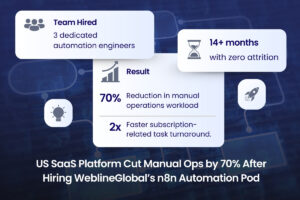
US SaaS Platform Cut Manual Ops by 70% After Hiring WeblineGlobal’s n8n Automation Pod
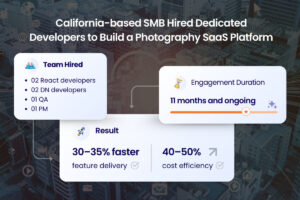
California-based SMB Hired Dedicated Developers to Build a Photography SaaS Platform