Table of Contents

INTRODUCTION
While working on a recent project for an enterprise SaaS CRM platform, our team was tasked with building a seamless omnichannel communication layer. The core requirement was to integrate Facebook Messenger natively so businesses could manage customer conversations directly from their CRM interface. To handle the middleware routing and API orchestration, we leveraged n8n, connecting incoming Facebook events to our FastAPI backend.
During the integration phase, we encountered a frustrating situation: the message flow worked flawlessly when utilizing n8n’s test webhook URLs. However, the moment we switched to the production webhook URLs to enable persistent background listening, Facebook’s verification process aggressively rejected our endpoint. We were met with the error: “The callback URL or verify token couldn’t be validated.”
In production environments, persistent and reliable webhook listeners are non-negotiable. Falling back to manual test executions is not an option for an enterprise system handling real-time customer data. This challenge inspired this article so other engineering teams can understand the subtle lifecycle differences between test and production webhooks in automation platforms, avoiding the same architectural roadblocks.
THE OMNICHANNEL CRM ARCHITECTURE
Before diving into the failure, it is important to understand the business use case and the architecture where this issue surfaced. The system was designed to centralize customer communications.
- Backend: A robust Python application built on FastAPI, hosted in a scalable cloud environment. Many tech leaders choose to hire python developers for backend integrations precisely to handle this level of asynchronous API processing.
- Database: PostgreSQL, utilizing the JSONB data type to flexibly store incoming conversation payloads.
- Middleware: n8n configured for webhook routing, parsing incoming Meta Graph API events, and pushing outgoing replies via the Facebook Send API.
- Frontend: A React-based interface allowing agents to read and respond to messages in real-time.
The intended message flow was straightforward. A customer sends a message to a Facebook Page. Facebook fires a webhook payload to n8n. n8n routes this to our FastAPI CRM endpoint, which stores it in PostgreSQL and surfaces it on the React frontend. When an agent replies, the CRM pushes the message back through n8n to Facebook.
WHAT WENT WRONG: THE VERIFICATION BOTTLENECK
To establish a webhook subscription, Meta’s Graph API requires a strict verification handshake. Facebook sends a GET request to the configured webhook URL containing three query parameters: hub.mode, hub.verify_token, and hub.challenge. The endpoint must validate the token and respond with a 200 HTTP status code, echoing back the exact integer or string provided in the hub.challenge parameter.
When we provided the Meta Developer Console with our n8n Test URL (e.g., https://[instance].n8n.cloud/webhook-test/[id]) and executed the workflow manually in the UI, verification succeeded instantly. The entire data flow functioned perfectly.
However, moving to production requires the standard URL (e.g., https://[instance].n8n.cloud/webhook/[id]). When we inputted this production URL, Facebook immediately returned the validation error. The symptoms were perplexing:
- Both the test and production webhook nodes had identical configurations: GET/POST methods enabled, and “Allow Multiple HTTP Methods” toggled ON.
- Authentication settings were identical.
- The CRM backend verification handler was functioning correctly.
- Manual cURL requests to the production webhook mimicking Facebook’s GET payload worked perfectly.
Yet, Meta’s automated verification process consistently failed.
HOW WE APPROACHED THE SOLUTION
Experienced architects understand that when a system works in manual testing but fails in automated production contexts, the issue usually lies in environmental states, execution lifecycles, or strict protocol enforcement. When enterprise teams hire software developer units for dedicated projects, they expect a structured diagnostic approach rather than random configuration tweaks.
We began by analyzing the fundamental differences between how n8n handles webhook-test versus webhook endpoints:
1. The Activation State Lifecycle
Test webhooks in n8n are ephemeral. They actively listen only when the user interface is open and the “Listen for Test Event” button is clicked. Production webhooks, conversely, only register with the underlying Express.js server when the entire workflow is toggled to Active. If you attempt to verify a production webhook with Meta while the workflow is inactive in n8n, the endpoint effectively does not exist, resulting in a 404 Not Found error from n8n, which Meta interprets as a validation failure.
2. The Strictness of the Response Payload
During a manual test execution, n8n captures the event and processes the workflow, often returning a default 200 OK with a generic success message if an explicit response isn’t configured. Meta’s verification bot is notoriously strict—it expects raw, unformatted text containing *only* the hub.challenge value. If n8n wraps this response in a JSON object (e.g., {"data": "123456789"}) or appends any HTML headers, Meta rejects it. Test environments sometimes mask these strict content-type enforcements because the developer manually verifies the payload flow.
FINAL IMPLEMENTATION
To resolve the issue and ensure the production webhook passed Meta’s rigorous verification while seamlessly handling subsequent POST events, we restructured our n8n workflow to explicitly handle HTTP methods and payload formatting.
Here is the technical fix we implemented:
1. Workflow Activation
We ensured the workflow was officially activated. We saved the workflow and toggled the “Active” switch in the top right corner of the n8n UI. We made sure never to test production URLs from Meta’s dashboard while the workflow was in an inactive editing state.
2. Webhook Node Configuration
We configured the initial Webhook node to listen precisely for both GET (for verification) and POST (for actual messages), and set the response strategy explicitly.
- HTTP Methods: GET, POST (using Allow Multiple HTTP Methods)
- Respond: “Using ‘Respond to Webhook’ Node” (This is critical. Do not use “Immediately” with default n8n bodies).
3. Request Routing (Switch Node)
We introduced a Switch node immediately after the Webhook to route the flow based on the incoming HTTP method. This isolates the verification logic from the message processing logic.
Expression for routing: {{$execution.customData.httpMethod || $request.method}}
Route 1 (GET): Routes to Verification Logic
Route 2 (POST): Routes to the FastAPI CRM Integration
4. The Production Verification Response
For the GET route, we added a “Respond to Webhook” node specifically tailored to Meta’s strict requirements. We extracted the hub.challenge and returned it as raw text, not JSON.
Node: Respond to Webhook
Respond With: Text
Response Body: {{$json.query['hub.challenge']}}
Response Headers: Content-Type: text/plain
Once this logic was deployed and the workflow activated, the Meta Developer Console verified the production URL instantly. Subsequent POST requests carrying JSONB message payloads successfully routed to our backend API. To ensure smooth user experiences on the front end, teams often hire react developers for enterprise platforms to handle the real-time state management required by these asynchronous webhooks.
LESSONS FOR ENGINEERING TEAMS
This challenge reinforced several architectural best practices that engineering teams should apply when working with third-party webhooks and middleware platforms:
- Respect Execution Contexts: Never assume a test environment’s runtime behavior matches production. Ephemeral test listeners often bypass the strict routing rules enforced by production web servers.
- Strict Protocol Adherence: When integrating with legacy or highly secured APIs (like Meta Graph API), adhere strictly to their documented response formats. A 200 OK status is not enough if the Content-Type or payload structure deviates even slightly.
- Explicit over Implicit Responses: Relying on a middleware platform’s default HTTP response behavior is risky. Always explicitly define your response nodes, headers, and body formats.
- Decouple Handshake from Processing: Use routing logic to separate the initial verification handshake (GET) from the primary data ingestion (POST). This makes the architecture easier to debug and scale.
- Monitor Middleware Logs: Ensure your automation platforms provide granular logging. When you hire automation developers for workflow integrations, ensure they implement comprehensive error tracking within the middleware layer to catch silent failures.
WRAP UP
Debugging third-party webhook verifications can be tedious, especially when middleware layers introduce their own environmental idiosyncrasies. By understanding the functional difference between n8n’s active and inactive states, and enforcing strict payload responses via dedicated nodes, we successfully bridged Facebook Messenger with our CRM backend in a robust production environment. If your organization is facing complex integration challenges and you need to scale your engineering capabilities, you can hire software developer teams with proven architectural experience. Feel free to contact us to discuss your next technical initiative.
Social Hashtags
#n8n #Webhooks #FacebookAPI #MetaDevelopers #APIDevelopment #AutomationTools #FastAPI #BackendDevelopment #CRMIntegration #SaaSDevelopment #NodeJS #DevOps #SoftwareEngineering #TechTutorial #Debugging
Frequently Asked Questions
Meta uses the GET request as a security handshake. By passing a verify token (which you define) and a challenge string, Meta ensures that you actually own the endpoint and are explicitly permitting Facebook to send data to it.
Yes, by enabling "Allow Multiple HTTP Methods", a single n8n Webhook node can accept both GET (verification) and POST (incoming messages). However, you must route them internally using a Switch node to handle the distinct response requirements of each method.
Manual cURL requests often do not enforce strict Content-Type validation on the response body, whereas Meta's automated systems expect a pure text response. Additionally, if the workflow was not actively enabled during Meta's automated ping, n8n would silently drop the request.
Set the Webhook node's response mode to "Using 'Respond to Webhook' Node". In the "Respond to Webhook" node, select "Text" as the response type and map your data accordingly, ensuring no surrounding JSON brackets are present in the output.

Success Stories That Inspire
See how our team takes complex business challenges and turns them into powerful, scalable digital solutions. From custom software and web applications to automation, integrations, and cloud-ready systems, each project reflects our commitment to innovation, performance, and long-term value.
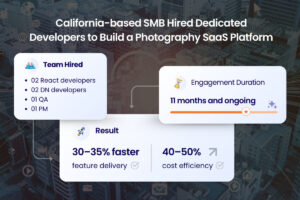
California-based SMB Hired Dedicated Developers to Build a Photography SaaS Platform
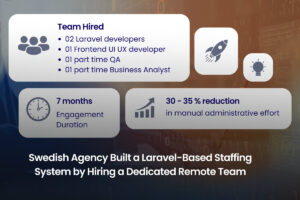
Swedish Agency Built a Laravel-Based Staffing System by Hiring a Dedicated Remote Team