Table of Contents

INTRODUCTION
During a recent engagement with a digital marketing agency, we were tasked with building a content syndication engine. The goal was to take approved content from a headless CMS and distribute it automatically across various social channels, specifically focusing on professional networks and micro-blogging platforms.
The system needed to process a queue of pending posts and publish them to both LinkedIn and X (formerly Twitter) with specific timing constraints. While the initial requirement seemed straightforward—iterate through a list and post—we encountered a workflow logic issue during the implementation phase. The engineering team initially attempted to fork the process inside the loop to handle both platforms simultaneously.
We realized that without strict flow control, the execution context within the automation tool (n8n) became fragmented. Some posts would publish to LinkedIn but fail on X, while others would trigger rate limits because the loop iterated too quickly. This challenge inspired this article, where we explain how to correctly structure multi-step actions within a single iteration block to ensure reliability and maintainability.
PROBLEM CONTEXT
In low-code orchestration platforms like n8n, managing the state of an item as it passes through multiple side effects (external API calls) is critical. The specific use case involved a “Loop Over Items” (or the legacy SplitInBatches) node.
The workflow needed to:
- Retrieve a batch of approved content items.
- Start a loop for each item.
- Post the content to LinkedIn.
- Wait for a predefined interval (to prevent spam triggers).
- Post the same content to X (Twitter).
- Mark the item as “Published” in the database.
The architectural challenge arose when the team questioned whether to use a single loop for all actions or separate loops for each platform. Using separate loops created a synchronization nightmare—if the LinkedIn loop finished but the X loop failed, the data state became inconsistent. The goal was to consolidate logic so that a single item is processed fully across all channels before the next item begins.
WHAT WENT WRONG
Initially, the workflow was designed with a branching logic immediately after the Loop node. One branch went to LinkedIn, and another branch went to X. In n8n, branching without a downstream Merge node often results in complex execution behaviors, especially inside a loop.
We observed the following issues in the execution logs:
- Context Loss: The loop would sometimes advance to the next iteration before both branches completed, leading to skipped items.
- Error Handling Complexity: If the LinkedIn node failed, the X node might still attempt to run, or vice versa, making it difficult to determine the final status of the content item.
- Rate Limiting Collisions: Without a sequential flow, the delays configured for LinkedIn did not necessarily respect the API limits required for X, causing
429 Too Many Requestserrors.
HOW WE APPROACHED THE SOLUTION
To resolve this, we audited the execution flow. We determined that for this specific volume of data, parallel execution was unnecessary and risky. The most robust architecture was a Sequential Daisy-Chain pattern within a single loop.
Our reasoning was based on three factors:
- Atomic Transactions: We wanted to treat the posting process as a single transaction. If the LinkedIn post fails, we might want to halt the X post to allow for a retry of the whole unit.
- Simplified Delay Logic: Chaining nodes allows for a single “Wait” node to throttle the entire loop, effectively protecting both API quotas.
- Unified State: Passing the data linearly ensures that the output of the LinkedIn node (e.g., the post URL) is available to the X node if cross-referencing is needed.
FINAL IMPLEMENTATION
The solution involves connecting the nodes in a direct line, rather than branching them. The output of the LinkedIn node becomes the input for the Wait node, which feeds the X node, which finally loops back to the start.
The Workflow Topology
The corrected structure looks like this:
[Data Source]
    --> [Loop Node (SplitInBatches)]
        --> [LinkedIn Node]
            --> [Wait Node (e.g., 30 seconds)]
                --> [X / Twitter Node]
                    --> [Loop Node (connects back to 'Input')]
Configuration Details
To implement this successfully, specific settings must be applied to ensure the chain doesn’t break if one API returns an error.
1. The Loop Node
Whether using SplitInBatches or Loop Over Items, ensure the batch size is set to 1. This forces the workflow to handle one post at a time, respecting the delay.
2. Error Handling (Continue On Fail)
In a production environment, APIs fail. If LinkedIn is down, you typically don’t want the entire workflow to crash. We configured the LinkedIn node settings to “Continue On Fail”.
// Generic Node Settings Representation
{
  "parameters": {
    "continueOnFail": true,
    "onError": "continueRegularOutput"
  }
}
By enabling this, the workflow passes an error object to the next node (the Wait node) instead of stopping. You can then add an If node before the X node to check: “Did the previous step succeed?” If yes, proceed to X. If no, log the error and skip to the next iteration.
3. The Sequential Connection
The key fix for the user’s dilemma—”Can I reuse the same loop?”—is strictly Yes. You do not create a second loop. You simply draw the connector from the output of the LinkedIn node directly into the input of the X node (or the Wait node in between).
The loop node will only trigger the next iteration once the execution reaches the end of the chain and returns to the loop’s input (or implicitly completes the branch).
LESSONS FOR ENGINEERING TEAMS
This implementation highlights several best practices for teams looking to hire n8n developers for workflow automation or build internal tooling:
- Linear vs. Parallel: Default to linear processing within loops unless you have a high-throughput requirement that demands parallelism. Linear flows are easier to debug and rate-limit.
- Idempotency Matters: Design your automation so that if a loop retries, it doesn’t create duplicate posts. We implemented a check against the database before the loop starts to filter out already-published IDs.
- Unified Error Handling: When you hire software developers for integration tasks, ensure they implement comprehensive error handling. A workflow shouldn’t just “fail”; it should log the failure, send an alert, and gracefully proceed to the next item.
- Rate Limiting Strategy: APIs like X and LinkedIn have strict enforcement. Using a “Wait” node inside a loop is a primitive but effective way to handle this without complex queue management systems.
- Context Preservation: In n8n, data flows from node to node. By daisy-chaining, you preserve the context of the current item naturally. Branching requires merging data back together, which adds unnecessary complexity for simple tasks.
WRAP UP
Configuring a single loop for multiple actions in n8n is not only possible but preferred for sequential tasks. by chaining the LinkedIn and X nodes together with appropriate delays, we achieved a stable, rate-limited publishing workflow that was easy to maintain. This approach eliminated race conditions and ensured that our client’s content reached all audiences consistently.
If you are looking to scale your engineering capabilities or need to contact us regarding dedicated development teams, we are ready to assist.
Social Hashtags
#n8n #WorkflowAutomation #NoCode #LowCode #APIAutomation #DevOps #EngineeringBestPractices
Struggling with broken loops or failed posts in your n8n workflows?
Talk to an n8n Automation Expert
Frequently Asked Questions
If your logic requires complex data transformation, custom algorithms, or high-performance concurrency outside of standard API limits, you should hire backend developers to build a custom microservice. For orchestrating existing APIs and standard logic, automation specialists using tools like n8n are often faster and more cost-effective.
Functionally, they serve the same purpose. Loop Over Items is the newer, more intuitive version in n8n. However, for complex legacy workflows, SplitInBatches is still widely used. The daisy-chaining logic described above applies to both.
Enable "Continue On Fail" in the LinkedIn node settings. This ensures the workflow continues to the next node (X) even if the API returns an error. You may want to add logic to log the LinkedIn failure separately.
Yes, but use it with caution. If you branch execution inside a loop (e.g., to run LinkedIn and X in parallel), you must use a Merge node (set to "Wait for both inputs") before the flow returns to the start of the loop. If you don't merge, the loop might trigger twice or lose context.



Success Stories That Inspire
See how our team takes complex business challenges and turns them into powerful, scalable digital solutions. From custom software and web applications to automation, integrations, and cloud-ready systems, each project reflects our commitment to innovation, performance, and long-term value.
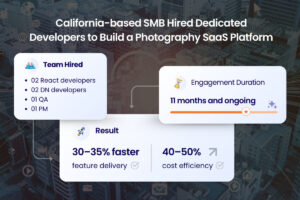
California-based SMB Hired Dedicated Developers to Build a Photography SaaS Platform
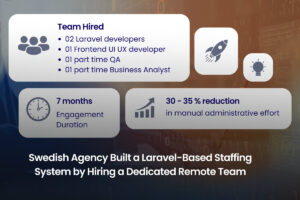
Swedish Agency Built a Laravel-Based Staffing System by Hiring a Dedicated Remote Team