Table of Contents

INTRODUCTION
During a recent project for a Logistics SaaS platform, we needed to rapidly spin up an enterprise automation workflow to orchestrate data synchronization between a legacy ERP system and a modern cloud-based CRM. We chose n8n, a powerful open-source node-based workflow automation tool, backed by PostgreSQL for state and execution logging. To accelerate the initial prototyping phase, we leveraged a standardized Platform-as-a-Service (PaaS) fast-deploy template.
However, what should have been a one-click provisioning process quickly turned into a roadblock. We encountered a situation where the deployment abruptly failed during the database add-on creation phase. The cloud provider rejected the requested PostgreSQL version, halting the entire pipeline. This scenario perfectly illustrates why relying on unverified infrastructure-as-code (IaC) templates without reviewing their underlying dependency matrices can lead to unexpected production delays.
When organizations hire nodejs developers for workflow automation, it is critical that these teams possess the DevOps maturity to look beyond application code and troubleshoot underlying infrastructure configuration. This challenge inspired this article, detailing how we diagnosed the PaaS versioning conflict, validated database compatibility, and implemented a robust fix so other engineering teams can avoid the same oversight.
PROBLEM CONTEXT
In our architecture, the n8n application operates as the API orchestration layer, requiring a persistent datastore to maintain workflow configurations, user credentials, and historical execution logs. PostgreSQL is the recommended database engine for production-grade n8n instances due to its robust concurrency handling and data integrity features.
To orchestrate the deployment, our PaaS environment utilizes an application manifest—typically an application configuration file that defines the runtime environment, environment variables, and necessary managed add-ons (like caching and databases). This manifest essentially acts as our IaC for rapid cloud provisioning. As business requirements expand, the decision to hire cloud architects for platform scaling becomes vital to ensure these automated provisioning scripts remain aligned with modern cloud provider standards and support lifecycles.
Our goal was to deploy the standard open-source n8n repository using a provided deployment manifest. However, PaaS providers frequently update their managed service offerings, deprecating older database versions to enforce security patches, compliance standards, and overall platform stability.
WHAT WENT WRONG
Upon triggering the automated deployment pipeline via the provider’s dashboard, the initial application build succeeded, but the environment provisioning failed. We extracted the following trace from the system logs:
We tried to create managed-postgresql:essential-0, but received an error from the add-on provider.
Try the request again, or log a support ticket and include this message:
Unsupported version: 14. We support the following versions: 15, 16, 17
The symptom was clear: the provisioning engine was attempting to instantiate a PostgreSQL database using major version 14. However, the PaaS provider had recently updated their infrastructure policies, officially deprecating version 14 for new deployments and mandating the use of versions 15, 16, or 17.
We investigated the deployment repository and traced the failure to the application manifest file (the configuration JSON defining the infrastructure requirements). Deep within the add-on configuration block, we found the following hardcoded parameter:
"plan": "managed-postgresql",
"options": {
   "version": "14"
}
The upstream deployment template had not been updated to reflect the cloud provider’s latest database support lifecycle. Because the version was explicitly hardcoded rather than negotiated or set to default, the PaaS provider explicitly rejected the API call to create the database.
HOW WE APPROACHED THE SOLUTION
To resolve this, we could not simply retry the deployment. We needed to intercept and modify the infrastructure configuration before it reached the PaaS provisioning engine. Our engineering approach involved a three-step validation process:
- Compatibility Verification: Before blindly bumping the PostgreSQL version to 16 or 17, we verified the official n8n documentation to ensure that the current Docker image and Node.js runtime fully supported PostgreSQL 16. Database major version upgrades often introduce driver compatibility issues or changes in default authentication mechanisms (such as SCRAM-SHA-256). We confirmed n8n was fully compatible with PostgreSQL 16.
- Manifest Customization: Since we were deploying from a public, third-party repository URL, we did not have write access to modify the upstream manifest directly. The solution required decoupling our deployment from the generic public template.
- Long-term Maintenance: Hardcoding infrastructure versions in fast-deploy templates creates technical debt. We determined that forking the repository and owning the deployment manifest was the only sustainable path for a production environment.
FINAL IMPLEMENTATION
We proceeded with a custom implementation that allowed us to bypass the upstream error while maintaining the streamlined deployment workflow. This level of infrastructure control is exactly why companies hire devops engineers for cloud deployments.
Step 1: Forking the Deployment Repository
Instead of using the fast-deploy URL pointing to the upstream repository, we cloned the repository into our own organizational Git structure. This provided us with full ownership of the application manifest.
Step 2: Updating the Application Manifest
We opened the configuration JSON file and updated the PostgreSQL add-on version requirement. We opted for version 16, as it offered a balance of proven stability and long-term support from the cloud provider.
"plan": "managed-postgresql",
"options": {
   "version": "16"
}
Step 3: Executing the Custom Deployment
With the updated configuration committed to our repository, we constructed a new deployment URL pointing to our internal branch. When we triggered the provisioning process, the PaaS engine successfully interpreted the new manifest:
- The application container was built seamlessly.
- The API call to the managed database provider requested PostgreSQL version 16.
- The database was provisioned successfully, and the connection string was injected into the n8n environment variables.
- Database schemas and migrations executed without compatibility warnings.
LESSONS FOR ENGINEERING TEAMS
This deployment block, while easily resolved, highlights several critical principles for maintaining cloud infrastructure:
- Beware of Upstream Fast-Deploy Templates: Public templates are excellent for quick proofs-of-concept but are notoriously prone to “bit rot.” As cloud providers evolve their supported stacks, static templates quickly become obsolete.
- Own Your Infrastructure as Code: Never rely on external application manifests for production or staging environments. Always fork, inspect, and maintain your own configurations.
- Monitor Provider Lifecycles: Managed database services have strict End-of-Life (EOL) policies. Understand your cloud provider’s deprecation schedule for major database versions to avoid unexpected deployment freezes.
- Verify Driver Compatibility: Upgrading a database version in a configuration file takes seconds, but ensuring the application’s ORM or database drivers support the new version requires due diligence.
- Leverage Experienced Talent: Knowing how to orchestrate these automated systems securely is a core competency. When you hire software developer teams from WeblineGlobal, you gain access to professionals who understand US-based accountability and structured delivery practices, ensuring deployments are handled with architectural maturity.
WRAP UP
A simple hardcoded version string in an infrastructure template can bring an entire automated deployment pipeline to a halt. By understanding the interaction between application manifests and PaaS provisioning engines, our team quickly identified the PostgreSQL version conflict, verified application compatibility, and implemented a customized deployment path. Taking ownership of your configuration files ensures your systems remain resilient against upstream changes and provider deprecations. If your engineering team is facing complex deployment bottlenecks or looking to modernize infrastructure practices, contact us to explore how our dedicated remote engineering teams can help.
Social Hashtags
#n8n #PostgreSQL #DevOps #CloudErrors #PaaS #DeploymentFailure #IaC #CloudComputing #NodeJS #AutomationTools #SaaSDevelopment #BackendDev #DevOpsLife #TechFix #CodingTips
Frequently Asked Questions
Cloud platform providers regularly deprecate older versions of managed databases to ensure all hosted systems benefit from the latest security patches, performance enhancements, and active support from the open-source community. Once a version is deprecated, new automated provisioning requests for that version are blocked.
Yes, modern versions of n8n use highly adaptable Node.js database drivers that are fully compatible with PostgreSQL 15, 16, and 17. However, always review the specific release notes of the application before forcing a major database version upgrade.
Instead of clicking a public "Deploy" button, fork the source repository to your own Git account. Modify the JSON manifest file to meet your infrastructure requirements, commit the changes, and point the PaaS platform's deployment engine to your specific repository branch.
Absolutely. Almost all major cloud providers (AWS, GCP, Azure, and various PaaS layers) enforce strict support windows for managed services like databases, caching layers, and Kubernetes versions. Any static IaC template will eventually fail if not updated to align with these lifecycles.
Success Stories That Inspire
See how our team takes complex business challenges and turns them into powerful, scalable digital solutions. From custom software and web applications to automation, integrations, and cloud-ready systems, each project reflects our commitment to innovation, performance, and long-term value.
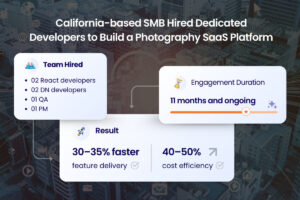
California-based SMB Hired Dedicated Developers to Build a Photography SaaS Platform
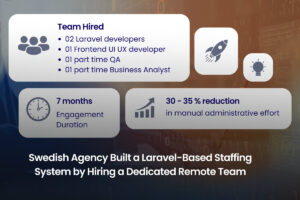
Swedish Agency Built a Laravel-Based Staffing System by Hiring a Dedicated Remote Team