
Table of Contents

How Do You Ensure Seamless Background Sync in Enterprise Mobile Apps?
While working on a .NET MAUI application for a global logistics provider, we encountered a classic mobile engineering challenge: reliable background data synchronization. The application was designed for field personnel who routinely operate in areas with fluctuating network connectivity. Their primary workflow required capturing inspection data and large media files, which then needed to be securely transferred to a centralized server.
Because the environments varied wildly, the destination server was sometimes accessible only via a localized warehouse LAN and other times via the public internet over mobile data. Our initial architecture tested the connection before initiating a transfer. If the server was unreachable, the payload was deferred into a local queue. However, we realized that the application was failing to resume these pending transfers if the application had been pushed to the background or if the user rebooted their device.
In enterprise field service, silent failures in data synchronization are unacceptable. Missing data delays downstream logistics and breaks operational workflows. When enterprise decision-makers look to hire app developer to create a mobile app, they expect a resilient architecture that gracefully handles system resource constraints and network hostility. We resolved this issue by stepping outside the standard cross-platform abstractions and leveraging native Android background scheduling mechanisms. This article details our approach so other engineering teams can avoid similar pitfalls in their cross-platform mobile architectures.
Why Does Background Network Detection Fail in Cross-Platform Frameworks?
To understand the business context, consider the daily routine of a warehouse auditor. They move seamlessly between Wi-Fi dead zones, active mobile data connections and secured LANs. The system architecture required the app to intelligently detect when the device connected to a network, evaluate if the required server (LAN or Internet) was accessible and execute the deferred payload transfers immediately.
.NET MAUI provides an excellent unified API for many hardware features, including the Microsoft.Maui.Networking.Connectivity class. In the foreground, subscribing to the ConnectivityChanged event works flawlessly. The architectural oversight occurred when assuming this event would continue to fire predictably when the application was suspended in the background.
Modern mobile operating systems, particularly Android, employ aggressive battery optimization strategies (like Doze mode and App Standby Buckets). Once an application transitions to the background, the OS suspends arbitrary code execution. A cross-platform event listener will simply stop receiving broadcasts. Furthermore, if the device undergoes a power cycle or hard restart, the MAUI application process is terminated entirely, meaning no in-memory queues or event subscriptions will survive.
What Are the Symptoms of Inadequate Background Network Handling?
During our field testing phases, several concerning symptoms surfaced that pointed to structural flaws in the background execution model:
- Stale Data Queues: Payloads remained indefinitely stuck in the local SQLite database if the connection dropped mid-transfer and the user pocketed the device.
- Silent Terminations: The OS routinely killed the application process to reclaim memory, wiping out any transient state related to retry logic.
- Missed Network Transitions: Even when moving from cellular to a highly stable warehouse Wi-Fi network, the app failed to wake up and initiate the LAN-specific file uploads.
- Reboot Amnesia: If a user restarted their tablet mid-shift, all queued transfers were ignored until the user explicitly reopened the app and triggered a manual sync.
How Should Engineering Teams Evaluate Background Sync Strategies?
To ensure resilience, we needed a mechanism that survived application termination, respected the operating system’s battery management rules and automatically triggered work based on network state changes. We considered several solutions, evaluating the trade-offs of each.
Is a Long-Running Foreground Service the Answer?
We first considered implementing an Android Foreground Service. This approach keeps the application process alive and displays a persistent notification to the user, allowing standard network listeners to function continuously. While technically viable, it drains battery rapidly and creates a poor user experience. For asynchronous file transfers, keeping a heavy service running 24/7 is an anti-pattern.
Can We Rely on a Standard BroadcastReceiver for Network Changes?
Historically, Android developers used a manifest-registered BroadcastReceiver to listen for CONNECTIVITY_ACTION. However, starting with Android 7.0 (API level 24), the OS heavily restricted implicit broadcasts to prevent the “thundering herd” problem, where dozens of apps wake up simultaneously upon connecting to Wi-Fi. Relying on this legacy approach in modern MAUI applications leads to inconsistent behavior and compliance failures on newer OS versions.
Why is Android WorkManager the Optimal Choice?
We ultimately chose to implement Android’s WorkManager API. WorkManager is the recommended solution for persistent, deferrable background work. It allows developers to define constraints (e.g., “only run when a network is available”) and the OS handles the complex scheduling. Crucially, WorkManager guarantees execution even if the app process is killed or the device reboots, making it the perfect architectural fit for our robust queue-based synchronization.
How Do You Implement WorkManager for Network Resilience in .NET MAUI?
To implement this in .NET MAUI, we bypassed the generic abstractions and wrote platform-specific code in the Platforms/Android directory, integrating the AndroidX.Work libraries.
First, we defined a custom Worker class responsible for handling the file transfer logic. The worker checks if the target server (LAN or Internet) is reachable before processing the queue.
using Android.Content;
using AndroidX.Work;
public class FileUploadWorker : Worker
{
    public FileUploadWorker(Context context, WorkerParameters workerParams)
        : base(context, workerParams) { }
    public override Result DoWork()
    {
        try
        {
            // 1. Verify server reachability (LAN vs Internet)
            bool isServerReachable = NetworkHelper.PingTargetServer();
            if (!isServerReachable)
            {
                // Instruct WorkManager to retry later when conditions change
                return Result.InvokeRetry();
            }
            // 2. Fetch pending transfers from local SQLite DB
            var pendingFiles = DatabaseService.GetPendingTransfers();
            // 3. Execute transfer
            foreach (var file in pendingFiles)
            {
                UploadService.TransferData(file);
                DatabaseService.MarkAsCompleted(file.Id);
            }
            return Result.InvokeSuccess();
        }
        catch (Exception ex)
        {
            Logger.LogError("Upload failed", ex);
            return Result.InvokeRetry();
        }
    }
}
Next, we needed to enqueue this work whenever a transfer failed or was deferred. We applied a network constraint so the OS would automatically trigger the worker when connectivity was restored.
using AndroidX.Work;
public void ScheduleBackgroundSync()
{
    // Define constraints: Requires any active network connection
    var constraints = new Constraints.Builder()
        .SetRequiredNetworkType(NetworkType.Connected)
        .Build();
    // Create a OneTimeWorkRequest, configuring backoff criteria for retries
    var uploadWorkRequest = OneTimeWorkRequest.Builder.From<FileUploadWorker>()
        .SetConstraints(constraints)
        .SetBackoffCriteria(BackoffPolicy.Exponential, TimeSpan.FromMinutes(1))
        .Build();
    // Enqueue unique work to avoid duplicate scheduling
    WorkManager.GetInstance(Android.App.Application.Context)
        .EnqueueUniqueWork(
            "SyncPendingFiles",
            ExistingWorkPolicy.Replace,
            uploadWorkRequest);
}
Because WorkManager persists its jobs in its own internal database, this request inherently survives device reboots. Once the phone restarts and connects to a network, the OS evaluates the constraints and wakes up the MAUI application process just enough to execute the worker.
What Key Architectural Lessons Can Teams Apply to Mobile Synchronization?
Solving this synchronization challenge reinforced several critical engineering principles. For tech leaders looking to hire dotnet developers for enterprise modernization, ensuring the team understands these nuances is vital:
- Embrace Platform Specifics: Cross-platform frameworks like .NET MAUI are excellent for UI and basic hardware interaction, but background lifecycle management almost always requires platform-native implementations (like AndroidX WorkManager or iOS BackgroundTasks).
- The Network is Hostile: Never assume a connection will remain stable for the duration of a file transfer. Implement granular chunking and robust retry logic.
- Design for Idempotency: Because WorkManager might retry a job that partially completed before a sudden network drop, the backend API and the mobile queue logic must be idempotent to prevent duplicate data corruption.
- Respect OS Battery Constraints: Attempting to force continuous background execution will lead to your app being penalized or terminated by modern operating systems. Defer to OS-managed task schedulers.
- Decouple State from Memory: Always persist deferred state to disk (e.g., SQLite) before relying on background triggers. In-memory queues will not survive a process termination or device restart.
Ready to Modernize Your Enterprise Mobile Architecture?
Reliable background network synchronization is often the differentiator between a resilient enterprise tool and a frustrating user experience. By utilizing native OS scheduling capabilities within a .NET MAUI architecture, we delivered a system that guaranteed data integrity, survived device reboots and adapted dynamically to shifting network environments from warehouses to remote field sites. When organizations hire software developer resources to tackle complex mobility challenges, it is this depth of architectural understanding that ensures long-term project success. If you are dealing with similar technical bottlenecks or planning a new enterprise mobile initiative, contact us to explore how our dedicated engineering teams can help you build fault-tolerant software.
Social Hashtags
#DotNetMAUI #NETMAUI #AndroidDevelopment #WorkManager #DotNet #MobileAppDevelopment #CrossPlatformDevelopment #AndroidDevelopers #EnterpriseMobility #SoftwareArchitecture #BackgroundSync #AppDevelopment #DotNetDeveloper #EnterpriseApps
Frequently Asked Questions
Android's Doze mode restricts background CPU and network activity when a device is unplugged and stationary. Standard network event listeners are paused during Doze. WorkManager jobs are bundled into maintenance windows, allowing network-dependent tasks to execute periodically without draining the battery.
Yes, but using different underlying APIs. On iOS, you must use the BGTaskScheduler API (specifically BGAppRefreshTaskRequest or BGProcessingTaskRequest) combined with proper Info.plist configurations. WorkManager is strictly an Android construct.
Returning InvokeRetry() signals to the WorkManager that the job failed due to transient conditions (like a localized server being temporarily unreachable despite having Wi-Fi). The OS will then reschedule the job using the configured backoff policy (e.g., exponential delay).
Yes. While WorkManager's constraint ensures a physical network connection exists, your Worker code should attempt to resolve or ping the specific LAN server IP before initiating a heavy payload transfer. If the ping fails, the worker can simply yield and retry later.
Not if you use WorkManager. One of the core architectural benefits of WorkManager is that it automatically handles device reboots. It maintains a persistent record of queued work and will restore the schedules once the OS finishes booting and network constraints are met.

Success Stories That Inspire
See how our team takes complex business challenges and turns them into powerful, scalable digital solutions. From custom software and web applications to automation, integrations, and cloud-ready systems, each project reflects our commitment to innovation, performance, and long-term value.
California-based SMB Hired Dedicated Developers to Build a Photography SaaS Platform
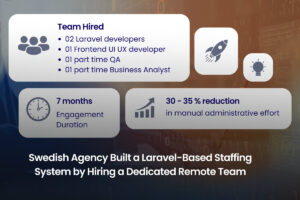
Swedish Agency Built a Laravel-Based Staffing System by Hiring a Dedicated Remote Team